
Thiruvathira 2026 is Thursday 24 December — the star, the fast, and the dance around the lamp
Thiruvathira 2026 is Thursday, 24 December in India, USA, UK, Germany, Mexico and Russia. Ardra nakshatra timings, the women's fast, ettangadi, Thiruvathirakali and the Chidambaram Arudra Darshan.
Thiruvathira 2026 falls on Thursday, 24 December — in India, the United States, the United Kingdom, Germany, Mexico and Russia, all six, on the same day. No city moves. That is the news, after a run of festivals that split across the map: this one does not. The Ardra star — Thiruvathirai in Tamil, Thiruvathira in Malayalam — is present at sunrise on 24 December in every city Drik lists, and gone by the next morning. The rest of this page is what happens on that day: a women's fast that starts the evening before, a bath before dawn, food with no rice in it, and, after sunset, a circle of women dancing around a lamp until midnight.
One thing to get straight before anything else, because it will confuse anyone who looks at the calendar. Thiruvathira follows the star, not the moon. The full moon — Margashirsha Purnima — is the day before, Wednesday 23 December, and by the time the sun comes up on Thursday the Purnima has already ended. In Delhi it ends at 6:57 AM, fourteen minutes before the 7:11 AM sunrise. So Thursday is not a Purnima, and this page will not call it one. It is the day the Ardra star falls in the month of Margazhi, which is Dhanu in Kerala, and that is a different kind of day altogether.
Thiruvathira 2026 at a glance
| Observance, all six cities | Thursday, 24 December 2026 |
| The star | Ardra (Thiruvathirai / Thiruvathira), in Margazhi / Dhanu month |
| Ardra, Delhi | 4:53 AM Thu 24 Dec – 1:47 AM Fri 25 Dec |
| Ardra, New York | 6:23 PM Wed 23 Dec – 3:17 PM Thu 24 Dec |
| Ardra, London | 11:23 PM Wed 23 Dec – 8:17 PM Thu 24 Dec |
| Ardra, Berlin | 12:23 AM Thu 24 Dec – 9:17 PM Thu 24 Dec |
| Ardra, Mexico City | 5:23 PM Wed 23 Dec – 2:17 PM Thu 24 Dec |
| Ardra, Moscow | 2:23 AM Thu 24 Dec – 11:17 PM Thu 24 Dec |
| Tithi at sunrise, 24 Dec | Krishna Pratipada everywhere — Purnima ended before sunrise |
| The Purnima | Wednesday 23 December (Margashirsha Purnima) |
| Who keeps it | In Kerala, chiefly women — married women for their husbands, unmarried women for a good husband; in Tamil Nadu, Shiva devotees at the temple |
| The centre of it | Chidambaram, Tamil Nadu — Nataraja's Arudra Darshan |
| What to eat | No rice. Ettangadi on the eve, tuber puzhukku, koova payasam |
| The evening | Thiruvathirakali — the circle dance around the nilavilakku |
Why Thursday, and why not Wednesday or Friday
The rule is simple, and it is the whole of the date. Arudra Darshan is the day in Margazhi on which the Ardra star is present at sunrise. On Wednesday 23 December the star had not yet begun at sunrise in any of the six cities — in Delhi it begins at 4:53 AM on Thursday, in Berlin at 12:23 AM, in Moscow at 2:23 AM, and in New York, London and Mexico City it begins late on Wednesday evening but after that day's sunrise. Wednesday's day pages list Dattatreya Jayanti, Annapurna Jayanti and the Margashirsha Purnima itself, not Arudra Darshan. By Friday the star is gone everywhere — Punarvasu has taken its place — and no Arudra Darshan appears on any 25 December page. So the star touches exactly one sunrise in each city, and it is the same one: Thursday 24 December.
Delhi's start time carries a one-minute footnote. Drik gives 4:53 AM; other published summaries give 4:52 AM. The end matches exactly — 1:47 AM on Friday — and one minute changes nothing about the day. This page follows Drik, which is the house source for this series, and says so rather than quietly rounding.
And the Purnima, again, because it matters. Drik's own festival description says the Ardra star "coincides with Pournami" — and in most years it does, near enough. This year it does not, not at sunrise. The Purnima ended at 6:57 AM in Delhi, before the 7:11 AM sunrise, and at 8:27 PM on Wednesday in New York. The full moon belongs to Wednesday, and the Margashirsha Purnima article covers it — the vrat, the Satyanarayan puja, Dattatreya Jayanti. Thursday is a second day, not an extension of it. Keep the two days straight and you have the whole of this week: the moon on Wednesday, the star on Thursday.
The fast: it starts on Makayiram, the evening before
In Kerala the festival belongs to women, and it starts before the day itself does. The eve is Makayiram — the Mrigashira star, the day before Thiruvathira — and the mothers fast from then, for the longevity and wellbeing of their children, in memory of Parvati fasting for the safe return of her son Kartikeya from his war with Tarakasura. Married women fast for their husbands and their marriages; unmarried women fast to find a good husband. A newly married woman's first Thiruvathira is Poothiruvathira, her first one as a wife, and it is kept with particular care.
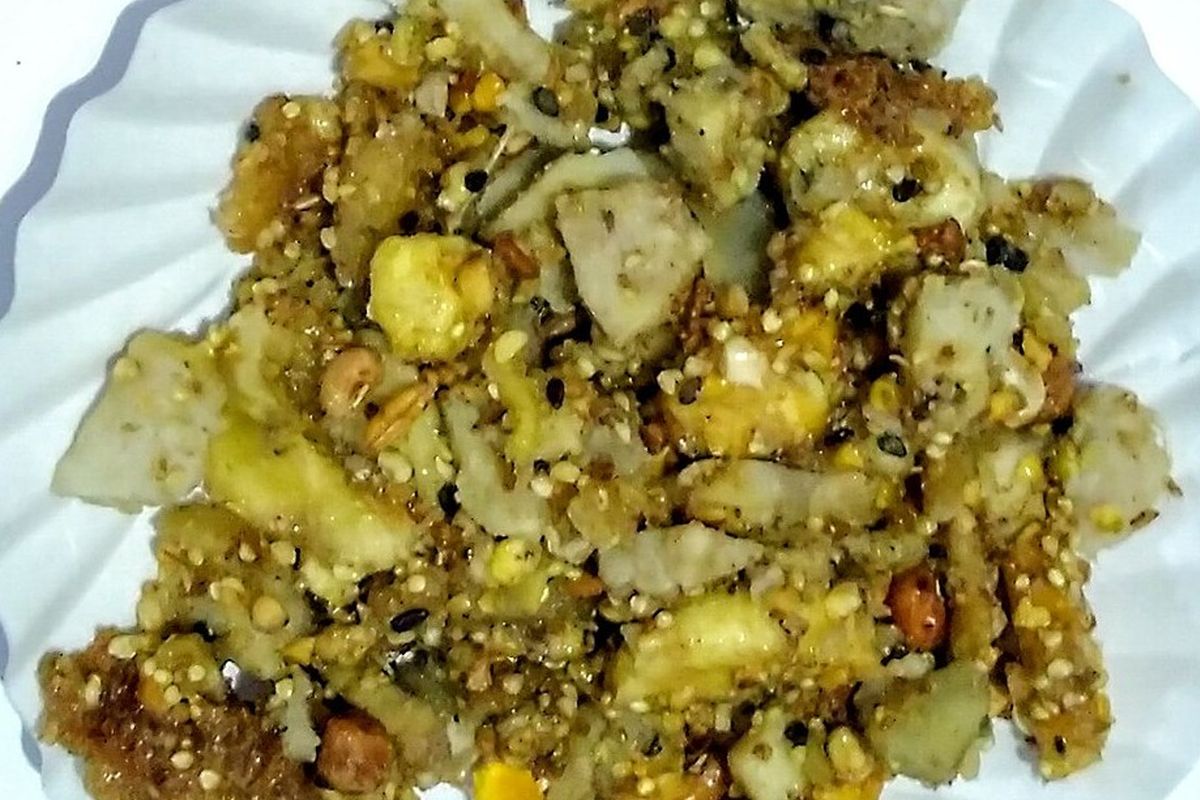
The eve has its own dish, and it is the one in the photograph below. Ettangadi — the "eight things" — is eaten on the night of Makayiram: tubers and roots, small yam and big yam and climbing yam, unripe plantain, beans, sugarcane and honey, roasted and mixed together. The ingredients vary a little from house to house, but the number is the point — eight — and the dish is the fast's opening, not its breaking.
The morning of Thiruvathira itself starts before the sun. Women take the Dhanumasakuli — the great bath of Dhanu — before sunrise, with turmeric and oils, and mark their foreheads with sandalwood paste. Married women apply henna to the hands of the unmarried girls of the family. The day's food is taken first and then the fast begins in earnest: a light meal of baked banana and tender coconut water, and then no rice at all for the rest of the day. What is eaten instead is the food of the fast — Thiruvathira puzhukku, a stew of tuber vegetables with long beans, raw plantain and freshly ground coconut, and koova payasam, arrowroot and jaggery in coconut milk. Broken wheat stands in for rice. The fast runs through the day and the night, and it is broken only at the dawn bath the next morning.
On the Tamil side the offering is different and just as fixed. Thiruvathirai kali — broken rice cooked with jaggery, moong dal, coconut, cardamom and ghee — is the neivedhyam for Nataraja, with ezhukari kuzhambu, a curry of seven vegetables, beside it. Some households keep the ten-day Thiruvempavai nonbu in the days before, a fast of dawn baths and devotional song that ends on Thiruvathirai itself.
The dance: a circle around the lamp, until midnight
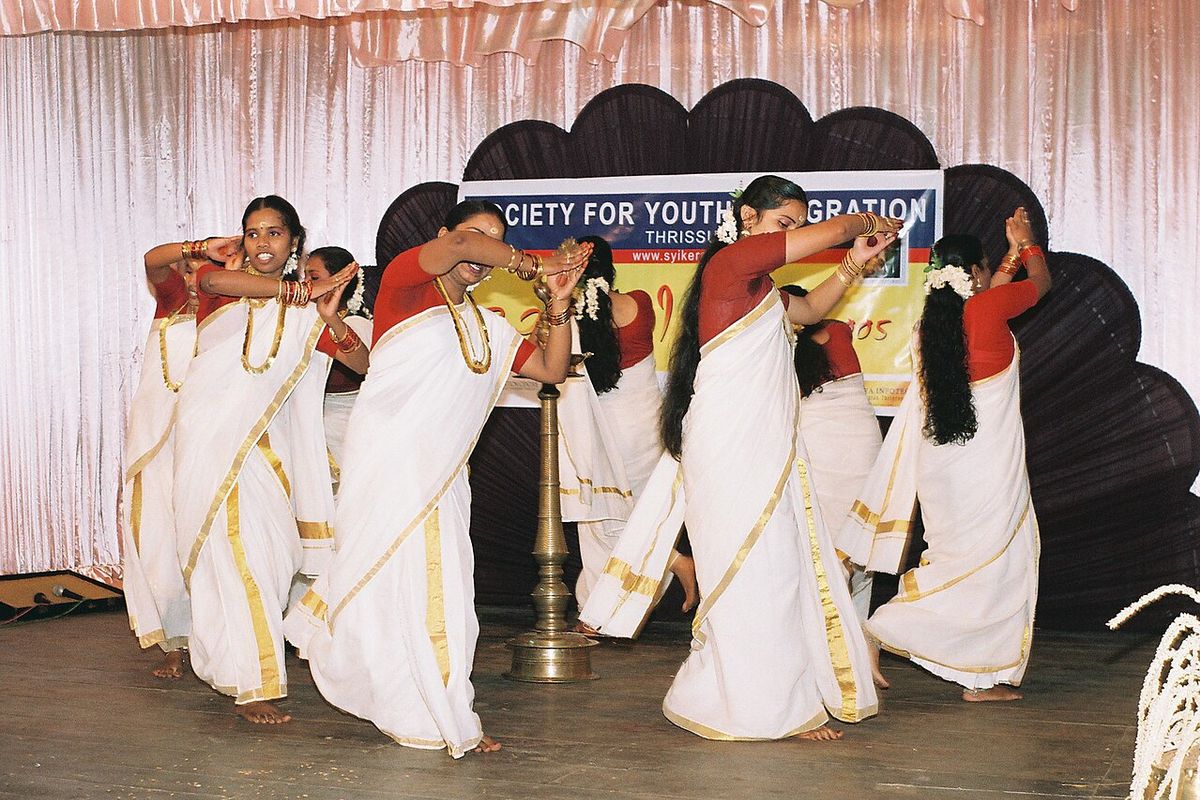
After sunset the day turns into something else, and this is the part of Thiruvathira that people who have never been to Kerala have usually seen in a photograph without knowing what it was. Thiruvathirakali — also called Kaikottikali, the clapping dance — is performed by women in small groups, in the white and gold kasavu sarees, their hair dressed with jasmine and the sacred dashapushpa, the ten flowers. They stand in a circle around the nilavilakku, the tall brass lamp, and dance to their own singing — songs of Shiva and Parvati, folk tales, verses from the Kathakali padams — stepping and clapping in rhythm, the movements slow and graceful, lasya rather than force. There are no classical mudras in it; the clapping and the footwork are the music. One woman sings the first line and the rest answer it. It goes on through the evening, and the pace quickens as the night deepens, to keep the dancers awake.
During the day the ten sacred flowers — dashapushpa — are gathered and laid at the entrance of the house. At midnight, when the Thiruvathira star sets, the women sing devotional songs and bring the flowers in with the lamp and the auspicious things, in the rite called pathirapoochoodal, the midnight flower ceremony, and wear the flowers in their hair. The night ends with the Parvatiswayamvaram song, the story of Parvati's wedding, sung through to its end. At dawn the women bathe again — tudichukuli, the bath that closes the fast — and the festival is over.
In some parts of Kerala the festival runs longer than a day. In the south it was once kept for twenty-eight days, and in places it is still an eleven-day observance, from the Tiruvonam star in Dhanu to the Thiruvathira star, with the dance performed every evening. Most families now keep the day and the night. The swing is part of it too — oonjalattom, swinging on the oonjal, the rope swing, is the festival's play, and the women's songs on the swing are as much a part of the night as the dance.
The story: Kamadeva, and Parvati's penance
Every part of the day points at the same story, and it is worth telling straight, because the fast only makes sense once you know whose marriage it is for. After Sati immolated herself in her father Daksha's yajna, Shiva withdrew into fierce tapas in the Himalayas, and the world went quiet. The demon Taraka had a boon that only Shiva's son could kill him, and the gods had no son of Shiva to call on. So they sent Kamadeva, the god of love, with his wife Rati, to wake Shiva from his meditation. Kamadeva shot his flower arrow at Shiva while Parvati was placing flowers in his hands — and Shiva, disturbed in his samadhi, opened his third eye and burnt Kamadeva to ash.
That is the first half. The second half is why the night is kept. Rati pleaded for her husband, and Shiva, pleased with her prayers — the telling also credits Parvati's own pleading — restored Kamadeva to life as a formless god, Ananga, the bodiless one, who exists now without a body. And Parvati, Sati reborn as the daughter of Himavan, undertook her own severe penance to win Shiva as her husband. In Kerala the telling goes that it was on this very night that Shiva finally accepted her — some say proposed to her — after her penance. That is the marriage the fast is for. Married women keep it to hold what Parvati won; unmarried women keep it to win the same.
There are other tellings, and this page will not pretend there is only one. Some call Thiruvathira Shiva's birthday — Ardra is his birth star. Some say it is the day Shiva, having ended his austerities after Sati's death, returned to the world. Some say it is the day Shiva merged the nine divine powers within himself before beginning creation. The origin is genuinely unclear, and the legends disagree with each other. What they agree on is the shape of the night: Shiva and Parvati, love restored from ash, and a fast kept by women for the marriages of their own houses.
Chidambaram: the dance of bliss, before dawn
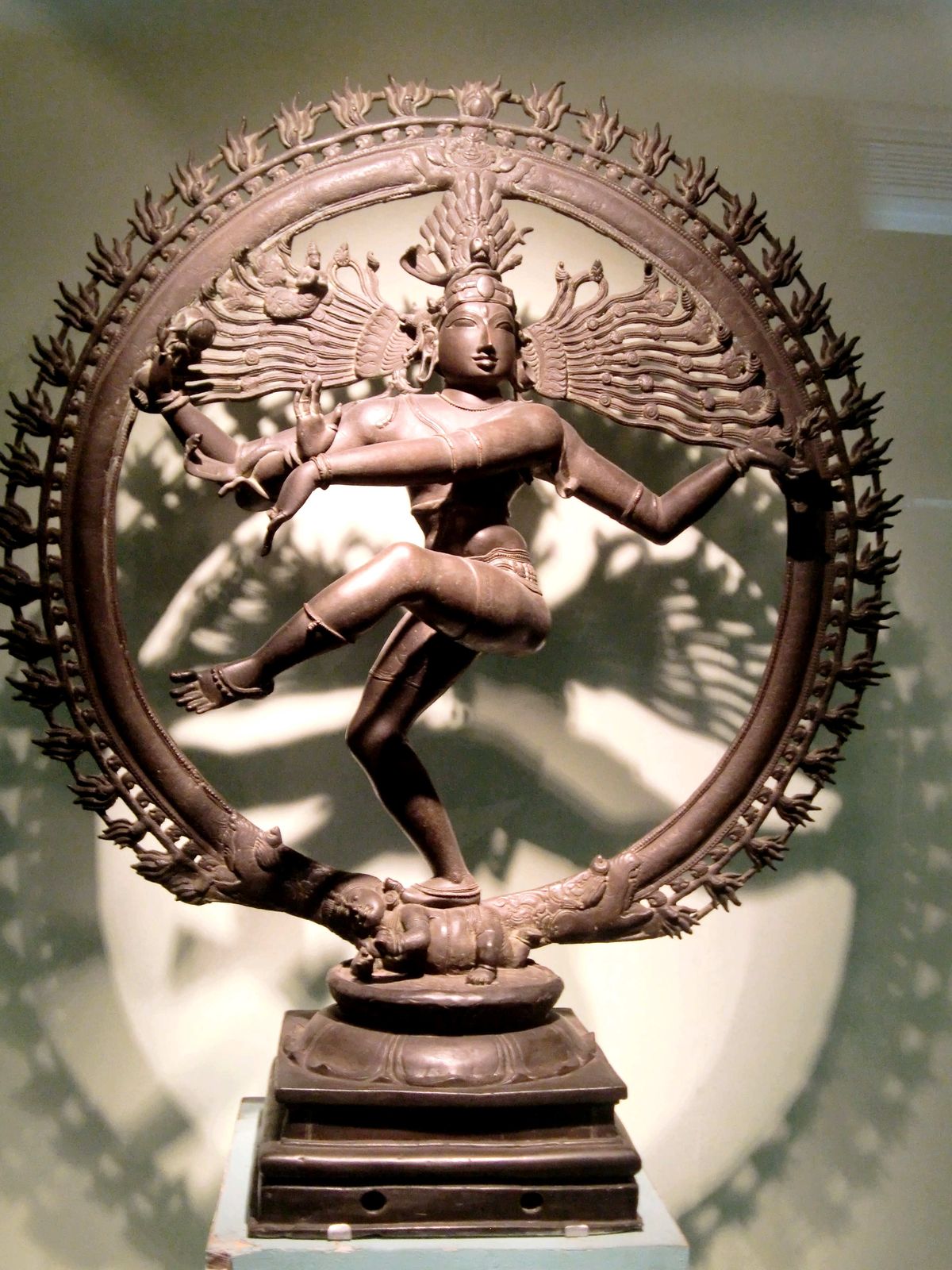
In Tamil Nadu the same star belongs to the temple, and the centre of it is Chidambaram — the Thillai Nataraja temple, the golden hall, Kanaka Sabha, where Shiva dances the Ananda Tandava, the dance of bliss. The Margazhi Brahmotsavam runs for ten days and ends with Arudra Darshan. The chariot procession is on Wednesday 23 December; then, in the small hours of Thursday, the Maha Abhishekam is performed to Nataraja and Sivakamasundari in the Raja Sabha, the thousand-pillared hall. The temple's own schedule, as the Margashirsha Purnima article records it, runs the abhishekam from 2 to 6 AM, and the god is then carried in procession to the golden hall for the darshan itself. Drik lists no abhishekam muhurat — that timing is the temple's, not the panchang's — and anyone planning to be there should confirm it with the temple.
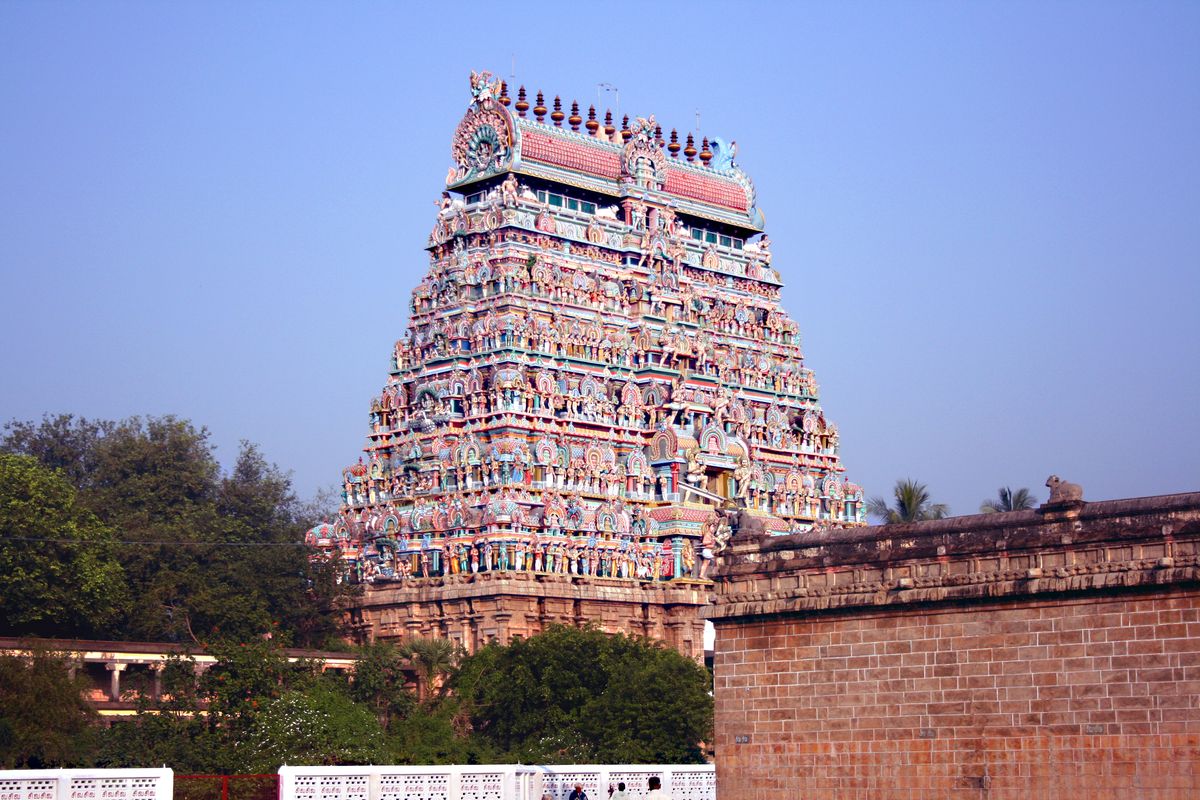
The dance is honoured in five halls across Tamil Nadu — the golden hall at Chidambaram, the silver hall at Madurai, the ruby hall at Thiruvalangadu, the copper hall at Tirunelveli and the hall of pictures at Kutralam — but Chidambaram is the one, and on this morning it is the one place in the world where the festival is a crowd rather than a household. If you are in Tamil Nadu, go before dawn. The abhishekam is the heart of it, and it is over by 6 AM.
Thiruvathira 2026 in India
The observance is Thursday, 24 December. The Ardra star runs 4:53 AM on Thursday to 1:47 AM on Friday, and it is present at sunrise — Delhi's sunrise is 7:11 AM — which is what makes Thursday the day. Sunset is 5:30 PM. The Brahma Muhurta runs 5:22 to 6:16 AM, the Abhijit 12:00 to 12:41 PM, and Rahu Kalam 1:38 to 2:56 PM. The tithi at sunrise is Krishna Pratipada; the Purnima ended at 6:57 AM, before the sun came up. Drik's day page lists "Pausha Begins *North, Arudra Darshan, Ishti" — the north Indian month turns on this day too, the morning after the Purnima.
Kerala and Tamil Nadu, and the rest of the country
In Kerala the day is kept at home, and in Tamil Nadu it is kept at the temple, and that split is the whole of the festival in India. Kerala's version is the women's vratam — the fast from Makayiram, the dawn bath, the puzhukku and the koova payasam, the dance around the lamp after sunset and the flowers at midnight. Tamil Nadu's version is the temple's — the kali and the seven-vegetable curry as the morning offering, and Chidambaram before dawn for anyone who can get there. Outside the south, the day is mostly kept quietly: a lamp before Nataraja at home, the story told to the children, and the fast kept by whoever in the family keeps it. The Dhanurmasam article covers the month this day sits in — Dhanu began on 16 December — and the season's next festivals, Makar Sankranti and Pongal, follow three weeks later.
Thiruvathira 2026 in USA
The observance is Thursday, 24 December, the same day as India. The Ardra star runs 6:23 PM on Wednesday 23 December to 3:17 PM on Thursday 24 December, and it is present at sunrise — New York's sunrise is 7:18 AM. Sunset is 4:33 PM. The Brahma Muhurta runs 5:20 to 6:19 AM, the Abhijit 11:37 AM to 12:14 PM, and Rahu Kalam 1:05 to 2:14 PM. The tithi at sunrise is Krishna Pratipada.
Christmas Eve, and a temple that may be busy
Thursday 24 December is Christmas Eve, and that is the practical fact of the day in America. A temple that holds a Thiruvathira puja will hold it in the morning, and a church down the road will be full by the evening — so check your temple's own schedule rather than assuming the evening is free. The fast itself travels well: the dawn bath is a bath at home, the puzhukku is made from yams and plantain from any Indian grocer, and the koova payasam needs arrowroot, jaggery and coconut milk, all of which keep. The dance is the hard part abroad — it needs a circle of women, and a circle needs a community — so in America it is usually the temple or the Malayalee association that stages it, after sunset, around a lamp in the hall. If yours does, go. The video call works the usual way here, only better than most festivals: call home on Thursday evening and Kerala is already into Friday morning, the fast broken at the dawn bath — so call on Wednesday evening instead, when the ettangadi is being eaten in Kerala and the fast is just beginning in New York, and both ends are in the same festival at the same time.
Thiruvathira 2026 in UK
The observance is Thursday, 24 December, the same day as India. The Ardra star runs 11:23 PM on Wednesday 23 December to 8:17 PM on Thursday 24 December, and it is present at sunrise — London's sunrise is 8:05 AM. Sunset is 3:55 PM, the earliest of the six cities. The Brahma Muhurta runs 5:56 to 7:00 AM, the Abhijit 11:44 AM to 12:16 PM, and Rahu Kalam 12:59 to 1:58 PM. The tithi at sunrise is Krishna Pratipada.
The earliest sunset, and a dance that starts at teatime
London gives you the hardest version of the morning again and the easiest version of the evening. The Brahma Muhurta ends at 7:00 AM, more than an hour before the sun comes up, so the bath and the start of the fast happen in full dark, in a cold house, in December. The compensation is the dance: sunset is 3:55 PM, so the evening comes early, and a circle of women can gather around the lamp at five o'clock and be done by nine, with the midnight flower rite still to come for those who keep the vigil. That is the part of this festival that travels best to London — a December evening that starts at teatime, in a warm room, with the lamps lit. And because the star runs until 8:17 PM, the whole of the evening is still Thiruvathira; the star does not leave until the dance is well under way.
Thiruvathira 2026 in Germany
The observance is Thursday, 24 December, the same day as India. The Ardra star runs 12:23 AM on Thursday to 9:17 PM on Thursday, and it is present at sunrise — Berlin's sunrise is 8:16 AM. Sunset is 3:56 PM. The Brahma Muhurta runs 6:05 to 7:11 AM, the Abhijit 11:51 AM to 12:21 PM, and Rahu Kalam 1:03 to 2:01 PM. The tithi at sunrise is Krishna Pratipada.
The latest sunrise, and the quietest fast
Berlin's morning is the latest and the darkest: the sun does not come up until 8:16 AM, so the bath before sunrise is a bath in the dark, and the fast begins before the city is awake. The evening is the same as London's — the sun goes down at 3:56 PM, so the lamps are lit early — and the dance, if your community stages one, will be indoors, in a hall, with the neighbours none the wiser. One practical note, the same one from the Dhanurmasam article: Germany has Ruhezeiten, and a 6 AM alarm and a running tap are still working hours for the neighbours. The fast is quiet by nature — a bath, a lamp, a plate of puzhukku — which is one more reason this festival travels better than the noisy ones. And Thursday is Christmas Eve in Germany too, so the shops shut early and the trams run thin: buy the yams and the plantain on Wednesday.
Thiruvathira 2026 in Mexico
The observance is Thursday, 24 December, the same day as India — and Mexico City is the one place in this series where the star's timing is kindest. The Ardra star runs 5:23 PM on Wednesday 23 December to 2:17 PM on Thursday 24 December, and it is present at sunrise — Mexico City's sunrise is 7:07 AM. Sunset is 6:05 PM, the latest of the six cities. The Brahma Muhurta runs 5:23 to 6:15 AM, the Abhijit 12:14 to 12:58 PM, and Rahu Kalam 1:58 to 3:21 PM. The tithi at sunrise is Krishna Pratipada.
The longest light, and a home observance
Mexico City gets the longest day of the six: sunrise 7:07 AM, sunset 6:05 PM, almost eleven hours of it, so the fast is kept in real daylight and the evening lamp is lit at a civilised hour. The Indian community in Mexico is small, and this is mostly a home observance there — which is fine, because a home observance is what this festival mostly is, even in Kerala, once you step outside the temple courtyard. A bath at dawn, the puzhukku made from whatever tubers the market has, the lamp lit before Nataraja, and the story told. The dance needs a circle, and a circle needs more women than most Mexico City households have; the songs can still be sung, and the flowers — ten of them, whatever the season gives — can still be gathered and brought in at midnight. And Thursday is Christmas Eve in Mexico too, so the evening belongs to the posadas on the street outside. Keep the lamp lit and the door open; the two festivals have shared December before.
Thiruvathira 2026 in Russia
The observance is Thursday, 24 December, the same day as India. The Ardra star runs 2:23 AM on Thursday to 11:17 PM on Thursday, and it is present at sunrise — Moscow's sunrise is 8:59 AM, the latest of the six cities. Sunset is 3:59 PM. The Brahma Muhurta runs 6:43 to 7:51 AM, the Abhijit 12:15 to 12:43 PM, and Rahu Kalam 1:22 to 2:14 PM. The tithi at sunrise is Krishna Pratipada.
The shortest day, and a fast kept indoors
Moscow gets the shortest day of the six: sunrise 8:59 AM, sunset 3:59 PM, seven hours of light. The morning is long and dark — the Brahma Muhurta ends at 7:51 AM, more than an hour before the sun comes up — and the afternoon is short, so the bath, the fast and the evening all happen close together, in the few hours between the late sunrise and the early sunset. The dance, if it happens, happens indoors, in a warm room, around a lamp that has been burning since the afternoon — and that is the point, really. Thiruvathirakali was always an indoor dance, a circle of women around a lamp in a house, not a procession in the street. Moscow's December, for once, suits it. East of Moscow the timings shift with the time zones, as always. Your local temple or your own city's panchang is the authority there; Moscow's hours belong to Moscow.
What you'll need, roughly
Water for the dawn bath, and turmeric and oil for it. Sandalwood paste for the forehead. A nilavilakku, or any tall brass lamp, and oil and a wick. The eight things for ettangadi — yams and roots, unripe plantain, beans, sugarcane and honey — eaten on the eve. For the day: tubers and long beans and raw plantain and coconut for the puzhukku, arrowroot and jaggery and coconut milk for the koova payasam, and broken wheat if your family eats it. Ten flowers, whatever the season gives, gathered during the day for the midnight rite. And a picture or idol of Shiva as Nataraja, before which the lamp is lit and the story is told.
That is the entire list. Thiruvathira is not a festival of shopping. It is a fast kept by women for the marriages of their houses, a bath before dawn, a plate of food with no rice in it, a circle of women dancing around a lamp until midnight, and a star that touches exactly one sunrise — Thursday 24 December, everywhere.
The Kartik–Margashirsha 2026 series: Diwali 2026 · Govardhan Puja 2026 · Bhai Dooj 2026 · Chhath Puja 2026 · Dev Uthani Ekadashi 2026 · Tulsi Vivah 2026 · Dev Diwali 2026 · Kalabhairav Jayanti 2026 · Utpanna Ekadashi 2026 · Margashirsha Amavasya 2026 · Vivah Panchami 2026 · Subrahmanya Shashthi 2026 · Dhanurmasam 2026 · Mokshada Ekadashi 2026 · Margashirsha Purnima 2026 · Akhuratha Sankashti Chaturthi 2026 · Sabarimala Mandala Pooja 2026 · Saphala Ekadashi 2027 · Magh Mela 2027 · Lohri 2027 · Makar Sankranti 2027 · Pongal 2027 · Makaravilakku 2027 · Pausha Amavasya 2027 · Pausha Putrada Ekadashi 2027 · Shakambhari Purnima 2027 · Pausha Purnima 2027 · Thiruvathira 2026
Check your own city before you rely on any date here: the Hindu Panchang Calculator shows today’s tithi and festival dates for your location, the Hindu Date Converter converts between Gregorian and Hindu calendar dates, and this article on the astronomy behind the panchang explains how these calculations are actually made.
Photos: Thiruvathirakali dancers around the nilavilakku — Jigesh, CC BY-SA 3.0; ettangadi — SijiR, CC BY-SA 4.0; 12th-century Chola bronze Nataraja — Miya.m, CC BY-SA 3.0; Thillai Nataraja Temple gopuram, Chidambaram — Lakshmanan, CC BY-SA 3.0; all via Wikimedia Commons.
Timings follow Drik Panchang's city pages for New Delhi, New York, London, Berlin, Mexico City and Moscow, checked 22 November 2026 — the Arudra Darshan festival pages for the observance dates and Ardra nakshatra windows, and the day-panchang pages for 23, 24 and 25 December for sunrise, sunset, Brahma Muhurta, Abhijit, Rahu Kalam, tithi and nakshatra. Where Drik's Delhi start time differs from other published summaries by one minute (4:53 AM against 4:52 AM), this page follows Drik and says so. Drik lists no puja or abhishekam muhurat for Arudra Darshan, so this page invents none; the Chidambaram 2–6 AM abhishekam is the temple's schedule as recorded in the Margashirsha Purnima article. The Kamadeva and Parvati legends, the ettangadi, puzhukku and Thiruvathirakali details follow the sourced accounts named in the article's research notes. Your local temple's announcement overrides any website, including this one.