
Mokshada Ekadashi 2026 is Sunday 20 December in India — and Saturday 19 December in New York and Mexico City
Mokshada Ekadashi 2026 is Sunday, 20 December in India — and Saturday, 19 December in New York and Mexico City (Gauna Sunday 20 December). Parana times city by city, Gita Jayanti, Vaikuntha Ekadashi and the Mokshada katha.
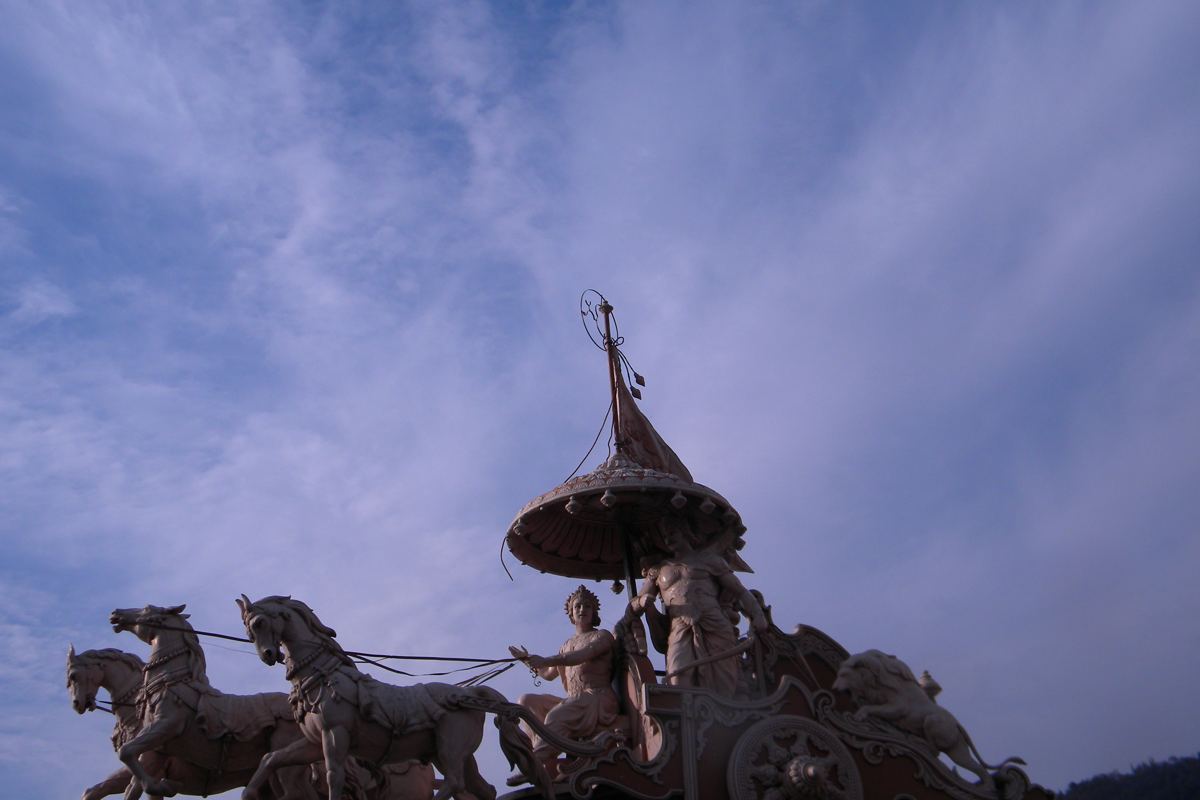
Mokshada Ekadashi 2026 falls on Sunday, 20 December in India, London, Berlin and Moscow — and on Saturday, 19 December in New York and Mexico City, where the Vaishnava (Gauna) fast is kept on Sunday 20 December instead. It is three observances in one day: the Ekadashi fast itself, Gita Jayanti — the day Krishna spoke the Bhagavad Gita — and, in the south, Vaikuntha Ekadashi, when the gate to Vishnu's own world is said to stand open.
That is the whole of it, and the rest of this page is the detail: the split, the Parana windows, the story, and what each city actually does.
Mokshada Ekadashi 2026 at a glance
| Smarta fast, India / London / Berlin / Moscow | Sunday, 20 December 2026 |
| Smarta fast, New York / Mexico City | Saturday, 19 December 2026 |
| Gauna (Vaishnava) fast, New York / Mexico City | Sunday, 20 December 2026 |
| Gita Jayanti | Same day as the Smarta fast in each city |
| Vaikuntha Ekadashi | Sunday, 20 December 2026, everywhere |
| Ekadashi tithi, Delhi | 10:09 PM Sat 19 Dec – 8:14 PM Sun 20 Dec |
| Ekadashi tithi, New York | 11:39 AM Sat 19 Dec – 9:44 AM Sun 20 Dec |
| Ekadashi tithi, London | 4:39 PM Sat 19 Dec – 2:44 PM Sun 20 Dec |
| Ekadashi tithi, Berlin | 5:39 PM Sat 19 Dec – 3:44 PM Sun 20 Dec |
| Ekadashi tithi, Mexico City | 10:39 AM Sat 19 Dec – 8:44 AM Sun 20 Dec |
| Ekadashi tithi, Moscow | 7:39 PM Sat 19 Dec – 5:44 PM Sun 20 Dec |
| Parana, Delhi | Mon 21 Dec, 7:10 – 9:13 AM |
| Parana, New York (Smarta) | Sun 20 Dec, 3:04 PM (a single time) |
| Parana, New York (Gauna) | Mon 21 Dec, 7:16 – 9:08 AM |
| Parana, London | Mon 21 Dec, 8:04 – 9:38 AM |
| Parana, Berlin | Mon 21 Dec, 8:15 – 9:47 AM |
| Parana, Mexico City (Smarta) | Sun 20 Dec, 2:04 – 3:51 PM |
| Parana, Mexico City (Gauna) | Mon 21 Dec, 7:06 – 9:17 AM |
| Parana, Moscow | Mon 21 Dec, 8:57 – 10:22 AM |
| The month | Margashirsha, Shukla Paksha (bright fortnight), Ekadashi |
| The deity | Vishnu as Damodara (Krishna) |
One wrinkle first, because it is the one that will catch people out. In New York and Mexico City the Smarta fast does not break on Monday morning. The Ekadashi tithi ends on Sunday morning there — 9:44 AM in New York, 8:44 AM in Mexico City — so Drik puts the Smarta Parana on Sunday afternoon itself: New York at a single time, 3:04 PM, which is also the moment Hari Vasara ends; Mexico City in a window, 2:04 to 3:51 PM, with Hari Vasara ending at 2:04 PM. The Gauna fast in both cities breaks the usual way, on Monday morning. Do not copy Delhi's Monday Parana onto the American Smarta fast. It would be a day late, and a day late is a missed Parana.
A second wrinkle, smaller. Drik gives no separate Hari Vasara end line for Delhi, London, Berlin or Moscow. It gives the Dwadashi end moment on the Parana day instead — 5:36 PM in Delhi, 12:06 PM in London, 1:06 PM in Berlin, 3:06 PM in Moscow, all on Monday 21 December. This page quotes those as listed and does not invent a Hari Vasara time for those cities.
And a third, about the name. Mokshada means the giver of moksha, liberation. The fast is named for what it is said to do, and the story it carries is about exactly that — a son getting his father out of suffering he could not get himself out of. That is the katha, and it is below, kept separate from the other two observances so none of the three gets blurred into the others.
Mokshada Ekadashi: the fast and the katha
Mokshada is the Shukla Ekadashi of Margashirsha, the bright fortnight's eleventh day, and it sits in the same month as Utpanna Ekadashi — the Krishna-paksha Ekadashi of 4 December, the day Ekadashi Devi herself was born. Utpanna opens the month's Ekadashis; Mokshada closes it. The fast is kept the same way in both, sunrise to sunrise, no grain, no beans, and the merit of the fast is the point of the day.
The katha comes from Krishna telling Yudhishthira, in the Padma Purana's Uttara Khanda according to one telling and the Brahmanda Purana according to another — the sources disagree on which Purana carries it, and this page names the disagreement rather than picking one quietly. The story itself is the same in both.
There was a king called Vaikhanasa, who ruled the city of Champaka-nagar and looked after his subjects as if they were his own children. One night he dreamed of his father suffering in a hellish place, crying out to his son to save him. The king woke in tears, told his council of brahmanas, and was sent to the sage Parvata Muni, who could see past and future. The sage told him what his father had done and what would undo it: in the bright fortnight of Margashirsha there comes an Ekadashi called Mokshada. Keep it strictly, with a full fast, and give the merit of it directly to your father, and he will be freed.
The king did exactly that, with his wife, his children and his relatives, and as he made the offering the story says flower petals showered from the devas watching above, and his father was lifted out of his suffering and taken up in a divine form. That is why the fast carries the name it does. Krishna's own words in the telling are the promise the day is built on: the merit of this fast, given to one's ancestors, can lift them out of lower births and into the heavenly spheres.
It is a story about a debt between the living and the dead, and it is why Mokshada is the Ekadashi people keep with their parents and grandparents in mind. The fast is for Vishnu as Damodara, and the day's work is the fast, the katha heard or read, and the merit consciously given away — not kept, given.
Gita Jayanti: the Gita's own day
Gita Jayanti is the same day, and it is not a coincidence. Tradition holds that on this Margashirsha Shukla Ekadashi, on the field of Kurukshetra, Krishna spoke the Bhagavad Gita to Arjuna — eighteen chapters, standing between two armies, with Arjuna's bow lowered and his nerve gone. The photograph at the top of this page is that moment in stone: Krishna driving Arjuna's chariot, at Rishikesh.
The place itself is still there. At Jyotisar, outside Kurukshetra, stands the banyan tree and the pavilion — the Geeta Upadesh Sthali — where the Gita is said to have been spoken, and the photograph below is that pavilion.
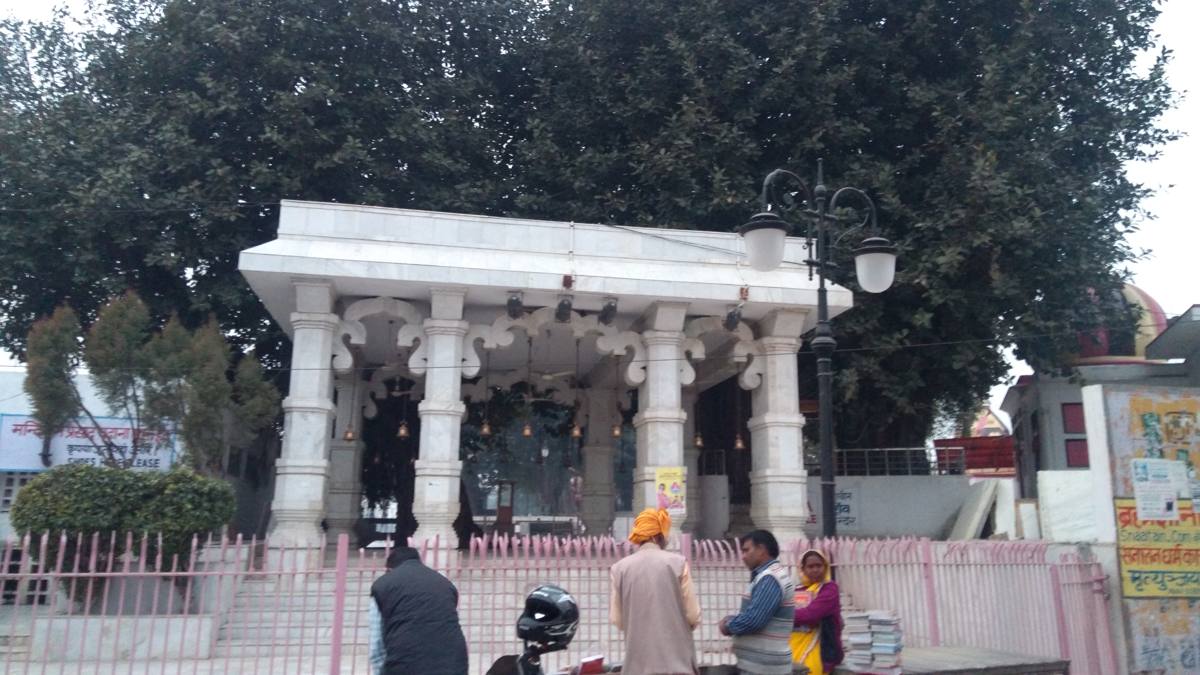 Families that can get there go there on this day. Most people can't, and the day is kept at home instead, by reading the Gita.
Krishna names the month himself, in the Gita's tenth chapter: māsānāṁ mārga-śīrṣo 'ham — "Among months, I am Margashirsha." It is the one line of the Gita that most people keeping this month already know, and it is why Margashirsha carries the weight it does in this series: Margashirsha Amavasya opened it, Vivah Panchami and Subrahmanya Shashthi filled it, Dhanurmasam began inside it, and now Mokshada and Gita Jayanti land on the same Sunday.
How the day is kept, in practice: the fast, and the Gita. A full parayana — all eighteen chapters — is the ideal, and it takes most of a day; most households read a chapter or two, or listen to a recitation, and that counts. Temples and Gita study circles run group readings, and in Kurukshetra the day is marked at Jyotisar itself. If you have never read the Gita, this is the day the tradition points you at, and the honest advice is to start with the second chapter — Arjuna's despair and Krishna's first answer — rather than trying to swallow all eighteen at once.
One thing worth saying plainly: Gita Jayanti follows the Smarta fast date, not the Sunday. In New York and Mexico City it is Saturday 19 December, with the Smarta fast. On Sunday 20 December in those two cities, Drik lists no Gita Jayanti — that Sunday belongs to the Gauna fast and to Vaikuntha Ekadashi. If your family keeps Gita Jayanti and you live in America, check which date your temple is using before you plan the reading.
Vaikuntha Ekadashi: the gate that opens once a year
Vaikuntha Ekadashi is the same tithi under its southern name, and it is the biggest of the three in the south — the day the Vaishnava world says the gate of Vishnu's own abode, Vaikuntha, stands open. It is also called Mukkoti Ekadashi, for the three crore devas said to come down to watch, and Swarga Vathil Ekadasi in Kerala, and Paramapada Ekadasi in the old books.
Nowhere is it kept like Srirangam. The island temple of Ranganatha in the Kaveri keeps a festival of about three weeks around it, in two halves: Pagal Pathu, the ten days before, and Ra Pathu, the ten nights after, when the Divya Prabandham is sung through the nights. Before dawn on the day itself the Paramapada Vasal — the northern gate, shut all year — is opened, and the processional god Namperumal is carried through it to the Thousand-Pillared Hall, with the pilgrims behind him. The photograph below is the gopurams of that temple.
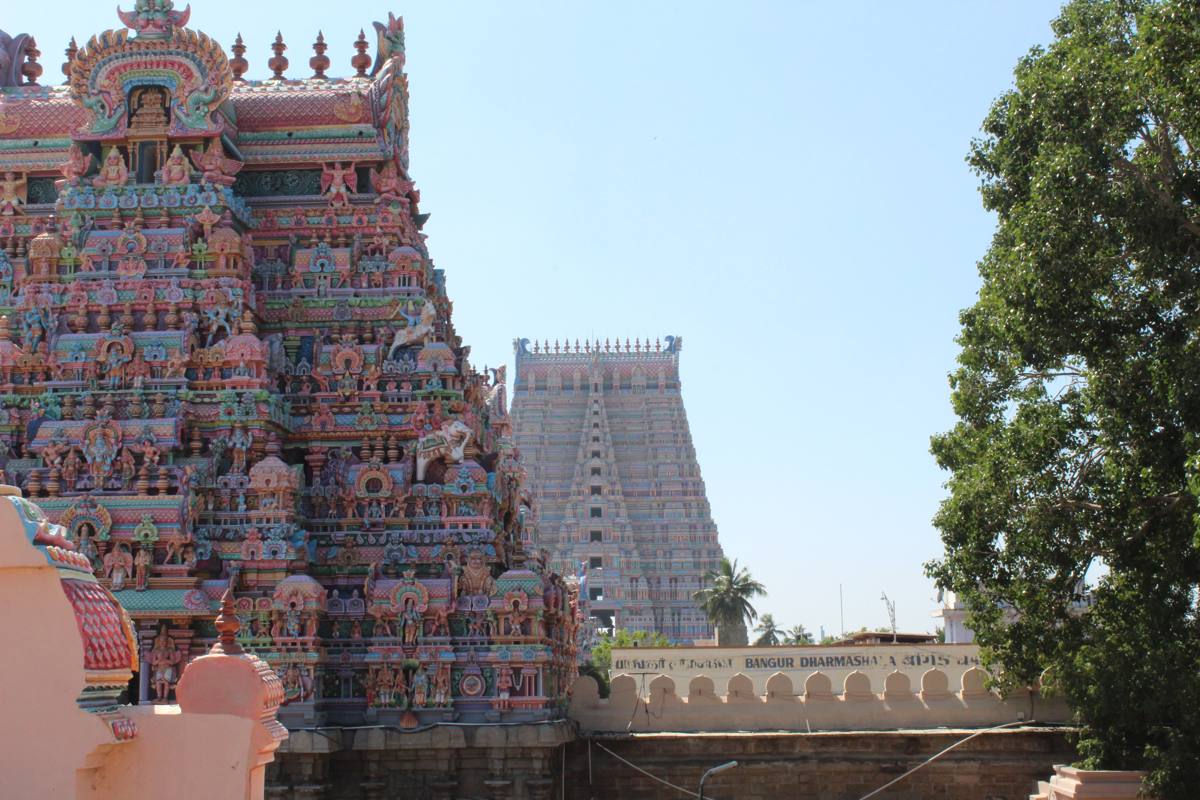
Passing through the gate with him is believed to be passing into Vaikuntha itself, and the crowds are among the largest of the temple's year.
At Tirumala the same gate has another name, the Vaikuntha Dwaram, a passage running round the sanctum of Venkateswara, shut all year and opened on this day. In recent years the temple has kept it open for ten days around the Ekadashi so the crowds can be spread — in 2026 that would mean roughly 20 to 29 December — but the exact window is the temple's announcement, not this page's, and it is due in November. Check ttdevasthanams.ap.gov.in before you plan a trip. The photograph below is the Tirumala facade, with the white gopuram against the green hills.
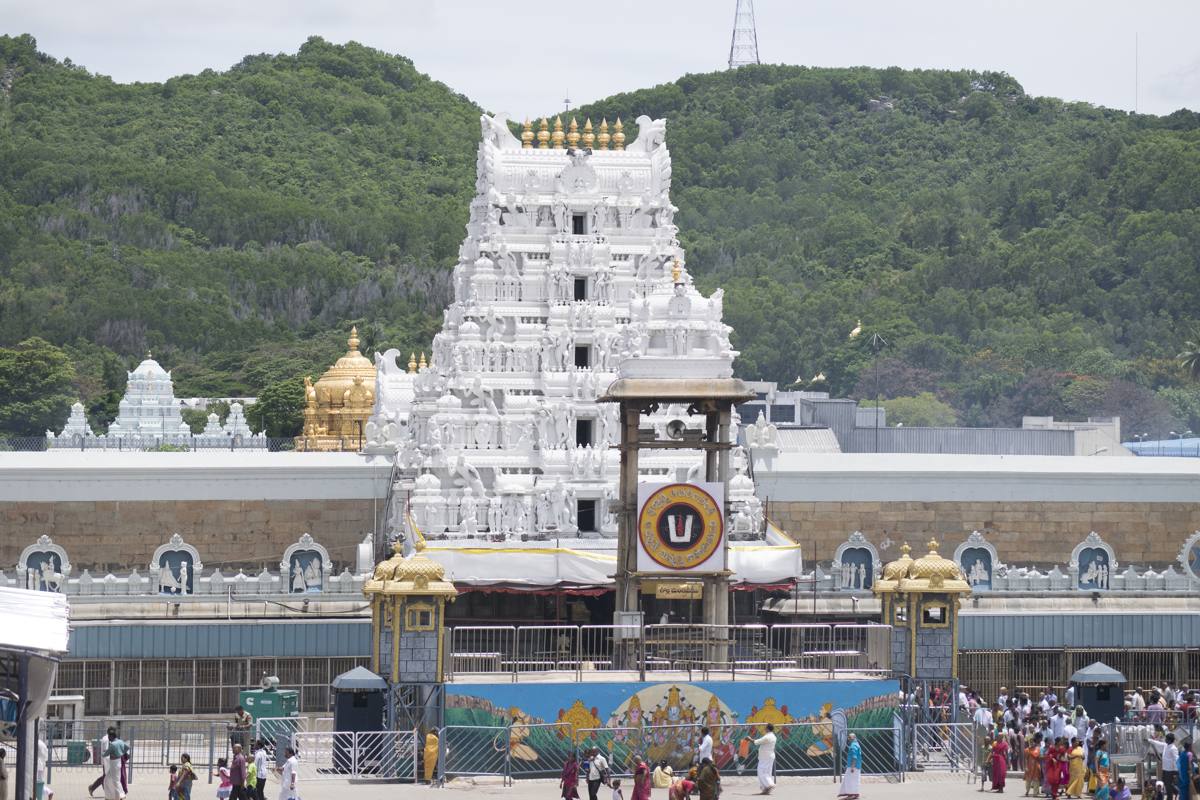
In Tamil Nadu, Andhra Pradesh, Telangana, Kerala and Karnataka the fast is often kept at its strictest — many families keep it nirjala, without water — and it is the year's most important Ekadashi in the home as well as the temple. In the north the same day is kept as Mokshada, and the two names describe one fast, not two. Drik lists Vaikuntha Ekadashi on Sunday 20 December in all six of this article's cities, including New York and Mexico City, where the Smarta fast was the day before.
One date to be careful with: some calendars list a Vaikuntha Ekadashi in early January 2026 as well, closing out the Dhanurmasa that began the previous December. That one has passed. The next one after it is this one, Sunday 20 December 2026.
How the fast is kept
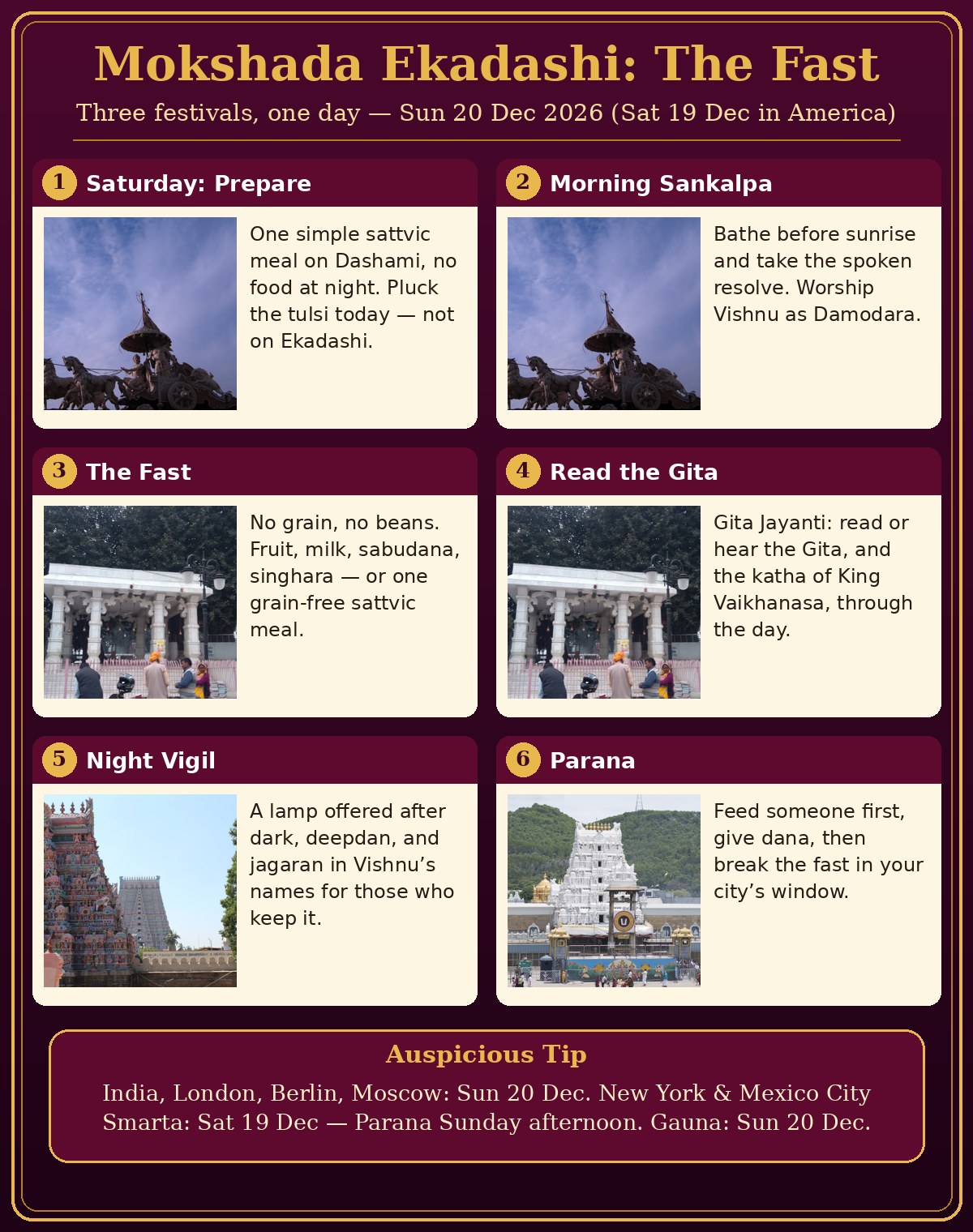
The shape is the same shape as Utpanna Ekadashi and Dev Uthani Ekadashi, and anyone who kept those will recognise it. The day before, Dashami, take one simple sattvic meal and no food at night, and pluck the tulsi today — not on Ekadashi. On the morning of the fast, bathe before sunrise and take the sankalpa, the spoken resolve, before the image of Vishnu or Krishna.
The fast itself is sunrise to sunrise. Drik's own pages list four grades of it: jalahar, water only; ksheerbhoji, milk and milk products; phalahari, fruit only; and naktabhoji, a single grain-free meal before sunset. Most households keep the fruit-and-milk version, with sabudana, singhara and potatoes, and no grain, no beans, no onion or garlic. The rule that matters most is the one Drik states plainly: skip grains at dinner the night before, so nothing of them is left in the stomach when the fast begins at sunrise.
Through the day, the Gita is read or heard, and the Mokshada katha with it. In the evening a lamp is offered, and those who keep the full night stay awake in Vishnu's names — jagaran — which the katha itself prescribes: devotional songs and hymns through the night for the Lord's joy. The next morning, break the fast inside your city's Parana window, after feeding someone first and giving dana. That order matters: feed, give, then eat.
Mokshada Ekadashi 2026 in India
The fast is Sunday, 20 December. The Ekadashi tithi runs 10:09 PM on Saturday 19 December to 8:14 PM on Sunday 20 December, and Parana is Monday 21 December, 7:10 to 9:13 AM. Delhi's sunrise on the 20th is 7:09 AM and sunset 5:28 PM, and the Brahma Muhurta runs 5:20 to 6:14 AM. Dwadashi ends at 5:36 PM on Monday.
Where India goes on this day
Kurukshetra, for Gita Jayanti — Jyotisar, the banyan, the pavilion where the Gita was spoken. Srirangam and Tirumala, for Vaikuntha Ekadashi — the Paramapada Vasal opening before dawn at Srirangam, the Vaikuntha Dwaram at Tirumala. And at home, the fast and the Gita, which is where most of India keeps it. If you are near a Vishnu temple, go in the morning: the fast begins at sunrise, and the day's reading is best done while the house is still quiet.
Mokshada Ekadashi 2026 in USA
The Smarta fast is Saturday, 19 December — a day earlier than India — and the Gauna (Vaishnava) fast is Sunday, 20 December. Gita Jayanti is on Saturday 19 December, with the Smarta fast. Vaikuntha Ekadashi is listed on Sunday 20 December.
The tithi runs 11:39 AM on Saturday 19 December to 9:44 AM on Sunday 20 December. New York's sunrise on Saturday is 7:15 AM and sunset 4:31 PM, and the Brahma Muhurta is 5:17 to 6:16 AM. On Sunday the sunrise is 7:16 AM and sunset 4:31 PM.
Two fasts, two Paranas — do not mix them up
This is the city where the article's warning matters most. The Smarta Parana is Sunday 20 December at 3:04 PM — a single time, not a window, and the same moment Hari Vasara ends. The Gauna Parana is Monday 21 December, 7:16 to 9:08 AM, and Drik notes that Dwadashi would be over before sunrise that Monday.
So a Smarta household in New York fasts from Saturday sunrise, breaks the fast on Sunday afternoon, and is done. A Vaishnava household — and most ISKCON temples in America follow the Vaishnava calendar, so check your temple's announcement — fasts from Sunday sunrise and breaks it on Monday morning. Both are right. They are different fasts, and the mistake is assuming your neighbour's Parana is yours.
The practical shape that works: Saturday is the hard day, and it is a Saturday, which helps — no work, the Gita reading in the afternoon, the katha with the children. A video call home on Saturday evening reaches India on Sunday morning, when Delhi families are just beginning the same fast. Both ends of the call are keeping Mokshada; they are just a day apart on the calendar, and neither side is wrong.
Mokshada Ekadashi 2026 in UK
The fast is Sunday, 20 December, the same day as India. The tithi runs 4:39 PM on Saturday 19 December to 2:44 PM on Sunday 20 December, and Parana is Monday 21 December, 8:04 to 9:38 AM. London's sunrise on Sunday is 8:03 AM and sunset 3:53 PM — seven hours and fifty minutes of daylight — and the Brahma Muhurta runs 5:54 to 6:58 AM. Dwadashi ends at 12:06 PM on Monday. Gita Jayanti and Vaikuntha Ekadashi both fall on Sunday 20 December.
The dark morning, again
London gives you the hardest version of the fast's first demand: the Brahma Muhurta ends at 6:58 AM, more than an hour before the sun comes up, so the bath and the sankalpa happen in full dark. The Gita reading is the part that travels best — a chapter with the morning tea, after the fast has begun, in the hour before the house wakes. And the evening is short: sunset at 3:53 PM, so the lamp and the jagaran begin in the middle of the afternoon, which honestly suits a lamp-lit puja.
Mokshada Ekadashi 2026 in Germany
The fast is Sunday, 20 December, the same day as India. The tithi runs 5:39 PM on Saturday 19 December to 3:44 PM on Sunday 20 December, and Parana is Monday 21 December, 8:15 to 9:47 AM. Berlin's sunrise on Sunday is 8:14 AM and sunset 3:54 PM — seven hours and forty minutes of daylight — and the Brahma Muhurta runs 6:04 to 7:09 AM. Dwadashi ends at 1:06 PM on Monday. Gita Jayanti and Vaikuntha Ekadashi both fall on Sunday 20 December.
The shortest day of the series
Berlin's fast begins in darkness and the sun, when it comes, is up for less than eight hours. The morning puja happens in the dark, the Gita reading in the first grey light, and the evening lamp in the middle of the afternoon. December in Berlin does not give you much sun to work with, and this fast, which is mostly about a bath, a verse and a lamp, is the one that minds least.
One practical note, the same one from the Dhanurmasam article: Germany has Ruhezeiten, and a 6 AM alarm and a running tap are still working hours for the neighbours. The home puja is quiet by nature — a lamp, a verse, a small bowl of fruit — which is one more reason this fast travels better than the noisy ones. If your temple stages a Gita Jayanti reading, it will be a temple affair, indoors, and the neighbours will never know.
Mokshada Ekadashi 2026 in Mexico
The Smarta fast is Saturday, 19 December — a day earlier than India — and the Gauna (Vaishnava) fast is Sunday, 20 December. Gita Jayanti is on Saturday 19 December, with the Smarta fast. Vaikuntha Ekadashi is listed on Sunday 20 December.
The tithi runs 10:39 AM on Saturday 19 December to 8:44 AM on Sunday 20 December. Mexico City's sunrise on Saturday is 7:05 AM and sunset 6:02 PM, and the Brahma Muhurta is 5:20 to 6:13 AM. On Sunday the sunrise is 7:05 AM and sunset 6:03 PM.
The longest light of the six cities
Mexico City gets the most generous December day of the six: sunrise 7:05 AM, sunset 6:02 PM, nearly eleven hours of light. The Smarta Parana is Sunday 20 December, 2:04 to 3:51 PM, with Hari Vasara ending at 2:04 PM — an afternoon Parana, in daylight, which is a kinder version of New York's single 3:04 PM moment. The Gauna Parana is Monday 21 December, 7:06 to 9:17 AM.
The Indian community in Mexico is small, and this is mostly a home observance there — which is fine, because a home observance is what this fast mostly is, even in Kurukshetra, once you step outside the temple courtyard. The fast needs a lamp, a verse and a day without grain. Everything else is commentary. And the Gita reading fits the day well here: Saturday, a long light day, a chapter in the morning and the katha in the evening.
Mokshada Ekadashi 2026 in Russia
The fast is Sunday, 20 December, the same day as India. The tithi runs 7:39 PM on Saturday 19 December to 5:44 PM on Sunday 20 December, and Parana is Monday 21 December, 8:57 to 10:22 AM. Moscow's sunrise on Sunday is 8:57 AM and sunset 3:57 PM — seven hours of daylight, the shortest day in this article — and the Brahma Muhurta runs 6:41 to 7:49 AM. Dwadashi ends at 3:06 PM on Monday. Gita Jayanti and Vaikuntha Ekadashi both fall on Sunday 20 December.
A fast staged in the dark
Moscow's Brahma Muhurta ends more than an hour before the sun is up, and the sun, when it comes, is up for seven hours. The bath before sunrise happens in full dark, which is the traditional form anyway: the bath at dawn, in darkness, is how the old guides describe the start of a fast day. A Moscow December simply makes the description literal.
The evening puja is the same as everywhere else, and the time zones offer their usual small mercy: a video call home after the evening lamp reaches India at around 8:30 PM IST, when Delhi families are sitting down to their own evening after a day that began four hours earlier. Both ends of the call are keeping Mokshada on the same Sunday — Moscow and Delhi agree on this one.
East of Moscow the timings shift with the time zones, as always. Your local temple or your own city's panchang is the authority there; Moscow's hours belong to Moscow.
What you'll need, roughly
A picture or idol of Vishnu or Krishna — Damodara, if your family keeps him by that name — flowers, tulsi, a lamp and oil. Fruit, milk, sabudana and potatoes for the fast, and nothing with grain in it. A copy of the Gita, in print or on the phone, and the Mokshada katha to read or hear. Rice and jaggery for the Parana meal, and something to give away first: food for someone who needs it, and dana for the temple or a brahmana.
That is the entire list. Mokshada is not a festival of shopping. It is a fast, a story, and a book — and a day kept for the people who are no longer here to keep it themselves.
The Kartik–Margashirsha 2026 series: Diwali 2026 · Govardhan Puja 2026 · Bhai Dooj 2026 · Chhath Puja 2026 · Dev Uthani Ekadashi 2026 · Tulsi Vivah 2026 · Dev Diwali 2026 · Kalabhairav Jayanti 2026 · Utpanna Ekadashi 2026 · Margashirsha Amavasya 2026 · Vivah Panchami 2026 · Subrahmanya Shashthi 2026 · Dhanurmasam 2026 · Mokshada Ekadashi 2026
Check your own city before you rely on any date here: the Hindu Panchang Calculator shows today’s tithi and festival dates for your location, the Hindu Date Converter converts between Gregorian and Hindu calendar dates, and this article on the astronomy behind the panchang explains how these calculations are actually made.
Photos: Krishna driving Arjuna’s chariot, Rishikesh — Bodhisattwa, CC BY-SA 3.0; Geeta Upadesh Sthali, Jyotisar — आशीष भटनागर, CC BY-SA 3.0; Tirumala Venkateswara Temple — Nikhilb239, CC BY-SA 4.0; Srirangam Ranganathaswamy Temple gopurams — Writer hit, CC BY-SA 4.0; all via Wikimedia Commons.
Timings follow Drik Panchang's city pages for New Delhi, New York, London, Berlin, Mexico City and Moscow, checked 14 November 2026 — festival pages for the tithi and Parana, day-panchang pages for sunrise, sunset and Brahma Muhurta. Gita Jayanti dates come from Drik's day-panchang listings; the festival pages themselves do not mention Gita Jayanti. Where Drik gives no separate Hari Vasara line (Delhi, London, Berlin, Moscow), this page quotes the Dwadashi end moment instead and says so. The Mokshada katha is told in the Padma Purana (Sandipani) and the Brahmanda Purana (Sushmajee) — the sources disagree on the Purana, and this page names that. The Tirumala Vaikuntha Dwaram ten-day window is as kept in recent years; confirm this year's dates at ttdevasthanams.ap.gov.in. Your local temple's announcement overrides any website, including this one.