
Shakambhari Purnima 2027 is Friday 22 January — except in Mexico City, where it's Thursday 21 January
Shakambhari Purnima 2027 is Friday, 22 January in India, USA, UK, Germany and Russia — Thursday 21 January in Mexico City. Tithi, moonrise and the katha.
Shakambhari Purnima 2027 falls on Friday, 22 January in India, the United States, the United Kingdom, Germany and Russia — and on Thursday, 21 January in Mexico City. It is the full moon of Pausha, the last day of Shakambhari Navratri, and the appearance day of the goddess who fed a starving world with vegetables grown from her own body. Mexico City is the one city of the six that moves, and New York keeps Friday by two minutes. Those two facts are the whole story of the timings, and the rest of this page is the detail: the Navratri that starts a day early in the Americas, the katha of the hundred-eyed goddess, and what each city actually does.
That is the date. The goddess is the reason anyone keeps it.
Shakambhari Purnima 2027 at a glance
| Observance, Delhi / New York / London / Berlin / Moscow | Friday, 22 January 2027 |
| Observance, Mexico City | Thursday, 21 January 2027 |
| Purnima tithi, Delhi | 9:29 PM Thu 21 Jan – 5:46 PM Fri 22 Jan |
| Purnima tithi, New York | 10:59 AM Thu 21 Jan – 7:16 AM Fri 22 Jan |
| Purnima tithi, London | 3:59 PM Thu 21 Jan – 12:16 PM Fri 22 Jan |
| Purnima tithi, Berlin | 4:59 PM Thu 21 Jan – 1:16 PM Fri 22 Jan |
| Purnima tithi, Mexico City | 9:59 AM Thu 21 Jan – 6:16 AM Fri 22 Jan |
| Purnima tithi, Moscow | 6:59 PM Thu 21 Jan – 3:16 PM Fri 22 Jan |
| Moonrise, Delhi | 5:50 PM, Fri 22 Jan |
| Moonrise, New York | 5:30 PM, Fri 22 Jan |
| Moonrise, London | 4:41 PM, Fri 22 Jan |
| Moonrise, Berlin | 4:38 PM, Fri 22 Jan |
| Moonrise, Mexico City | 5:48 PM, Thu 21 Jan |
| Moonrise, Moscow | 4:38 PM, Fri 22 Jan |
| Shakambhari Navratri begins | Sat 16 Jan (Delhi, London, Berlin, Moscow); Fri 15 Jan (New York, Mexico City) |
| Shakambhari Navratri ends | Fri 22 Jan (Thu 21 Jan in Mexico City) |
| The month | Pausha, Shukla Paksha (bright fortnight) |
| The goddess | Shakambhari, the bearer of vegetables — Shatakshi, the hundred-eyed |
The first wrinkle is New York, and it is worth saying plainly because it is the sort of thing that looks like a mistake when it is not. In New York the Purnima tithi ends at 7:16 AM on Friday 22 January, and the sun rises at 7:14 AM. Purnima is still running at sunrise — by two minutes. That is all that keeps New York on Friday. Drik's festival page lists New York's observance as Friday 22 January, and the 22 January day panchang confirms it: Bava karana, the first karana of Purnima, runs upto 7:16 AM, so Purnima is the tithi at sunrise. Do not move New York to Thursday on the strength of the 7:16 AM end time alone. Two minutes is a thin margin, but it is a real one, and it is the margin the calendar itself draws.
The second wrinkle is Mexico City, and it goes the other way. There the Purnima tithi begins at 9:59 AM on Thursday 21 January and ends at 6:16 AM on Friday 22 January, about an hour before Friday's 7:13 AM sunrise — so Purnima holds no Mexico City sunrise on Friday, and the full moon rises on Thursday evening, at 5:48 PM. Drik lists Mexico City's observance as Thursday 21 January. One thing to get right in Mexico City: at Thursday's sunrise the tithi is still Chaturdashi — it ends at 9:59 AM — so do not say Purnima holds the Thursday sunrise. Purnima begins mid-morning, and the full moon belongs to Thursday evening.
A third wrinkle, and this one moves the whole week, not just the day. Shakambhari Navratri starts on Pausha Shukla Ashtami, Banada Ashtami, and in New York and Mexico City the Ashtami tithi ends in the small hours of Saturday 16 January — 3:12 AM in New York, 2:12 AM in Mexico City — before sunrise. So Ashtami holds the Friday 15 January sunrise there, and the Navratri starts on Friday 15 January in the Americas, a day earlier than in India, London, Berlin and Moscow, where it starts on Saturday 16 January. A family in New York keeping the Navratri fasts starts while the Delhi family is still a day away from beginning.
And a small one, for the record. Drik gives the Delhi tithi as 9:29 PM on 21 January to 5:46 PM on 22 January; several other published 2027 panchangs give 9:30 PM to 5:47 PM — a one-minute calculation difference, and the same one-minute gap shows in the Ashtami window. This page follows Drik, which is the house source for this series. One minute changes nothing here; it is worth naming so nobody thinks the two sources disagree about the day.
One more structural detail, because it explains why the Navratri counts the way it does. The run holds eight tithis — Ashtami to Purnima — but only seven mornings in Delhi, because this fortnight's Shukla Dwadashi is kshaya: it begins and ends between two sunrises, and owns no morning of its own. Drik says so itself. It is the same kind of skipped tithi that moved Pausha Putrada Ekadashi — which falls inside this very Navratri, on Monday 18 January — onto its Monday date.
What Shakambhari means, and the katha
The name is the whole theology in two words. Shaka means vegetable, or green food; bhari means the bearer, the one who carries it. Shakambhari is she who bears vegetables — the goddess as the giver of food, not in the abstract but as actual greens, fruit and roots, grown from her own body and handed out. She is also Shatakshi, the hundred-eyed, because she watched the world's suffering with a hundred eyes at once.
The story is told in the Devi Bhagavata Purana, Book 7, Chapter 28, and the Devi Mahatmya, Chapter 11, verses 46 to 49, gives it as the goddess's own prophecy: when rain fails for a hundred years and the earth is without water, she will appear, born from no womb, gaze on the sages with a hundred eyes, nourish the world from her own body, and kill the asura Durgama.
Durgamasura — Durgama, son of Ruru, of Hiranyaksha's line — went to the Himalaya and worshipped Brahma for a thousand years, living on air, and asked for the Vedas and their mantras, with strength enough to defeat the gods. Brahma granted it. And then the brahmins forgot the Vedas. Sandhya, sacrifice, shraddha, the daily homam — all of it fell silent, and because no offerings rose, no rain fell for a hundred years. Famine spread across the earth.
When the sages turned to her in prayer, the goddess appeared covered with countless eyes, dark blue, four-handed, bearing a lotus, arrows, a great bow, and vegetables, fruits, flowers and roots. Seeing the misery of the people, she wept from her hundred eyes for nine nights, until her tears filled the rivers again, and from her hands she gave out vegetables, fruits, flowers and roots — food grown from her own body. That is why she is called Shakambhari. Then Durgama marched against her with a vast army, and from her body came Shaktis — Kalika, Tarini, Bagala, Matangi, Tripura Sundari and others — who fought for ten days, and on the eleventh she brought Durgama down with fifteen arrows. She returned the Vedas to the brahmins, and from the slain Durgama she took the name Durga.
That is the telling as the Purana gives it, and this page reports it as the telling's own. The Uma Samhita of the Shiva Purana identifies Shatakshi and Shakambari as manifestations of Parvati, and a parallel account stands in the Skanda Purana. The point of the story is not really the demon. It is the sentence in the middle: a goddess who answers a famine not with a weapon first but with food, and whose tears become rivers before her arrows fly.
Banashankari: the same goddess, in Karnataka
In Karnataka she is called Banashankari — bana, forest, and Shankari, the Shakti of Shankara — the goddess of the forest, and the name Shakambhari is her other name there. The Banashankari temple at Cholachagudda near Badami, in Bagalkot district, is the famous seat of this worship: a Chalukya temple of the 7th century, built in 603 CE under King Jagadekamalla III and rebuilt around 1750 by the Maratha chieftain Parusharam Agale, with a black-stone, eight-armed image of the goddess seated on a lion, facing the great square tank called Haridra Tirtha.
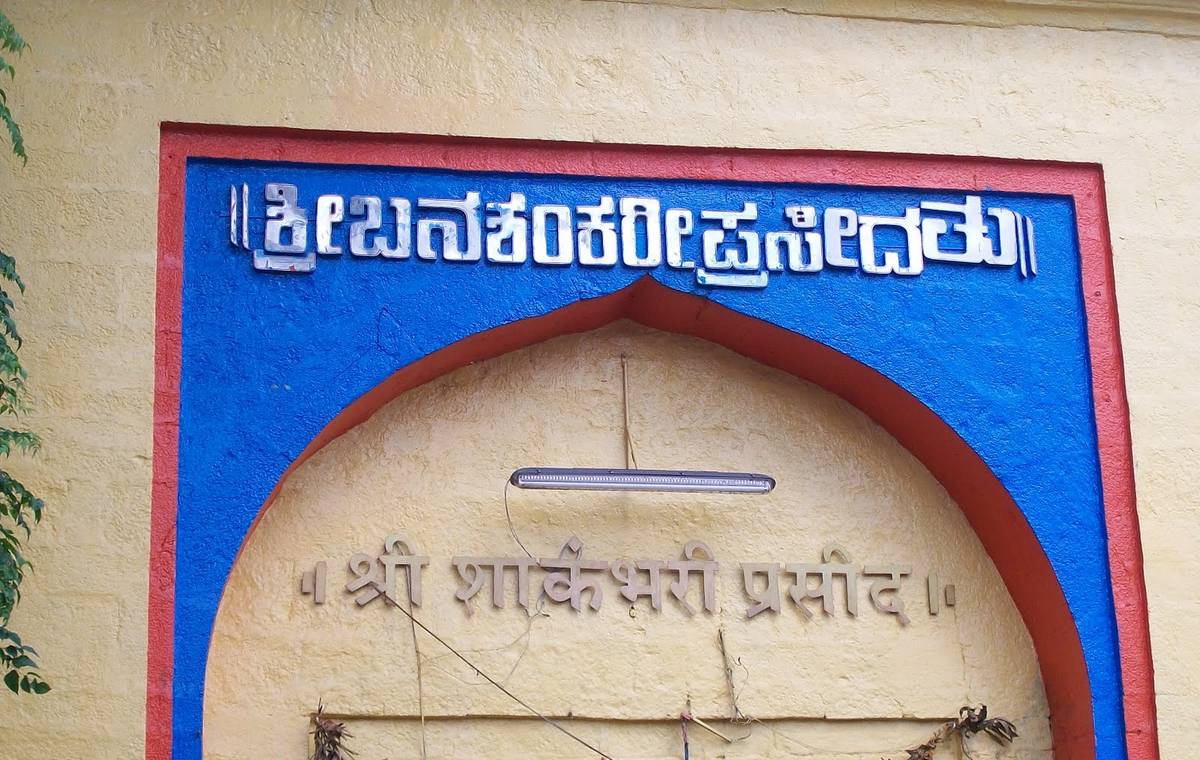
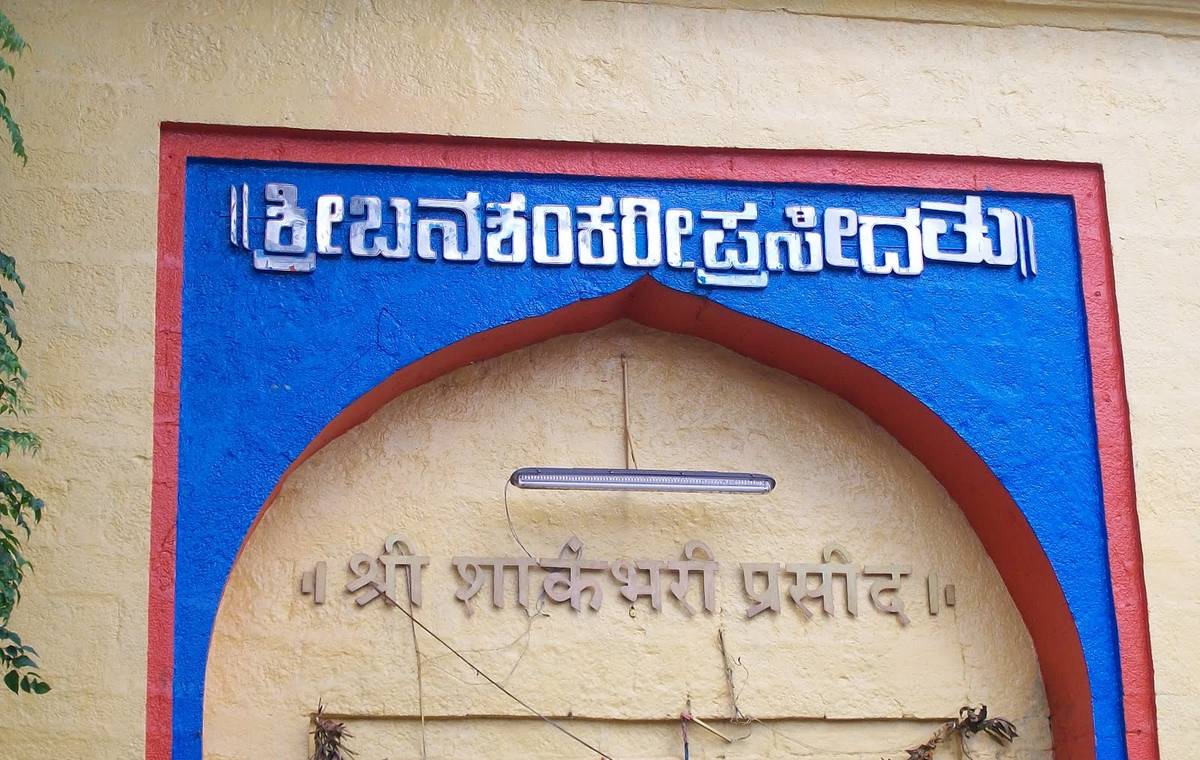
The photograph at the top of this page is the entrance of that temple, and the two names of the goddess stand on one doorway: Kannada "Shri Banashankari" above, Devanagari "Shri Shakambhari" below. It is the whole article in a single frame — one goddess, two names, and a doorway between them.
Banashankari Navratri is the temple's major festival of the Paush month: it begins on Banadashtami and ends on Paush Purnima — this very day. During the Navratri the goddess is dressed in a different form each day, and the festival closes with the Palleda Habba, the vegetable festival, in which the Devi is decorated with vegetables and various curries are prepared and offered to her. It is the katha acted out with real food: the goddess who fed the world gets fed, in vegetables, by the people she fed.
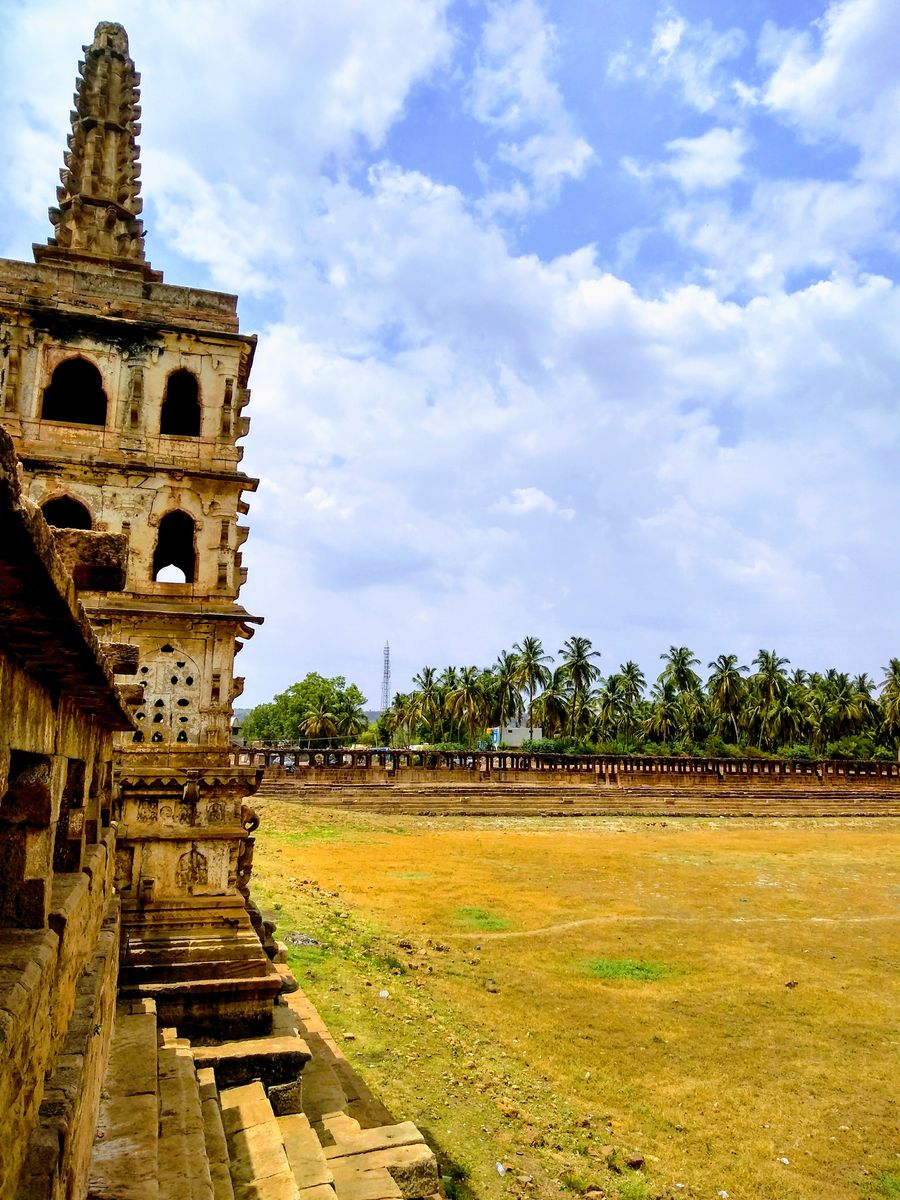
The tank in the photograph is the Haridra Tirtha, photographed dry — it has stood dry for decades, as the photographer notes. It is worth saying so rather than pretending otherwise: the tank is empty, the temple is not, and the fair still fills the town every January.
The worship travels further than Badami. There is a Banashankari temple in Bangalore, and Shakambhari's seats in the north are the Shakambhari Mata temple in the Shivalik foothills of Saharanpur district, Uttar Pradesh, and the Sakray and Sambhar peeths in Rajasthan. In Gujarat the same full moon is Ambaji's pragatya din — the appearance day of the goddess at Ambaji — kept with the goddess dressed in vegetables and an annakut offered to her. And in Tamil Nadu the same moon is Thai Pusam, kept by devotees of Murugan. One full moon, four names, and the same idea underneath all of them: the gods feed the world, and the world answers with food.
How the day is kept
The day is a Purnima first and a goddess day second, and the shape of it follows the Purnima shape this series has used all along: a bath before sunrise, charity, and the Satyanarayan katha in the evening. The general Pausha Purnima guide — the snan, the daan, the vrat itself — publishes here tomorrow morning, and this page is the Shakambhari half of that moon.
What is specific to Shakambhari is the food. Families offer the goddess what she gave the world: leafy greens, vegetables, fruit and roots, set before her image with flowers and a lamp. In the temples the offering is on a grander scale — the vegetable annakut at Ambaji, the Palleda Habba at Badami — but at home it is the same gesture, smaller: a plate of greens and fruit, offered first, eaten afterwards as prasad. Those keeping the Navratri fast through the week break it on this day, with the Purnima meal.
The katha is read or heard in the evening — the story of Durgamasura and the hundred-eyed goddess, from the Devi Bhagavata or the Devi Mahatmya — and the lamps are lit at dusk. Abroad, where there is no Banashankari temple down the road, it is mostly a home observance: a picture of the goddess, a plate of vegetables, the story read aloud, and the full moon watched from a window or a balcony. That is the whole of it, and it is enough. The goddess in the story did not ask for a temple. She asked to be remembered, and then she fed everyone.
Shakambhari Purnima 2027 in India
The observance is Friday, 22 January. The Purnima tithi runs 9:29 PM on Thursday 21 January to 5:46 PM on Friday 22 January, and the full moon rises at 5:50 PM on Friday, two minutes before sunset at 5:52 PM — so the moon is up as the light goes, which is the loveliest version of this evening. Delhi's sunrise on Friday is 7:14 AM, and the Brahma Muhurta runs 5:27 to 6:20 AM. The Abhijit Muhurta is 12:11 to 12:54 PM, and Rahu Kalam 11:13 AM to 12:33 PM. The nakshatra is Punarvasu in the morning, then Pushya from 10:24 AM.
The Navratri, and where to go
Shakambhari Navratri begins on Saturday, 16 January (Banada Ashtami; Ashtami tithi 2:13 PM Friday 15 January to 1:42 PM Saturday 16 January) and ends on this Purnima, Friday 22 January. Pausha Putrada Ekadashi falls inside it, on Monday 18 January — a fast inside a fast, which is how this fortnight is.
If you are in Karnataka, Badami is the place: the Banashankari Navratri runs the whole week there and closes on this day with the Palleda Habba. If you are in the north, the Saharanpur Shakambhari temple keeps Pausha Purnima as her jayanti, and in Gujarat, Ambaji keeps it as the goddess's pragatya din. And if you are in Tamil Nadu, the same moon is Thai Pusam — Murugan's day, kept with vows and temple processions. Four festivals on one moon, and none of them is wrong about which moon it is.
One practical note: the day after this Purnima, Saturday 23 January, Magha begins in the north Indian purnimanta calendar. The month turns with this moon. Keep the bath and the charity on Friday, and let Saturday be the new month.
Shakambhari Purnima 2027 in USA
The observance is Friday, 22 January — the same day as India, and by the thinnest margin in this series. The Purnima tithi runs 10:59 AM on Thursday 21 January to 7:16 AM on Friday 22 January. New York's sunrise on Friday is 7:14 AM, two minutes before the tithi ends, so Purnima is the tithi at sunrise and Friday is the day. The full moon rises at 5:30 PM on Friday, after sunset at 5:01 PM. The Brahma Muhurta is 5:20 to 6:17 AM, the Abhijit 11:48 AM to 12:27 PM, and Rahu Kalam 10:54 AM to 12:08 PM. The nakshatra is Pushya until 9:01 PM, then Ashlesha.
A Navratri that starts on Friday, and a two-minute margin
The Navratri starts a day early in New York: Friday, 15 January (Ashtami tithi 3:43 AM Friday 15 January to 3:12 AM Saturday 16 January), because Ashtami ends before Saturday's sunrise. So a New York family keeping the Navratri begins on Friday, while the Delhi family begins on Saturday — and both end together on Friday 22 January. Say that out loud at home, because it is easy to copy the Indian start date off the internet and begin a day late.
And the two minutes. If anyone in the family follows a calendar that puts the Purnima on Thursday — and some will, because a tithi ending at 7:16 AM looks like a Thursday tithi to anyone who does not check the sunrise — the answer is the sunrise itself: 7:14 AM, two minutes before the tithi ends, and Drik's own festival page lists Friday. Follow your temple if it says otherwise, but do not let a screenshot of the 7:16 AM end time move you to Thursday without checking the sunrise first.
The video call works the usual way here, only better: a call home on Friday evening reaches India on Saturday morning, after the Purnima has ended there — so call on Thursday evening instead, when Delhi is still in the Navratri's last stretch and the New York Purnima has just begun, and both ends are in the same festival at the same time.
Shakambhari Purnima 2027 in UK
The observance is Friday, 22 January, the same day as India. The Purnima tithi runs 3:59 PM on Thursday 21 January to 12:16 PM on Friday 22 January, so the whole of Friday morning is Purnima — no knife-edge here. The full moon rises at 4:41 PM on Friday, nine minutes after sunset at 4:32 PM. London's sunrise on Friday is 7:53 AM and the Brahma Muhurta runs 5:50 to 6:51 AM. The Abhijit is 11:55 AM to 12:30 PM, and Rahu Kalam 11:07 AM to 12:12 PM. The nakshatra is Pushya until 2:01 AM on Saturday.
The dark morning, and a moonrise you can actually see
London gives you the hardest version of the morning again: the Brahma Muhurta ends at 6:51 AM, a full hour before the sun comes up, so the bath and the sankalpa happen in full dark, in a cold house, in January. The compensation is the evening. Sunset is 4:32 PM and the moon rises at 4:41 PM, so the full moon comes up nine minutes after the sun goes down — early enough that you can stand at a window with the children and watch it, instead of waiting until bedtime. That is the part of this festival that travels best to London: a January moonrise at twenty to five, in time for tea.
The Navratri starts on Saturday, 16 January here, the same as India (Ashtami tithi 8:43 AM Friday 15 January to 8:12 AM Saturday 16 January), and ends on Friday 22 January. No split to remember. And because the Purnima runs until 12:16 PM on Friday, the morning puja has room in it — the offering of greens and fruit, the katha, the lamp — without the hurry that a tithi ending at sunrise would impose.
Shakambhari Purnima 2027 in Germany
The observance is Friday, 22 January, the same day as India. The Purnima tithi runs 4:59 PM on Thursday 21 January to 1:16 PM on Friday 22 January. The full moon rises at 4:38 PM on Friday, four minutes after sunset at 4:34 PM. Berlin's sunrise on Friday is 8:03 AM — the latest sunrise of the three European cities in this article — and the Brahma Muhurta runs 5:59 to 7:01 AM. The Abhijit is 12:01 to 12:35 PM, and Rahu Kalam 11:14 AM to 12:18 PM. The nakshatra is Pushya until 3:01 AM on Saturday.
The latest sunrise, and the quietest puja
Berlin's morning is the latest and the darkest: the sun does not come up until 8:03 AM, so the bath before sunrise is a bath in the dark, and the sankalpa is spoken before the city is awake. The evening makes up for it, the same as London's: the moon rises four minutes after sunset, so the full moon is there as the lamps are lit, and the whole of the evening puja happens under it.
The Navratri starts on Saturday, 16 January (Ashtami tithi 9:43 AM Friday 15 January to 9:12 AM Saturday 16 January) and ends on Friday 22 January, the same as India. One practical note, the same one from the Dhanurmasam article: Germany has Ruhezeiten, and a 6 AM alarm and a running tap are still working hours for the neighbours. The home puja is quiet by nature — a lamp, a verse, a plate of greens — which is one more reason this festival travels better than the noisy ones. If your temple stages a reading of the katha, it will be indoors, and the neighbours will never know.
Shakambhari Purnima 2027 in Mexico
The observance is Thursday, 21 January — a day earlier than India, and the only one of the six cities that moves. The Purnima tithi runs 9:59 AM on Thursday 21 January to 6:16 AM on Friday 22 January, and the full moon rises at 5:48 PM on Thursday, before sunset at 6:22 PM. Mexico City's sunrise on Thursday is 7:13 AM, and the Brahma Muhurta runs 5:30 to 6:22 AM. The Abhijit is 12:26 to 1:10 PM, and Rahu Kalam 2:11 to 3:35 PM. The nakshatra is Punarvasu until 10:54 PM, then Pushya.
The whole week is a day early — and the day itself is blessed twice over
Mexico City does not just move the Purnima. The Navratri starts on Friday, 15 January (Ashtami tithi 2:43 AM Friday 15 January to 2:12 AM Saturday 16 January) and ends on Thursday, 21 January — the whole run, start to finish, is a day earlier than India's. A family in Mexico City that copies the Indian dates off the internet will be a day late for everything: the start, the Ekadashi inside it, and the Purnima itself. Use the Mexico City dates on this page, not Delhi's.
Two things make Thursday itself worth noting. At Thursday's sunrise the tithi is still Chaturdashi — Purnima does not begin until 9:59 AM — so the morning bath happens under the old tithi and the Purnima puja belongs to the late morning and the evening, when the full moon is up. And Drik's day panchang for Thursday lists Guru Pushya Yoga and Sarvartha Siddhi Yoga for the whole day, which is a generous thing for a festival day to carry. The longest light of the six cities helps too: sunrise 7:13 AM, sunset 6:22 PM, eleven hours and nine minutes of it, so the offering of greens and fruit happens in real daylight and the evening lamp at a civilised hour.
The Indian community in Mexico is small, and this is mostly a home observance there — which is fine, because a home observance is what this festival mostly is, even in Badami, once you step outside the temple courtyard. A picture of the goddess, a plate of vegetables, the story read aloud, and the full moon watched from a balcony at 5:48 PM. That is the whole of it.
Shakambhari Purnima 2027 in Russia
The observance is Friday, 22 January, the same day as India. The Purnima tithi runs 6:59 PM on Thursday 21 January to 3:16 PM on Friday 22 January. The full moon rises at 4:38 PM on Friday, four minutes before sunset at 4:42 PM — so the moon is already up when the sun goes down. Moscow's sunrise on Friday is 8:41 AM, the latest of the six cities, and the Brahma Muhurta runs 6:33 to 7:37 AM. The Abhijit is 12:25 to 12:57 PM, and Rahu Kalam 11:41 AM to 12:41 PM. The nakshatra is Pushya until 5:01 AM on Saturday.
The shortest day, and a moonrise before sunset
Moscow gets the shortest day of the six: sunrise 8:41 AM, sunset 4:42 PM, eight hours and one minute of light. The morning is long and dark — the Brahma Muhurta ends at 7:37 AM, more than an hour before the sun comes up — and the afternoon is short, so the puja, the offering and the katha all happen close together, in the few hours between the late sunrise and the early sunset. The moonrise is the compensation: at 4:38 PM the full moon is up four minutes before the sun sets, so the evening lamp is lit under a moon that is already there, and the whole of the night belongs to it.
The Navratri starts on Saturday, 16 January (Ashtami tithi 11:43 AM Friday 15 January to 11:12 AM Saturday 16 January) and ends on Friday 22 January, the same as India. East of Moscow the timings shift with the time zones, as always. Your local temple or your own city's panchang is the authority there; Moscow's hours belong to Moscow.
What you'll need, roughly
A picture or idol of the goddess — Shakambhari, Banashankari, Durga, whichever name your family uses — flowers, a lamp and oil. Leafy greens, vegetables, fruit and roots for the offering: whatever the market has in January, and in January that is plenty. A copy of the katha to read or hear, and the story told to the children, because it is the one about a goddess who answered a famine with food. Rice, sweets and fruit for the prasad, and something to give away first: food for someone who needs it, and dana for the temple.
That is the entire list. Shakambhari is not a festival of shopping. It is a bath, a plate of greens, a story, and a full moon watched from wherever you are — and a reminder, in the coldest month, that food is the condition of life, and the goddess who gives it is not a lesser deity but the mother of the world.
The Kartik–Margashirsha 2026 series: Diwali 2026 · Govardhan Puja 2026 · Bhai Dooj 2026 · Chhath Puja 2026 · Dev Uthani Ekadashi 2026 · Tulsi Vivah 2026 · Dev Diwali 2026 · Kalabhairav Jayanti 2026 · Utpanna Ekadashi 2026 · Margashirsha Amavasya 2026 · Vivah Panchami 2026 · Subrahmanya Shashthi 2026 · Dhanurmasam 2026 · Mokshada Ekadashi 2026 · Margashirsha Purnima 2026 · Akhuratha Sankashti Chaturthi 2026 · Sabarimala Mandala Pooja 2026 · Saphala Ekadashi 2027 · Magh Mela 2027 · Lohri 2027 · Makar Sankranti 2027 · Pongal 2027 · Makaravilakku 2027 · Pausha Amavasya 2027 · Pausha Putrada Ekadashi 2027 · Shakambhari Purnima 2027
Check your own city before you rely on any date here: the Hindu Panchang Calculator shows today’s tithi and festival dates for your location, the Hindu Date Converter converts between Gregorian and Hindu calendar dates, and this article on the astronomy behind the panchang explains how these calculations are actually made.
Photos: Entrance to Banashankari (Shakambhari) Mandir, Badami — Deepak Patil, CC BY-SA 3.0; Haridra Tirtha kalyani, Banashankari Temple, Badami — Anupkolagad, CC BY-SA 4.0; all via Wikimedia Commons.
Timings follow Drik Panchang's city pages for New Delhi, New York, London, Berlin, Mexico City and Moscow, checked 21 November 2026 — the Shakambhari Purnima and Banada Ashtami festival pages for the tithi windows, observance dates and Navratri start, and the day-panchang pages for 21 and 22 January for sunrise, sunset, moonrise, Brahma Muhurta, Abhijit, Rahu Kalam and nakshatra. Where Drik's tithi differs from other published 2027 panchangs by one minute (Delhi 9:29 PM – 5:46 PM against 9:30 PM – 5:47 PM), this page follows Drik and says so. The katha follows the Devi Bhagavata Purana (Book 7, Chapter 28) and the Devi Mahatmya (Chapter 11, verses 46–49); the Banashankari temple details follow the temple's published histories and the Skanda Purana account. Your local temple's announcement overrides any website, including this one.