
Saphala Ekadashi 2027 is Sunday 3 January in India — and Saturday 2 January in New York and Mexico City
Saphala Ekadashi 2027 is Sunday, 3 January in India — and Saturday, 2 January in New York and Mexico City (Vaishnava Sunday 3 January in New York). Parana times city by city, the Lumpaka katha, and how the fast is kept.
Saphala Ekadashi 2027 falls on Sunday, 3 January in India, London, Berlin and Moscow — and on Saturday, 2 January in New York and Mexico City, where the Vaishnava fast in New York is kept on Sunday 3 January instead. It is the first Ekadashi of the year, the Krishna-paksha Ekadashi of Pausha, and its name is its promise: saphala means fruitful, the fast that is said to make effort bear fruit.
That is the whole of it, and the rest of this page is the detail: the split, the Parana windows, the story of the prince who kept the fast without meaning to, and what each city actually does.
Saphala Ekadashi 2027 at a glance
| Fast, India / London / Berlin / Moscow | Sunday, 3 January 2027 |
| Fast, New York / Mexico City | Saturday, 2 January 2027 |
| Vaishnava fast, New York | Sunday, 3 January 2027 |
| Ekadashi tithi, Delhi | 2:24 PM Sat 2 Jan – 4:08 PM Sun 3 Jan |
| Ekadashi tithi, New York | 3:54 AM Sat 2 Jan – 5:38 AM Sun 3 Jan |
| Ekadashi tithi, London | 8:54 AM Sat 2 Jan – 10:38 AM Sun 3 Jan |
| Ekadashi tithi, Berlin | 9:54 AM Sat 2 Jan – 11:38 AM Sun 3 Jan |
| Ekadashi tithi, Mexico City | 2:54 AM Sat 2 Jan – 4:38 AM Sun 3 Jan |
| Ekadashi tithi, Moscow | 11:54 AM Sat 2 Jan – 1:38 PM Sun 3 Jan |
| Parana, Delhi | Mon 4 Jan, 7:15 – 9:19 AM |
| Parana, New York (main) | Sun 3 Jan, 12:57 – 2:49 PM |
| Parana, New York (Vaishnava) | Mon 4 Jan, 7:20 – 7:45 AM |
| Parana, London | Mon 4 Jan, 8:06 – 9:42 AM |
| Parana, Berlin | Mon 4 Jan, 8:17 – 9:50 AM |
| Parana, Mexico City | Sun 3 Jan, 1:47 – 3:59 PM |
| Parana, Moscow | Mon 4 Jan, 8:58 – 10:25 AM |
| The month | Pausha, Krishna Paksha (waning fortnight) — Margashirsha in the Amanta reckoning |
| The deity | Narayana (Vishnu) |
One wrinkle first, because it is the one that will catch people out. In New York and Mexico City the fast does not break on Monday morning. The Ekadashi tithi ends on Sunday morning there — 5:38 AM in New York, 4:38 AM in Mexico City — so Drik puts the Parana on Sunday afternoon itself: New York 12:57 to 2:49 PM, with Hari Vasara ending at 12:10 PM; Mexico City 1:47 to 3:59 PM, with Hari Vasara ending at 11:10 AM. The Vaishnava fast in New York breaks the usual way, on Monday morning — and in a window of only twenty-five minutes, 7:20 to 7:45 AM, with Dwadashi ending at 7:45 AM. Do not copy Delhi's Monday Parana onto the American fast. It would be a day late, and a day late is a missed Parana.
A second wrinkle, smaller. Drik gives no separate Hari Vasara end line for Delhi, London, Berlin or Moscow. It gives the Dwadashi end moment on the Parana day instead — 6:15 PM in Delhi, 12:45 PM in London, 1:45 PM in Berlin, 3:45 PM in Moscow, all on Monday 4 January. This page quotes those as listed and does not invent a Hari Vasara time for those cities.
And a third, about the calendar itself. 2027 has twenty-five Ekadashis, not twenty-four, because Saphala falls twice: it opens the year on 3 January and comes again on Thursday 23 December 2027. This page is about the January one. The December one gets its own page when the time comes.
What Saphala means, and why it is the success fast
Saphala means fruitful — bearing fruit, coming to something. Of all the Ekadashis, this is the one people keep when they want an undertaking to actually work out: a new job, an exam, a business, a house, a year that has just begun and needs to go somewhere. It is the first fast of the year, and the first weekend of the year at that, which is part of why it draws a crowd. A resolution made on 1 January is a wish. A fast kept on 3 January is a start.
The deity of the day is Narayana, Vishnu in his universal form, and the offering the day is known for is fruit — fresh fruit, offered to Narayana according to time, place and circumstance, as the telling puts it. That is the whole shape of the day in one image: you bring fruit to the god of fruitfulness, and you ask that your own work bear fruit too.
It sits a fortnight after Mokshada Ekadashi, which closed December, and it opens the year's Ekadashi cycle the way Utpanna Ekadashi opened the Ekadashi Devi's own story. The three belong together in this series for a reason: Utpanna is where the fast was born, Mokshada is what it gives, and Saphala is what it does to a life that has gone wrong.
The katha: the prince who fasted by accident
The story is told as Krishna telling Yudhishthira, and the sources disagree on which Purana carries it — the Brahmanda Purana in one telling, the Bhavishya Uttara Purana in another — and this page names the disagreement rather than picking one quietly. The story itself is the same in both.
There was a city called Champavati, ruled by the saintly King Mahishmata. He had four sons, and the eldest, Lumpaka, was the worst of them: gambling, illicit affairs with other men's wives, drinking, keeping company with prostitutes, and — the telling is specific about this — going out of his way every day to blaspheme the devas, the brahmanas and the Vaishnavas. His habits drained his father's wealth, and at last the king, seeing no repentance in him at all, exiled him to the forest.
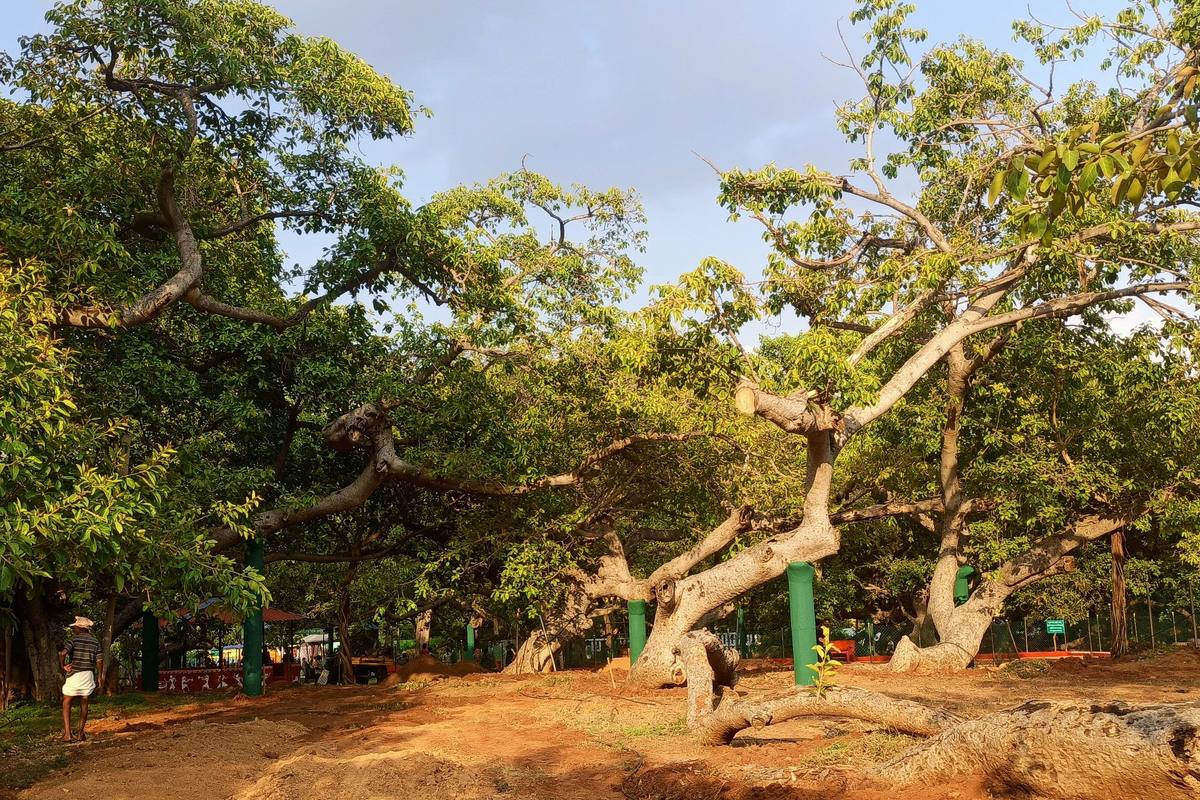
Lumpaka lived the way exiled men live. By day he hunted animals in the forest and ate their flesh; by night he slipped back into the city and stole valuables. He slept under an old banyan tree, not knowing that the tree happened to be very dear to Lord Vasudeva. The photograph below is that kind of tree — an eight-hundred-year-old banyan at Pillalamarri in Telangana, its branches come down to the ground and rooted again, so one tree looks like a whole forest.
Then Saphala Ekadashi arrived, and Lumpaka kept it without knowing he was keeping anything. On the night before, Dashami, the cold got into him through his scanty bedding and he could not sleep at all. By midday of Ekadashi he was too weak to hunt, too weak to stand, and the hunger was burning in his stomach. All he could do was gather the fruits that had fallen under the tree and offer them to the Lord — and then lie awake the whole night, because the hunger would not let him sleep.
That was the fast, kept in full and entirely by accident: no food, no sleep, fruit offered, a night awake under a tree dear to Vasudeva. And the next morning, as the sun rose on Dwadashi, a handsome horse walked up to him and stood beside him, and a voice from the sky said this horse was his — mount it, ride out of the forest, and go back to his family, because by the mercy of Vasudeva and the merit of the Saphala Ekadashi he had kept, his sins were destroyed and his kingdom would be returned to him without hindrance.
He rode back to Champavati, and the telling says he had become a handsome prince again, decorated with Vaishnava ornaments and tilak. His father gave him the kingdom, and he ruled it well for many years, married, had a son, kept every Ekadashi after that one, and in old age handed the kingdom to his son and went back to the forest to serve the Lord — and, purified of all material desire, left his body and returned home, to Goloka.
That is why the fast carries the name it does. Lumpaka did nothing right on purpose, and the day still gave him everything back: the kingdom, the family, the life. The telling adds two promises for those who hear it — that hearing the katha alone carries the merit of a Rajasuya yagya, and that staying awake through the night chanting Krishna's names carries the merit of five thousand years of austerity — and this page reports them as the telling's promises, not as its own.
The point of the story is not that accidents count. It is that the day itself does the work, whether you meant to keep it or not — which is a kinder thing to hear on the third day of January than most new-year advice.
How the fast is kept
The shape is the same shape as Utpanna Ekadashi and Dev Uthani Ekadashi, and anyone who kept those will recognise it. The day before, Dashami — Saturday 2 January in India, Friday 1 January in New York and Mexico City — take one simple sattvic meal and no food at night, and pluck the tulsi today, not on Ekadashi. On the morning of the fast, bathe before sunrise and take the sankalpa, the spoken resolve, before the image of Narayana.
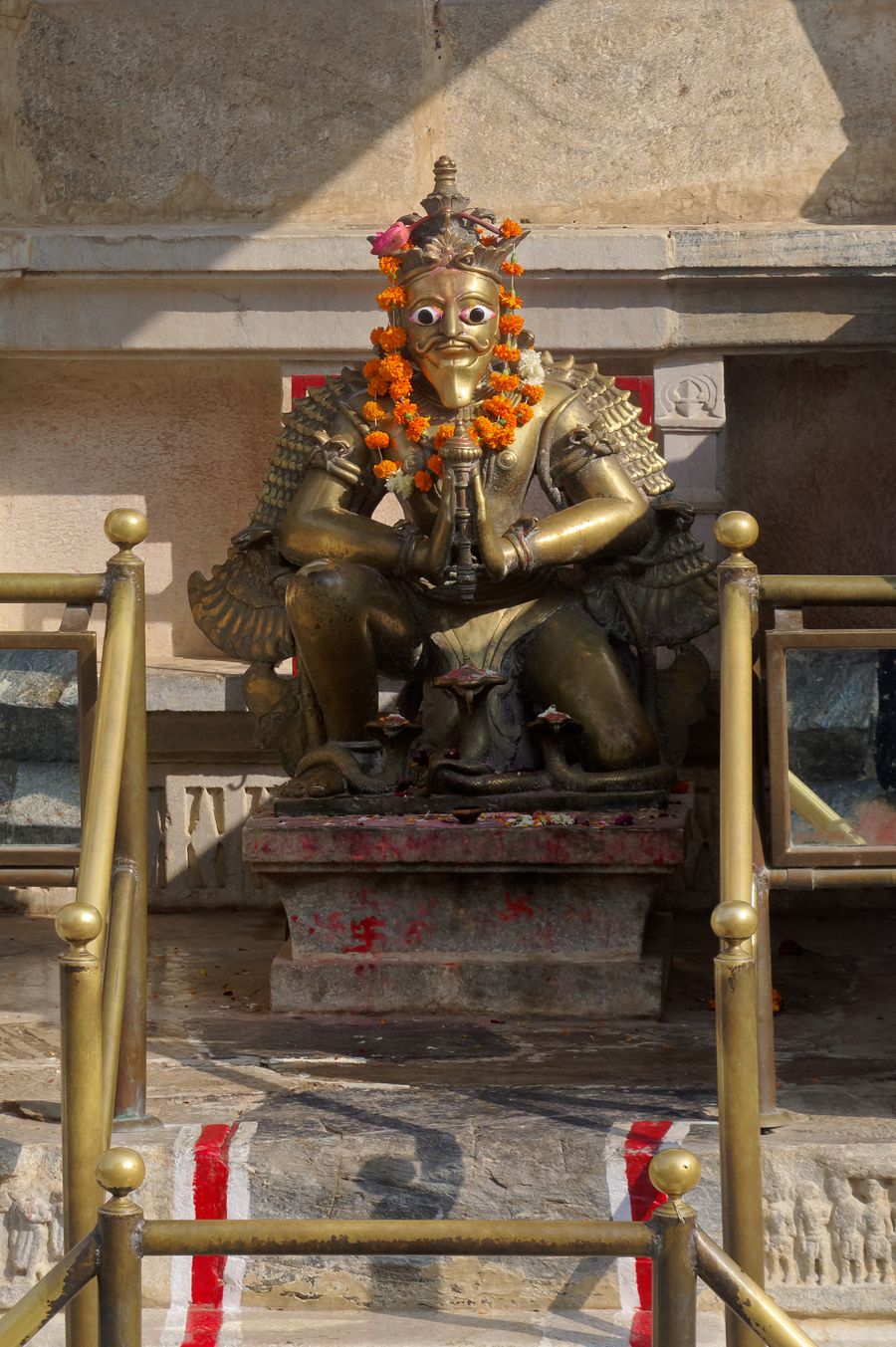
The fast itself is sunrise to sunrise. Drik's own pages list four grades of it: jalahar, water only; ksheerbhoji, milk and milk products; phalahari, fruit only; and naktabhoji, a single grain-free meal before sunset. Most households keep the fruit-and-milk version, with sabudana, singhara and potatoes, and no grain, no beans, no onion or garlic. On Saphala the offering that matters is fruit — fresh fruit to Narayana, in the morning, before anything else. The photograph below is the god of the day, Vishnu at the Jagdish Temple in Udaipur, crowned, four-armed, the club in his hand.
Through the day, the katha is read or heard, and those who keep the full night stay awake in Vishnu's names — jagaran — which the story itself prescribes: Lumpaka stayed awake because he could not sleep, and the telling counts it as part of the fast. The next morning, break the fast inside your city's Parana window, after feeding someone first and giving dana. That order matters: feed, give, then eat.
One more thing the day panchang notes: on Sunday 3 January, Drik also lists Krishna Matsya Dwadashi — the Dwadashi the fast breaks into — in New York, Berlin and Moscow. It is a small entry, but it is the day the Parana belongs to, and it is why the American Parana falls on Sunday afternoon rather than Monday morning.
Saphala Ekadashi 2027 in India
The fast is Sunday, 3 January. The Ekadashi tithi runs 2:24 PM on Saturday 2 January to 4:08 PM on Sunday 3 January, and Parana is Monday 4 January, 7:15 to 9:19 AM. Delhi's sunrise on the 3rd is 7:14 AM and sunset 5:37 PM, and the Brahma Muhurta runs 5:25 to 6:20 AM. Dwadashi ends at 6:15 PM on Monday.
Where India goes on this day
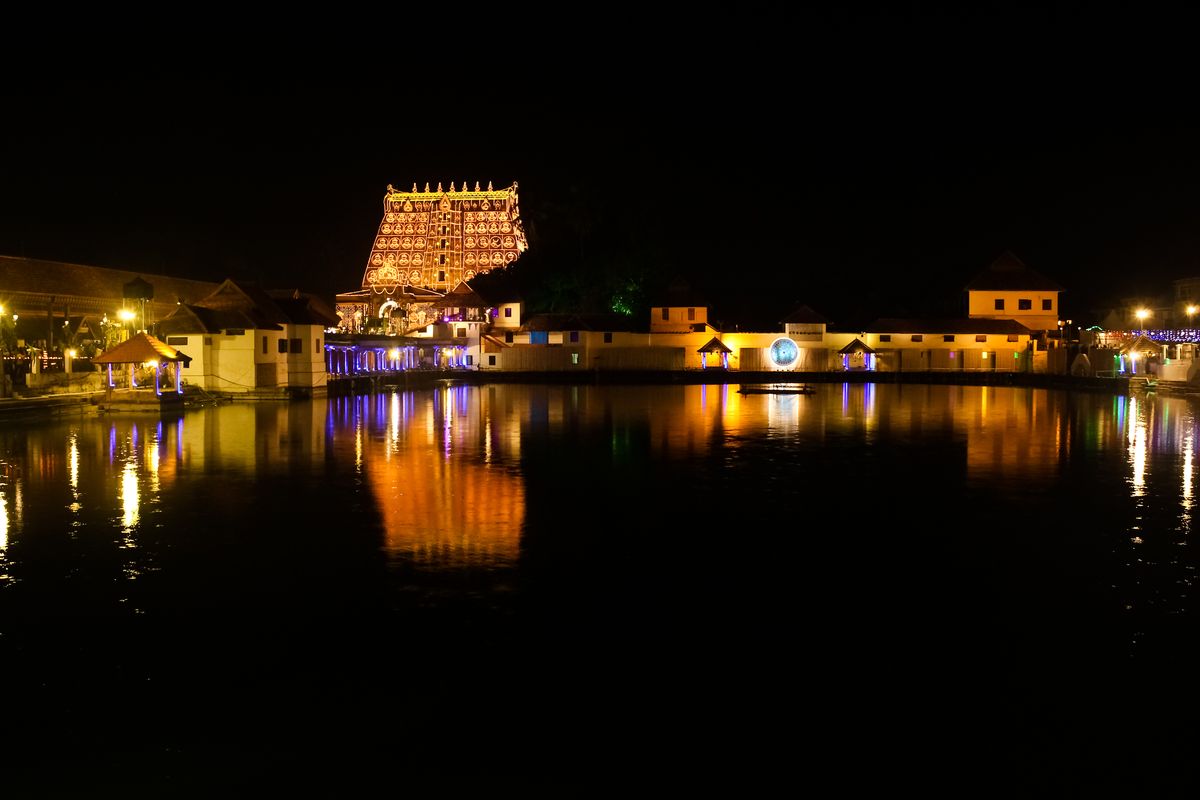
The photograph at the top of this page is the Sree Padmanabhaswamy Temple in Thiruvananthapuram, lit for Lakshadeepam — Vishnu asleep on Ananta, the richest and one of the oldest Vishnu temples in India, and the right picture for a fast whose god is Narayana. Most of India keeps this one at home, though: it is the first Sunday of the year, the house is still in holiday mood, and the fast needs a lamp, a verse and a day without grain. If you are near a Vishnu temple, go in the morning — the fast begins at sunrise, and the fruit offering is best made while the house is still quiet.
And one practical note for the new year: Dashami is Saturday 2 January, so the preparation day is a Saturday too. Do the shopping on Friday. The fruit for the offering, the sabudana, the milk — all of it is easier bought before the weekend starts.
Saphala Ekadashi 2027 in USA
The Smarta fast is Saturday, 2 January — a day earlier than India — and the Vaishnava fast is Sunday, 3 January. This is the city where the split matters most, because New York is the only one of the six where Drik lists both.
The tithi runs 3:54 AM on Saturday 2 January to 5:38 AM on Sunday 3 January. New York's sunrise on Saturday is 7:20 AM and sunset 4:40 PM, and the Brahma Muhurta is 5:23 to 6:21 AM. On Sunday the sunrise is 7:20 AM and sunset 4:41 PM.
Two fasts, two Paranas — do not mix them up
The Smarta Parana is Sunday 3 January, 12:57 to 2:49 PM, with Hari Vasara ending at 12:10 PM. The Vaishnava Parana is Monday 4 January, 7:20 to 7:45 AM — twenty-five minutes, and Dwadashi ends at 7:45 AM, so the window closes exactly when Dwadashi does. Set an alarm for that one. It is the narrowest Parana in this series.
So a Smarta household in New York fasts from Saturday sunrise, breaks the fast on Sunday afternoon, and is done. A Vaishnava household — and most ISKCON temples in America follow the Vaishnava calendar, so check your temple's announcement — fasts from Sunday sunrise and breaks it on Monday morning. Both are right. They are different fasts, and the mistake is assuming your neighbour's Parana is yours.
The practical shape that works: Saturday is the hard day, and it is a Saturday, which helps — no work, the katha in the afternoon, the fruit offering in the morning. A video call home on Saturday evening reaches India on Sunday morning, when Delhi families are just beginning the same fast. Both ends of the call are keeping Saphala; they are just a day apart on the calendar, and neither side is wrong.
Saphala Ekadashi 2027 in UK
The fast is Sunday, 3 January, the same day as India. The tithi runs 8:54 AM on Saturday 2 January to 10:38 AM on Sunday 3 January, and Parana is Monday 4 January, 8:06 to 9:42 AM. London's sunrise on Sunday is 8:06 AM and sunset 4:04 PM — just under eight hours of daylight — and the Brahma Muhurta runs 5:57 to 7:02 AM. Dwadashi ends at 12:45 PM on Monday.
The dark morning, again
London gives you the hardest version of the fast's first demand: the Brahma Muhurta ends at 7:02 AM, more than an hour before the sun comes up, so the bath and the sankalpa happen in full dark. The fruit offering is the part that travels best — a bowl of fruit set before the picture in the morning, while the house is still quiet. And the evening is short: sunset at 4:04 PM, so the lamp and the jagaran begin in the middle of the afternoon, which honestly suits a lamp-lit puja.
One small thing worth noting: the Parana window opens at 8:06 AM on Monday, exactly at sunrise. If you are up for the bath anyway, you are already there — but do not break the fast before the window opens, even by a minute.
Saphala Ekadashi 2027 in Germany
The fast is Sunday, 3 January, the same day as India. The tithi runs 9:54 AM on Saturday 2 January to 11:38 AM on Sunday 3 January, and Parana is Monday 4 January, 8:17 to 9:50 AM. Berlin's sunrise on Sunday is 8:17 AM and sunset 4:05 PM — seven hours and forty-eight minutes of daylight — and the Brahma Muhurta runs 6:07 to 7:12 AM. Dwadashi ends at 1:45 PM on Monday.
The shortest days of the series
Berlin's fast begins in darkness and the sun, when it comes, is up for less than eight hours. The morning puja happens in the dark, the fruit offering in the first grey light, and the evening lamp in the middle of the afternoon. January in Berlin does not give you much sun to work with, and this fast, which is mostly about a bath, a fruit and a lamp, is the one that minds least.
One practical note, the same one from the Dhanurmasam article: Germany has Ruhezeiten, and a 6 AM alarm and a running tap are still working hours for the neighbours. The home puja is quiet by nature — a lamp, a verse, a small bowl of fruit — which is one more reason this fast travels better than the noisy ones. If your temple stages a reading of the katha, it will be a temple affair, indoors, and the neighbours will never know.
Saphala Ekadashi 2027 in Mexico
The fast is Saturday, 2 January — a day earlier than India — and Mexico City is the simpler of the two American cases: Drik lists a single January entry here, no separate Vaishnava date, unlike New York.
The tithi runs 2:54 AM on Saturday 2 January to 4:38 AM on Sunday 3 January. Mexico City's sunrise on Saturday is 7:11 AM and sunset 6:10 PM, and the Brahma Muhurta is 5:27 to 6:19 AM.
The longest light of the six cities
Mexico City gets the most generous January day of the six: sunrise 7:11 AM, sunset 6:10 PM, nearly eleven hours of light. The Parana is Sunday 3 January, 1:47 to 3:59 PM, with Hari Vasara ending at 11:10 AM — an afternoon Parana, in daylight, which is a kinder version of New York's. And because the fast is on a Saturday, the whole thing fits inside the weekend: Dashami on Friday 1 January — New Year's Day itself, so the preparation meal is the holiday meal, kept simple — the fast on Saturday, the Parana on Sunday afternoon.
The Indian community in Mexico is small, and this is mostly a home observance there — which is fine, because a home observance is what this fast mostly is, even in Champavati, once you step outside the temple courtyard. The fast needs a lamp, a verse and a day without grain. Everything else is commentary. And the fruit offering fits the day well here: Saturday, a long light day, a bowl of fruit in the morning and the katha in the evening.
Saphala Ekadashi 2027 in Russia
The fast is Sunday, 3 January, the same day as India. The tithi runs 11:54 AM on Saturday 2 January to 1:38 PM on Sunday 3 January, and Parana is Monday 4 January, 8:58 to 10:25 AM. Moscow's sunrise on Sunday is 8:59 AM and sunset 4:09 PM — seven hours and ten minutes of daylight, the shortest day in this article — and the Brahma Muhurta runs 6:44 to 7:51 AM. Dwadashi ends at 3:45 PM on Monday.
A fast staged in the dark
Moscow's Brahma Muhurta ends more than an hour before the sun is up, and the sun, when it comes, is up for seven hours. The bath before sunrise happens in full dark, which is the traditional form anyway: the bath at dawn, in darkness, is how the old guides describe the start of a fast day. A Moscow January simply makes the description literal.
One small detail from Drik's own numbers: the Parana window opens at 8:58 AM on Monday, a minute before the 8:59 AM sunrise. Take the minute. Break the fast inside the window, after feeding someone first and giving dana, and do not rush it for the sake of a minute.
The evening puja is the same as everywhere else, and the time zones offer their usual small mercy: a video call home after the evening lamp reaches India at around 8:30 PM IST, when Delhi families are sitting down to their own evening after a day that began four hours earlier. Both ends of the call are keeping Saphala on the same Sunday — Moscow and Delhi agree on this one.
East of Moscow the timings shift with the time zones, as always. Your local temple or your own city's panchang is the authority there; Moscow's hours belong to Moscow.
What you'll need, roughly
A picture or idol of Narayana or Krishna — Vishnu, if your family keeps him by that name — flowers, tulsi, a lamp and oil. Fresh fruit for the offering, and fruit, milk, sabudana and potatoes for the fast, and nothing with grain in it. A copy of the katha to read or hear, and the story of Lumpaka to tell the children, because it is the one about a man who got everything back. Rice and jaggery for the Parana meal, and something to give away first: food for someone who needs it, and dana for the temple or a brahmana.
That is the entire list. Saphala is not a festival of shopping. It is a fast, a story, and a bowl of fruit — and a day kept at the start of the year, when the year still has room in it to bear fruit.
The Kartik–Margashirsha 2026 series: Diwali 2026 · Govardhan Puja 2026 · Bhai Dooj 2026 · Chhath Puja 2026 · Dev Uthani Ekadashi 2026 · Tulsi Vivah 2026 · Dev Diwali 2026 · Kalabhairav Jayanti 2026 · Utpanna Ekadashi 2026 · Margashirsha Amavasya 2026 · Vivah Panchami 2026 · Subrahmanya Shashthi 2026 · Dhanurmasam 2026 · Mokshada Ekadashi 2026 · Margashirsha Purnima 2026 · Akhuratha Sankashti Chaturthi 2026 · Sabarimala Mandala Pooja 2026 · Saphala Ekadashi 2027
Check your own city before you rely on any date here: the Hindu Panchang Calculator shows today’s tithi and festival dates for your location, the Hindu Date Converter converts between Gregorian and Hindu calendar dates, and this article on the astronomy behind the panchang explains how these calculations are actually made.
Photos: Sree Padmanabhaswamy Temple at night — JVN5871, CC BY-SA 4.0; Pillalamarri Banyan Tree, Telangana — Kavali Chandrakanth KCK, CC BY-SA 4.0; Vishnu at the Jagdish Temple, Udaipur — Jakub Hałun, CC BY-SA 4.0; all via Wikimedia Commons.
Timings follow Drik Panchang's city pages for New Delhi, New York, London, Berlin, Mexico City and Moscow, checked 17 November 2026 — festival pages for the tithi and Parana, day-panchang pages for 2 and 3 January for sunrise, sunset and Brahma Muhurta. Where Drik gives no separate Hari Vasara line (Delhi, London, Berlin, Moscow), this page quotes the Dwadashi end moment instead and says so. The Saphala katha is told in the Brahmanda Purana according to one source and the Bhavishya Uttara Purana according to another — the sources disagree, and this page names that. The fruit offering and the four grades of the fast follow Drik's Ekadashi guidance and the ISKCON telling of the katha. Your local temple's announcement overrides any website, including this one.