Pongal 2027 is Thursday 14 January abroad, Friday 15 January in India — four days, one Sun
Pongal 2027: Thai Pongal is Thu 14 Jan in New York, London, Mexico City and Fri 15 Jan in Delhi, Berlin, Moscow — Bhogi, Mattu and Kaanum dates, the pot and the cattle.
Pongal 2027 runs Wednesday 13 to Saturday 16 January in New York, London and Mexico City, and Thursday 14 to Sunday 17 January in Delhi, Berlin and Moscow. Thai Pongal, the main day, is Thursday, 14 January in the first group and Friday, 15 January in the second — because the Sun enters Makara at one single instant, 15:44 UTC on Thursday, 14 January, which is 9:14 PM in Delhi and 10:44 AM in New York, and where the moment falls after sunset the whole four-day festival moves a day later. This page gives you your city's dates for all four days, the sunrise your pot is cooked at, and what actually happens on each day: the bonfire, the boiling milk, the painted cattle, and the day out with the family.
Pongal 2027 at a glance
| Thai Pongal, New York / London / Mexico City | Thursday, 14 January 2027 |
| Thai Pongal, Delhi / Berlin / Moscow | Friday, 15 January 2027 |
| The Sankranti moment | 14 January everywhere — Delhi 9:14 PM, Moscow 6:44 PM, Berlin 4:44 PM, London 3:44 PM, New York 10:44 AM, Mexico City 9:44 AM (15:44 UTC) |
| Bhogi (day before Thai Pongal) | Wed 13 Jan in New York, London, Mexico City; Thu 14 Jan in Delhi, Berlin, Moscow |
| Mattu Pongal (day after Thai Pongal) | Fri 15 Jan in New York, London, Mexico City; Sat 16 Jan in Delhi, Berlin, Moscow |
| Kaanum Pongal (last day) | Sat 16 Jan in New York, London, Mexico City; Sun 17 Jan in Delhi, Berlin, Moscow |
| Punya Kaal, Delhi | 7:15 AM–5:46 PM on Fri 15 Jan; Maha Punya Kaal 7:15–9:00 AM |
| Punya Kaal, New York | 10:44 AM–4:52 PM on Thu 14 Jan; Maha Punya Kaal 10:44 AM–12:20 PM |
| Punya Kaal, London | 3:44–4:19 PM on Thu 14 Jan — only 35 minutes |
| Punya Kaal, Berlin | 8:10 AM–4:22 PM on Fri 15 Jan; Maha Punya Kaal 8:10–9:32 AM |
| Punya Kaal, Mexico City | 9:44 AM–6:18 PM on Thu 14 Jan; Maha Punya Kaal 9:44–11:35 AM |
| Punya Kaal, Moscow | 8:50 AM–4:28 PM on Fri 15 Jan; Maha Punya Kaal 8:50–10:06 AM |
| The night before | Lohri — same day as Bhogi in every city |
| The same day, under another name | Makar Sankranti 2027 — Thai Pongal is the Tamil name for it |
Three honest wrinkles before anything else. First, the split is real and it is Drik's own: the festival pages for every city give the same moment, 14 January, and then observe it on the 14th where the moment falls in daylight and on the 15th where it falls after sunset. And the shift moves all four days, not just the main one — so if your family group chat says "Pongal is the 14th" and your cousin in Chennai says "the 15th", both of you are right, for your own cities, and both of you are a day apart on Mattu and Kaanum too.
Second, Drik lists no cooking muhurat for Pongal. The Thai Pongal page gives the date and the Sankranti moment and nothing else — no window for boiling the pongal. This page does not invent one. The tradition is to cook at sunrise, outdoors, so the sunrise time for your city is the honest guide, and the Punya Kaal from the Makar Sankranti page — the same day, the same moment — is the auspicious window around it. London's whole window is thirty-five minutes, 3:44 to 4:19 PM, which is worth knowing before you plan the afternoon.
Third, some printed calendars mark Thai Pongal on 14 January in India, and the Tamil Nadu holiday list was reported both ways in October 2026 before settling on Friday the 15th, with Thiruvalluvar Day on Saturday the 16th and Uzhavar Thirunal on Sunday the 17th. This page follows Drik, which puts India on the 15th because the moment falls after sunset, and names the disagreement: if your printed calendar says the 14th, check with your local temple before you fix the pot.
One more, smaller than the others. Drik's day panchang for 15 January in Delhi lists no festival name at all in the text as fetched — only "Makara" as a rashi and a lagna. The dedicated Pongal festival pages are the authority this page follows, and the day panchang corroborates them independently: sunrise 7:15 AM, sunset 5:46 PM, Brahma Muhurta 5:27 to 6:21 AM, and the Sun in Makara from the start of the day, because the change happened at 9:14 PM the previous evening.
What Pongal actually is
It is the Tamil harvest festival, and the one big Hindu festival that follows the Sun instead of the Moon. Thai Pongal is the first day of the Tamil month of Thai, the day the Sun enters Makara and starts Uttarayan, its six-month northward journey. The days get longer from here, the winter harvest is in, and the whole festival is a thank-you to the Sun and to the cattle and to the land, said with food.
The word itself tells you the ritual. Pongal means to boil over. Fresh rice is cooked with fresh milk and jaggery in a new clay pot until it spills over the rim, and the overflow is the point — it is the sign of abundance, of a year that will spill over too. When the milk rises and runs down the side of the pot, everyone shouts "Pongalo Pongal!", and that shout is the festival.
It is four days, not one, and the four days are the whole story: clear out the old, thank the Sun, thank the cattle, then go out with the family. In Andhra Pradesh and Telangana the same four days are Bhogi, Pedda Panduga, Kanuma Panduga and Mukkanuma. In Tamil Nadu they are Bhogi, Thai Pongal, Mattu Pongal and Kaanum Pongal, and the rest of this page takes them in order.
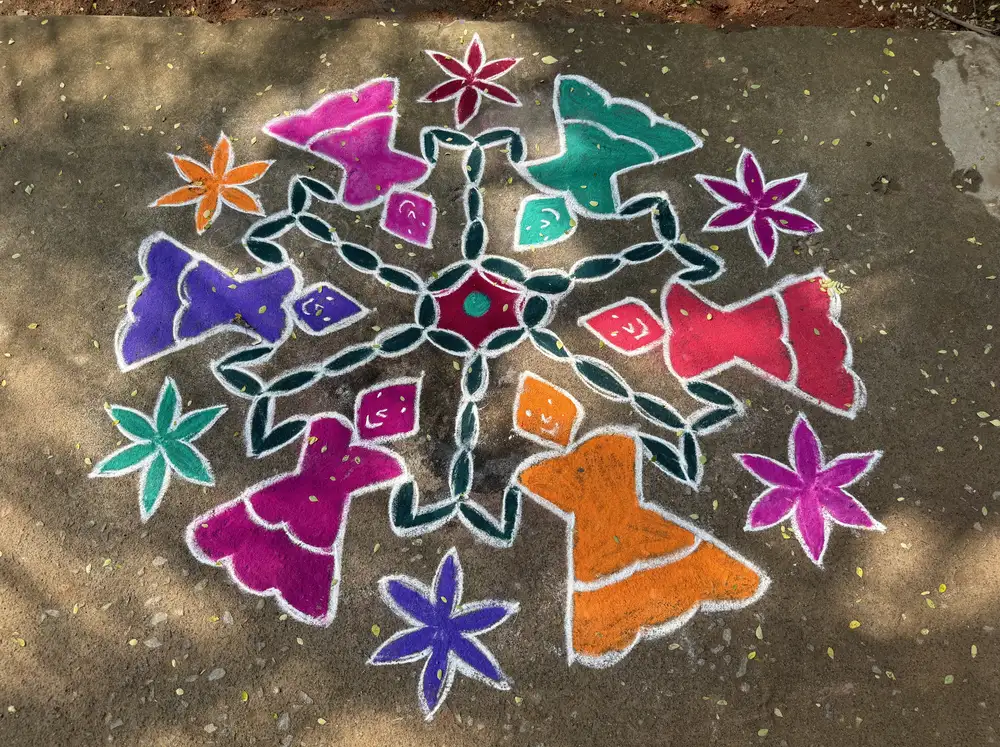
The photograph above is the first thing you see on Pongal morning: the kolam, drawn in rice flour at the entrance, fresh every morning of the festival. This one is from Kuilapalayam, in Tamil Nadu, drawn for Pongal in January 2024 — the colours are powder, the lines are rice flour, and the whole thing will be walked over by evening and drawn again tomorrow.
Bhogi — the day before, and the bonfire
Bhogi is the clearing-out. The house is cleaned, the old and derelict things — broken furniture, worn-out clothes, anything that has outlived its use — are gathered up, and before dawn a bonfire is lit, the Bhogi Mantalu, and the old things are offered to it. Crackers go off early in the morning, the house smells of smoke and fresh paint, and the sweets are made in quantity and shared round the neighbours.
It is the same day as Lohri in every city — Wednesday 13 January in New York, London and Mexico City, Thursday 14 January in Delhi, Berlin and Moscow — because both are the night before the same Sankranti. Different fires, same evening.
In Telugu families Bhogi has its own children's rite, Bhogi Pallu. Children between three and six are showered with Regi Pallu — Indian jujube fruit — mixed with soaked black gram, flower petals, pieces of sugarcane, jaggery and coins, to protect them from the evil eye and bless them with abundance and a long life. The girls wear langa-voni, the boys are dressed up, and the fruit rains down on their heads while the elders watch. Ariselu Adugulu goes with it: ariselu, rice sweets, are laid on the floor and the smallest children are asked to walk on them, to mark the occasion of their first steps.
Thai Pongal — the pot, the Sun, the shout
This is the main day, and it starts at sunrise. A new clay pot — a turmeric plant tied round it, a stalk of sugarcane leaning against it — is set over a wood fire outdoors, in the courtyard or the garden or, abroad, on the balcony with a small stove. Freshly harvested rice goes in with fresh milk and jaggery, and the family stands round and watches the milk. When it rises and spills over the rim, the shout goes up: "Pongalo Pongal!"
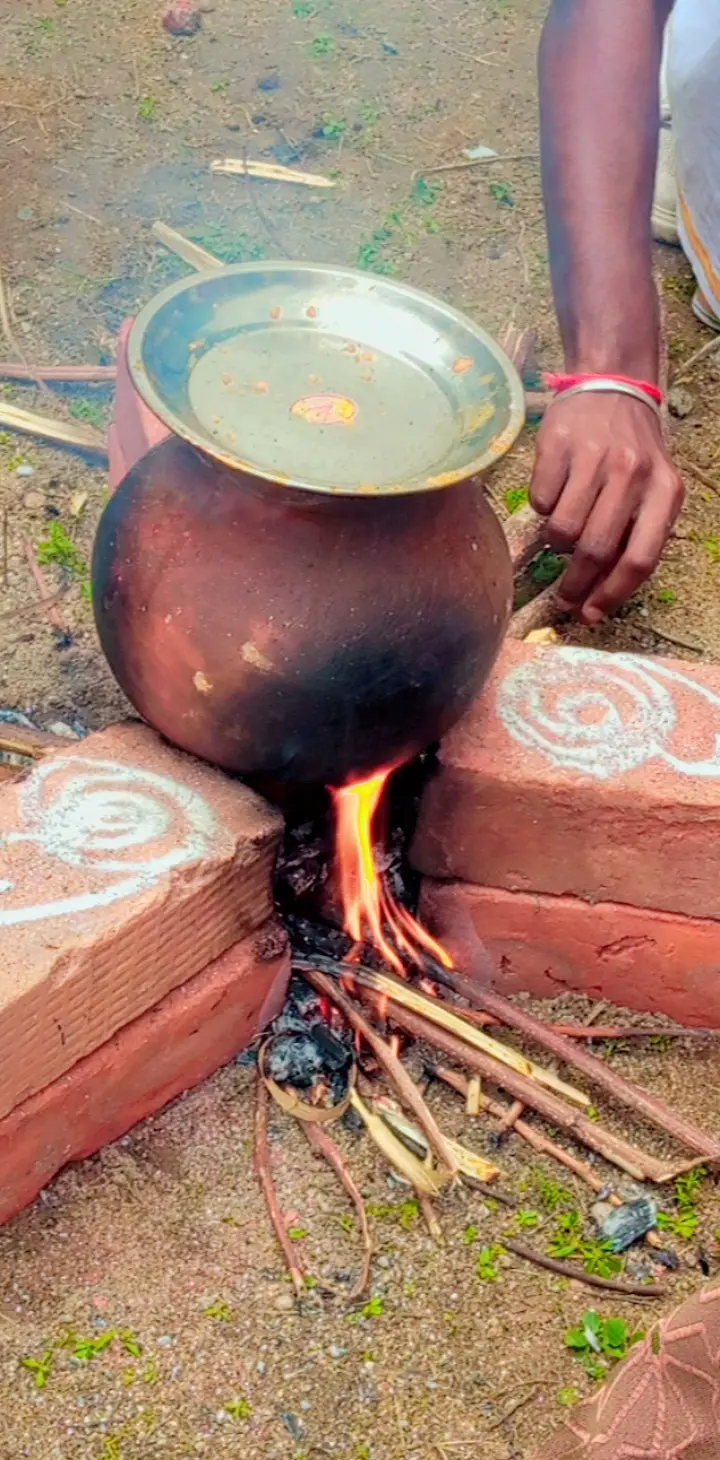
The photograph above is the pot itself, over a wood fire between bricks marked with kolam. It is not a display piece. The pot is blackened from the fire, the plate on top is an ordinary steel plate, and the hand at the edge of the frame is feeding the fire. That is what the morning looks like.
Drik puts the cooking plainly: the rice, milk and jaggery are boiled in the new clay pot, the milk is let spill over as an auspicious sign of material abundance and prosperity, and the cooked pongal is topped with brown sugar, ghee, cashew nuts and raisins. It is offered first to Surya, the Sun God, in thanks for the harvest, and then served on banana leaves to everyone present. Traditionally it is cooked at sunrise, in an open place — and the sunrise times are in the table at the top of this page, because Drik gives no separate cooking window and this page will not invent one.
The meal that follows is the festival on a plate. Sakkarai pongal, the sweet one, and ven pongal, the savoury one made with moong dal, pepper and cumin, served with ezhu kari kootu — the seven-vegetable curry — and vada, and sugarcane to chew on afterwards. The sugarcane is not a garnish; it is one of the harvest crops, and the stalks are tied to the pot and offered with the rice.
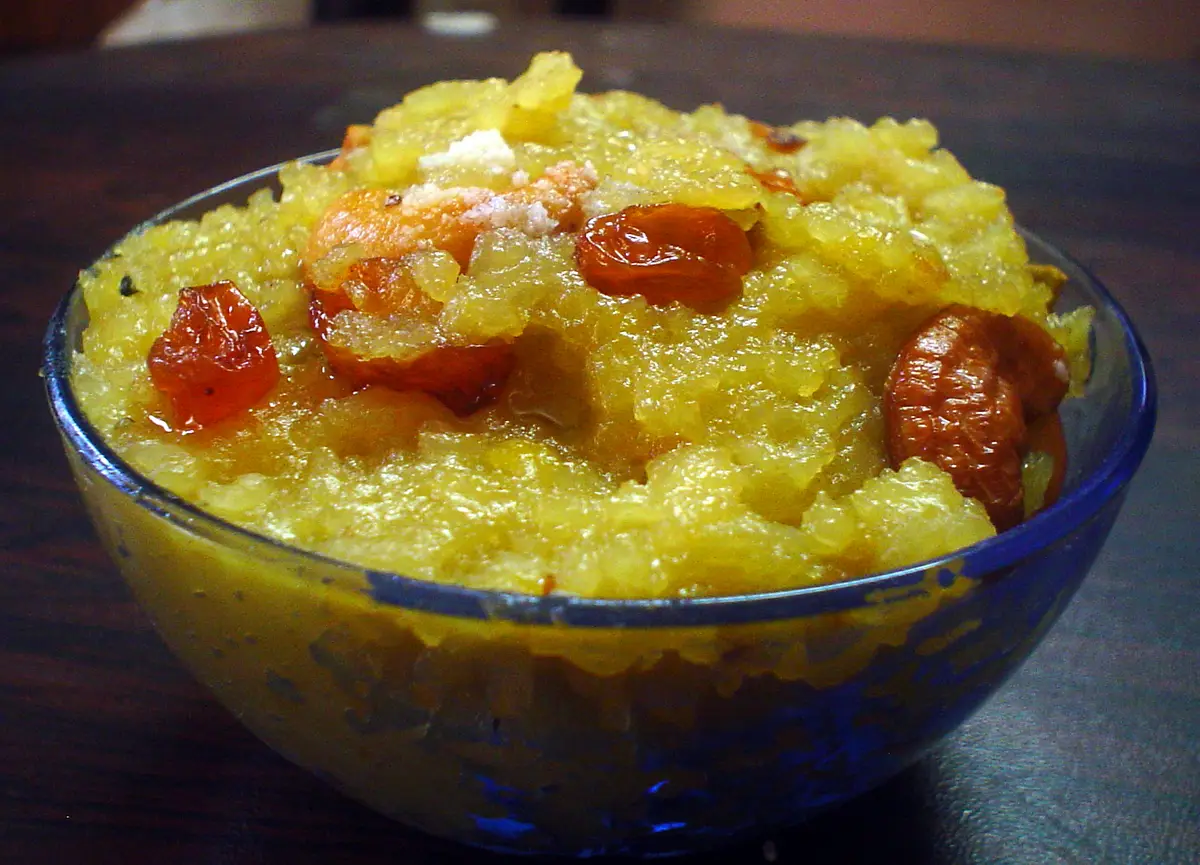
The photograph above is the sweet itself: sakkarai pongal in a bowl, cashews and raisins on top, jaggery giving it the colour. It is the first thing offered to the Sun and the first thing eaten, and it tastes of the morning it was cooked in.
Mattu Pongal — the cattle
The day after Thai Pongal belongs to the animals that did the work. The cows and bulls are bathed, their horns painted, garlands round their necks, bells and coloured powders, and they are worshipped for their part in the harvest. In the villages they are fed pongal and taken in procession, and the whole day is a thank-you to livestock — mattu means cattle, and the day is theirs.
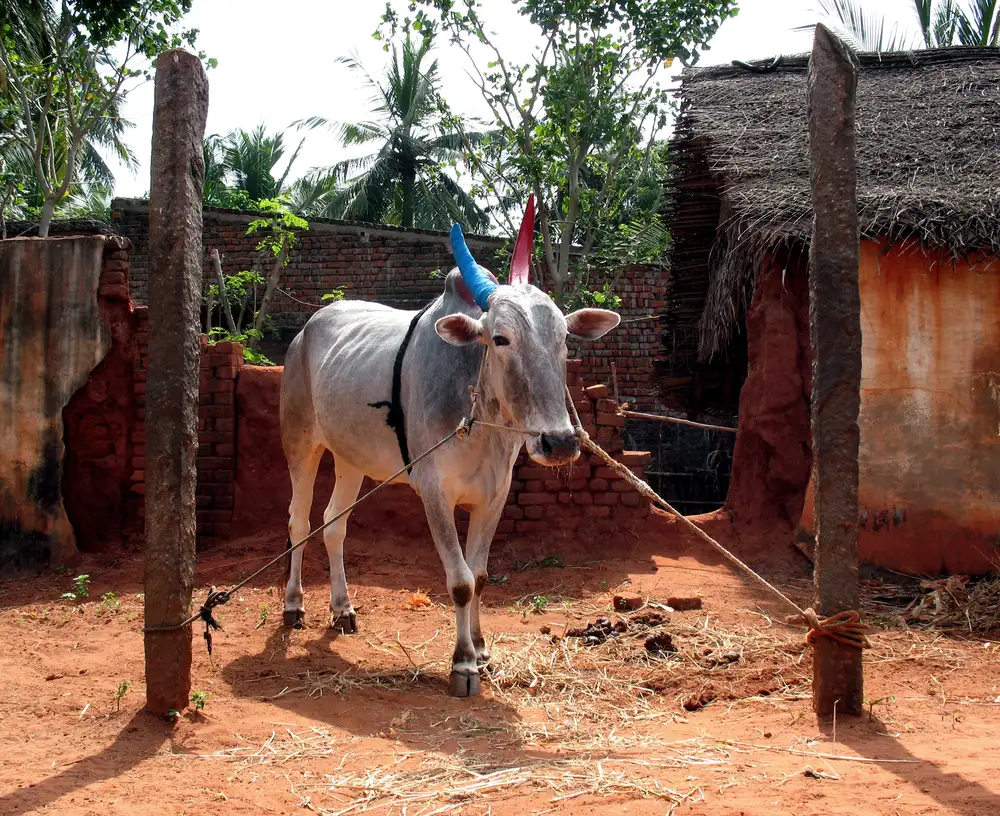
The photograph above is a cow in a Puducherry village, horns painted blue and red, tethered between two stone posts on red earth, with a thatched hut behind her. She is not decorated for a photograph. The paint is the festival.
And then there is Jallikattu, the bull-taming sport that Drik itself names on the Mattu Pongal page. It is held on this day in Tamil Nadu, most famously at Alanganallur, Palamedu and Avaniyapuram near Madurai, where a bull is released into a crowd and young men try to hold on to its hump. It is old, it is dangerous, and it is the part of the festival that makes the news every year.
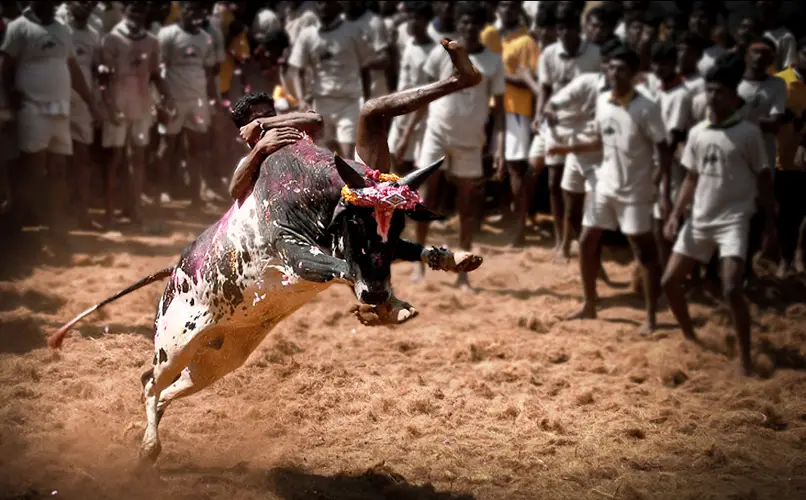
The photograph above is Alanganallur: a bull mid-leap, a youth holding on, the crowd behind them in the dust. It is not a tame tradition, and this page does not pretend it is. If you are in Madurai on Mattu Pongal, you will hear it before you see it.
Kaanum Pongal — the day out
Kaanum means to see, or to visit, and the last day is exactly that. No more cooking, no more ritual at dawn. The families go out — to parks and beaches, to relatives' houses, to the elders to pay homage and receive a little token money in return. In Chennai the beaches fill with families, and the day ends with everyone tired and full and together, which is the point.
For sisters the day holds a small rite, Kanu Pidi — sometimes called Kaka Pidi, Kanu Pidi. The women of the house assemble in the courtyard before bathing, rice is placed on a turmeric leaf, and they pray for the prosperity of their brothers' houses and families. Arati is performed for the brothers with turmeric water, limestone and rice, and the water is sprinkled on the kolam in front of the house. Small balls of coloured rice are set out on turmeric leaves with betel leaves, betel nuts and sugarcane, and left for the crows — if a crow comes and eats the offering, it is taken as good fortune.
Two honest notes here. The sister's rite is kept in some households, not all, and the sources differ on whether it belongs to Kaanum morning or Mattu morning. Drik's own Kaanum page says only that it is "time for family reunions in Tamil Nadu", so this page does not present the rite as a universal rule. And the crow offering is not a Pongal invention — many South Indian households set out the first bit of rice for the crows every day. Pongal just makes a festival of it.
Kaanum Pongal is also Thiruvalluvar Day in Tamil Nadu — Uzhavar Thirunal, the farmers' festival — which is why the state holiday list gives it its own name on Sunday the 17th. The poet and the farmer share the last day, and neither is the wrong name for it.
Pongal 2027 in India
Pongal is Friday, 15 January in India. The moment is 9:14 PM on Thursday, 14 January, after sunset, so everything moves to the Friday morning: Punya Kaal 7:15 AM to 5:46 PM, Maha Punya Kaal 7:15 to 9:00 AM. Delhi's sunrise on the 15th is 7:15 AM and sunset 5:46 PM, and the Brahma Muhurta runs 5:27 to 6:21 AM. The four days run Thursday 14 to Sunday 17 January: Bhogi on the 14th, Thai Pongal on the 15th, Mattu Pongal on Saturday the 16th, Kaanum Pongal on Sunday the 17th.
Where India keeps it
In Tamil Nadu the sequence runs across the four days as described above: the bonfire before dawn on Bhogi, the pot at sunrise on Thai Pongal, the cattle on Mattu Pongal, the beaches and the family visits on Kaanum Pongal. The Jallikattu at Alanganallur, Palamedu and Avaniyapuram runs on Mattu Pongal, Saturday the 16th. In Chennai, Marina Beach fills on Kaanum Pongal, Sunday the 17th, and the kolam competitions run through the week. In Andhra Pradesh and Telangana the same four days are Bhogi, Pedda Panduga, Kanuma Panduga and Mukkanuma, with Bhogi Pallu for the small children.
The same day is Makar Sankranti across the rest of India — the kites in Gujarat, the pithas in Bengal, the khichdi in Uttar Pradesh — and the Magh Mela opens at Prayagraj on Friday the 15th with the first snan of the season. One Sun, one crossing, half a dozen names, and every one of them is the same day.
Pongal 2027 in USA
Pongal is Thursday, 14 January — a day earlier than India, because the moment falls at 10:44 AM in New York, in full daylight. Punya Kaal runs 10:44 AM to 4:52 PM, Maha Punya Kaal 10:44 AM to 12:20 PM. New York's sunrise on the 14th is 7:18 AM and sunset 4:52 PM, and the Brahma Muhurta is 5:23 to 6:20 AM. The four days run Wednesday 13 to Saturday 16 January: Bhogi on the 13th, Thai Pongal on the 14th, Mattu Pongal on Friday the 15th, Kaanum Pongal on Saturday the 16th.
The pot on the Thursday, the party on the Saturday
The practical shape abroad is the one the Tamil community has settled on, and it is the same split as the festival itself: the pot is boiled on the Thursday, in the window Drik gives, and the community celebration falls on the Saturday closest to it. The Tamil sangams — the Federation of Tamil Sangams of North America is the umbrella body, and the Chicago Tamil Sangam has existed since 1969 — hold Pongal programmes on the nearest weekend, with parai performances, cultural competitions and food, and the temples hold their own programmes: the Hindu Temple Society's Ganapati temple in Flushing, New York, the Venkateswara temple in Pittsburgh, the Malibu Hindu Temple in California.
At home it is all four days, kept properly: a Boston family that spoke to DT Next put it plainly — "we celebrate not just one day, but the four days, from Bhogi, till Kaanum Pongal" — with the preparations done the day before, the pongal cooked in the morning, and a glimpse of Surya Bhagavan before the eating starts. The kolam goes at the door, the pot boils until it overflows, and the shout is the same as in Madurai: "Pongalo Pongal!"
A video call home on Thursday evening reaches Chennai on Friday morning, before their pot is lit: your Pongal is already done, and theirs is just beginning. Both are the same festival, on different days, and neither side is wrong. Check your local sangam or temple's website in early January for this year's programme — none had published a 2027 programme when checked in November, and this page will not invent one.
Pongal 2027 in UK
Pongal is Thursday, 14 January, a day earlier than India, like New York. The moment is 3:44 PM, and here is the number to remember: Punya Kaal is 3:44 to 4:19 PM — thirty-five minutes, because the Sun sets at 4:19 PM. Maha Punya Kaal is the same thirty-five minutes. London's sunrise on the 14th is 8:00 AM and the Brahma Muhurta runs 5:55 to 6:58 AM. The four days run Wednesday 13 to Saturday 16 January.
Thirty-five minutes, so cook in the morning
This is the sharpest practical detail in the whole article, and it belongs to London alone. Every other city gets hours; London gets half an hour, at the end of the working day, in the middle of January. But the pot is not the Punya Kaal. The pot is cooked at sunrise — 8:00 AM, a civilised hour even in January — and the offering is made in the morning, so the short window in the afternoon is not the disaster it looks like. Cook at sunrise, offer in the morning, and use the 3:44 to 4:19 window for the prayer and the daan. If you are keeping it properly, take the afternoon off anyway, or arrange to be home by half past three.
January is Tamil Heritage Month in London — the London Assembly agreed the motion unanimously in December 2021, and boroughs mark it, Waltham Forest among them, with a Pongal flag hoisting and a harvest celebration where the community gathers to cook and share the sweet rice dish. The temples keep the festival too: the London Sri Murugan Temple in Manor Park, east London; the Highgate Hill Murugan Temple in north London, whose trust bought its Archway Road site in 1977 and consecrated the temple in 1986; the Shri Venkateswara (Balaji) Temple at Tividale in the West Midlands, serving South Indian families across the Birmingham area. The community celebrations, like everywhere else abroad, fall on the nearest weekend — check your temple's website in early January for this year's programme.
Pongal 2027 in Germany
Pongal is Friday, 15 January, the same day as India — Berlin is on the Delhi side of the split. The moment is 4:44 PM on Thursday, 14 January, and Punya Kaal runs 8:10 AM to 4:22 PM on Friday, with Maha Punya Kaal 8:10 to 9:32 AM. Berlin's sunrise on the 15th is 8:10 AM and sunset 4:22 PM, and the Brahma Muhurta runs 6:03 to 7:07 AM. The four days run Thursday 14 to Sunday 17 January.
A quiet Friday morning
Germany's Indian community is smaller than London's or New York's, and the celebration is usually a family or temple affair, indoors. No Pongal-specific community programme for Berlin was found for 2027 when this page was checked, and this page will not invent one — check your local temple's notice in early January. The same note from the Lohri article applies here too: Germany has Ruhezeiten, and a festival that starts before dawn is not a neighbourly proposition at full volume. The pot is cooked on a stove on the balcony or in the kitchen, the kolam is drawn at the door, the pongal is offered at the window facing the rising Sun, and the call home after the morning reaches Chennai at around midday, when the pot there is already boiling. Both ends of the call are keeping Pongal on the same day — Berlin and Delhi agree on the 15th — and the Sun on the screen is the same Sun.
Pongal 2027 in Mexico
Pongal is Thursday, 14 January, a day earlier than India, like New York and London. The moment is 9:44 AM, and Punya Kaal runs 9:44 AM to 6:18 PM — the longest window of the six cities, eight and a half hours. Maha Punya Kaal is 9:44 to 11:35 AM. Mexico City's sunrise on the 14th is 7:13 AM and sunset 6:18 PM, and the Brahma Muhurta runs 5:30 to 6:21 AM. The four days run Wednesday 13 to Saturday 16 January.
The most generous morning of the six
Mexico City gets the easiest version of the festival: more than eleven hours of daylight, a 6:18 PM sunset, and a mild January morning. The Indian community is small, so the celebration is usually a family gathering, and no Pongal-specific community programme for Mexico City was found for 2027 — check your local temple's notice in early January. But the observance itself is the least constrained of any city in this article: the pot at sunrise, the offering in the morning, the cattle honoured on Friday the 15th, the family day out on Saturday the 16th, and nobody freezing and nobody watching the clock. It is the one city where the whole four days fit comfortably into four days, and the video call home on Thursday evening reaches Chennai on Friday morning, before their pot is lit.
Pongal 2027 in Russia
Pongal is Friday, 15 January, the same day as India — Moscow is on the Delhi side of the split. The moment is 6:44 PM on Thursday, 14 January, and Punya Kaal runs 8:50 AM to 4:28 PM on Friday, with Maha Punya Kaal 8:50 to 10:06 AM. Moscow's sunrise on the 15th is 8:50 AM — the latest of the six — and sunset is 4:28 PM, so the Sun is up for less than eight hours. The Brahma Muhurta runs 6:39 to 7:44 AM. The four days run Thursday 14 to Sunday 17 January.
A pot on the stove, a lamp at the window
A Moscow January is the closest any city in this article comes to the winter morning the festival describes, and the pot is cooked indoors, on the stove, before a sunrise that does not come until nearly nine. The kolam is drawn at the door in coloured powder, the pongal is offered at the window facing a Sun that rises low and late, and the family day out on Sunday the 17th is a walk in the snow rather than a beach. No Pongal-specific community programme for Moscow was found for 2027 — check your local temple's notice in early January. The call home after the morning reaches Chennai at around midday, when their pot is already boiling. Both ends of the call are keeping Pongal on the same day — Moscow and Delhi agree on the 15th — and the Sun on the screen is the same Sun, a day's warmth carried across four time zones.
East of Moscow the timings shift with the time zones, as always. Your local temple or your own city's panchang is the authority there; Moscow's hours belong to Moscow.
What you'll need, roughly
A new clay pot, or a clean steel one if clay is not to be had — the pot matters, but the overflow matters more. Fresh rice, fresh milk, jaggery, a turmeric plant to tie round the pot, a stalk of sugarcane. Ghee, cashew nuts and raisins for the topping, moong dal, pepper and cumin for the ven pongal, seven vegetables for the ezhu kari kootu, and banana leaves to serve on. Rice flour and coloured powder for the kolam, and a brass lamp for the offering. For Mattu Pongal, paint and garlands for the cattle — or, abroad, a photograph of the family cow, which is what most families do. For Kaanum Pongal, nothing but the family and a day out.
That is the entire list. Pongal is not a festival of shopping. It is a pot that boils over, an offering to the Sun, something sweet eaten off a banana leaf — and four days kept in the company of people who know what the overflow is for.
The Kartik–Margashirsha 2026 series: Diwali 2026 · Govardhan Puja 2026 · Bhai Dooj 2026 · Chhath Puja 2026 · Dev Uthani Ekadashi 2026 · Tulsi Vivah 2026 · Dev Diwali 2026 · Kalabhairav Jayanti 2026 · Utpanna Ekadashi 2026 · Margashirsha Amavasya 2026 · Vivah Panchami 2026 · Subrahmanya Shashthi 2026 · Dhanurmasam 2026 · Mokshada Ekadashi 2026 · Margashirsha Purnima 2026 · Akhuratha Sankashti Chaturthi 2026 · Sabarimala Mandala Pooja 2026 · Saphala Ekadashi 2027 · Magh Mela 2027 · Lohri 2027 · Makar Sankranti 2027 · Pongal 2027
Check your own city before you rely on any date here: the Hindu Panchang Calculator shows today’s tithi and festival dates for your location, the Hindu Date Converter converts between Gregorian and Hindu calendar dates, and this article on the astronomy behind the panchang explains how these calculations are actually made.
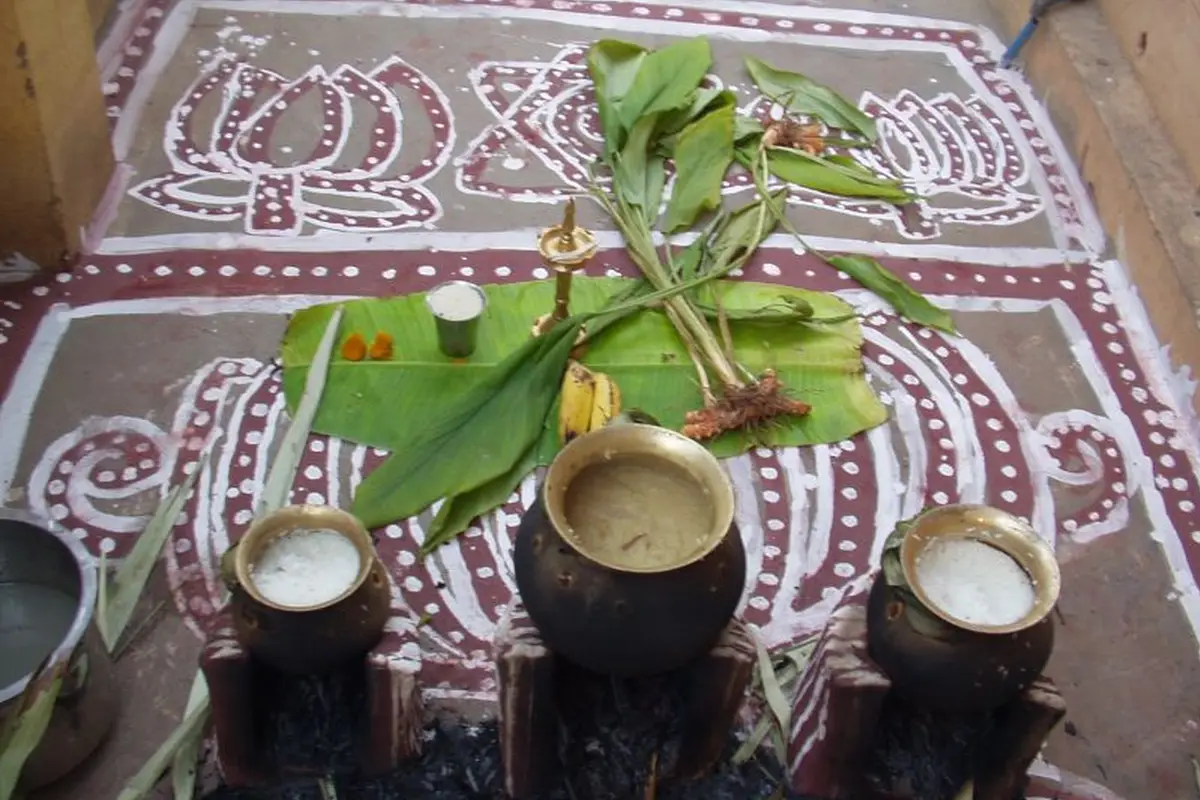
Photos: Three pongal pots on a kolam, 15 January 2007 — Kamala Lakshminarayanan, CC BY-SA 2.0; Clay pongal pot over a wood fire — Bharmitha Selvaraj, CC0; Cow with painted horns, Puducherry village — Alex Graves, CC BY-SA 2.0; Jallikattu at Alanganallur, Madurai — Iamkarna, CC BY 3.0; Sakkarai pongal — Balamurugan Natarajan, CC BY 2.0; Pongal kolam, Kuilapalayam, Tamil Nadu — Satdeep Gill, CC BY-SA 4.0; all via Wikimedia Commons.
Timings follow Drik Panchang's Thai Pongal, Mattu Pongal, Kaanum Pongal and Bhogi Pandigai festival pages for New Delhi, New York, London, Berlin, Mexico City and Moscow, checked 19 November 2026, with Punya Kaal from Drik's Makar Sankranti festival page for the same day and moment, and sunrise, sunset and Brahma Muhurta from Drik's day-panchang pages for the observance day in each city. Drik lists no Pongal cooking muhurat; the sunrise times are given instead and no window has been invented. Some printed calendars mark Thai Pongal on 14 January in India; this page follows Drik, which puts India on 15 January, and names the disagreement. The day panchang text as fetched lists no festival name for 15 January in Delhi; the dedicated festival pages are the authority followed here. No 2027 community Pongal programme had been published for any city when checked in November 2026; check your local sangam or temple's website in early January. Your local temple's announcement overrides any website, including this one.