Margashirsha Purnima 2026 is Wednesday 23 December — with Dattatreya Jayanti, and a moon that touches no sunrise
Margashirsha Purnima 2026 is Wednesday, 23 December — vrat, moonrise and Dattatreya Jayanti in India, USA, UK, Germany, Mexico and Russia. The kshaya tithi, the Hyderabad split, Annapurna Jayanti and Arudra Darshan on 24 December.
Margashirsha Purnima 2026 is Wednesday, 23 December, in India, America, Britain, Germany and Russia — the vrat, the full moon, and Dattatreya Jayanti all on the same day. The moon rises in Delhi at 4:41 PM, and the puja is done in the evening, once the Purnima is established.
That is the date. The rest of this page is the wrinkle underneath it, because this Purnima has one: the tithi begins at 10:47 AM on Wednesday and ends at 6:57 AM on Thursday, and Delhi's sunrise is 7:11 AM on both days. The full moon touches no sunrise at all. And in Hyderabad the same tithi is read the other way round — vrat on Wednesday, Purnima day on Thursday — which is why this article gives both readings instead of pretending there is only one.
Margashirsha Purnima 2026 at a glance
| Purnima vrat | Wednesday, 23 December 2026, all six cities and Hyderabad |
| Dattatreya Jayanti | Wednesday, 23 December 2026, everywhere |
| Purnima tithi, Delhi | 10:47 AM Wed 23 Dec – 6:57 AM Thu 24 Dec |
| Purnima tithi, New York | 12:17 AM – 8:27 PM Wed 23 Dec |
| Purnima tithi, London | 5:17 AM Wed 23 Dec – 1:27 AM Thu 24 Dec |
| Purnima tithi, Berlin | 6:17 AM Wed 23 Dec – 2:27 AM Thu 24 Dec |
| Purnima tithi, Mexico City | 11:17 PM Tue 22 Dec – 7:27 PM Wed 23 Dec |
| Purnima tithi, Moscow | 8:17 AM Wed 23 Dec – 4:27 AM Thu 24 Dec |
| Moonrise, Delhi | 4:41 PM, Wed 23 Dec |
| Moonrise, New York | 4:04 PM, Wed 23 Dec |
| Moonrise, London | 2:57 PM, Wed 23 Dec |
| Moonrise, Berlin | 2:53 PM, Wed 23 Dec |
| Moonrise, Mexico City | 5:55 PM, Wed 23 Dec |
| Moonrise, Moscow | 2:44 PM, Wed 23 Dec |
| Annapurna Jayanti | Wed 23 Dec in Delhi and all six cities; Thu 24 Dec in Hyderabad |
| Arudra Darshan | Thursday, 24 December 2026, everywhere |
| Hyderabad split | Vrat Wed 23 Dec; Purnima festival day Thu 24 Dec |
| The month | Margashirsha, Shukla Paksha (bright fortnight), Purnima |
| The deities | Vishnu as Satyanarayan; Dattatreya; Annapurna; Shiva as Nataraja (24 Dec) |
The wrinkle first: a Purnima that touches no sunrise
Most festival dates are decided by which tithi is running at sunrise. This one breaks the rule, because the Purnima tithi never meets a sunrise in Delhi. It begins at 10:47 AM on Wednesday, after the sun is already up, and it ends at 6:57 AM on Thursday, fourteen minutes before the sun comes up. A tithi that touches no sunrise is called kshaya — diminished, skipped — and it is the reason the calendars disagree with each other about this day.
Drik settles the vrat on Wednesday 23 December for Delhi, and for every one of the six cities in this article. The fast, the Satyanarayan puja and Dattatreya Jayanti are all Wednesday. But Drik's own day panchang for Hyderabad reads the same tithi differently: on 23 December Hyderabad's list has Dattatreya Jayanti, the Purnima vrat and Rohini Vrat — but not Margashirsha Purnima itself, and not Annapurna Jayanti. Those two appear on Hyderabad's 24 December list instead, alongside Bhairavi Jayanti and Arudra Darshan, under a header that finally reads Shukla Purnima.
So a family in Hyderabad keeps the vrat on Wednesday and the Purnima day — the holy bath, the charity, Annapurna Jayanti — on Thursday. A family in Delhi does the whole of it on Wednesday, and on Thursday Delhi has already moved on: Drik lists Pausha Begins for the north on 24 December. Same moon, same tithi window, different reading. Neither side is sloppy; the tithi itself is the problem, and it is the tithi that is kshaya.
One practical consequence. If your family follows a Hyderabad or south Indian panchang, do not copy Delhi's Wednesday for Annapurna Jayanti — yours is Thursday. And if you follow Delhi, do not stretch the Purnima into Thursday because someone else's calendar says so. Your own city's Drik day panchang — or your temple's announcement — is the authority here, and this page quotes both readings so you can see which one is yours.
A second, smaller disagreement to name and set aside. One online calendar lists Annapurna Jayanti on 17 December, on Margashirsha Shukla Ashtami. That is wrong by Drik's reckoning: Drik places Annapurna Jayanti on the Margashirsha Purnima tithi, 23 December in Delhi and 24 December in Hyderabad. This page follows Drik.
The vrat and the Satyanarayan katha
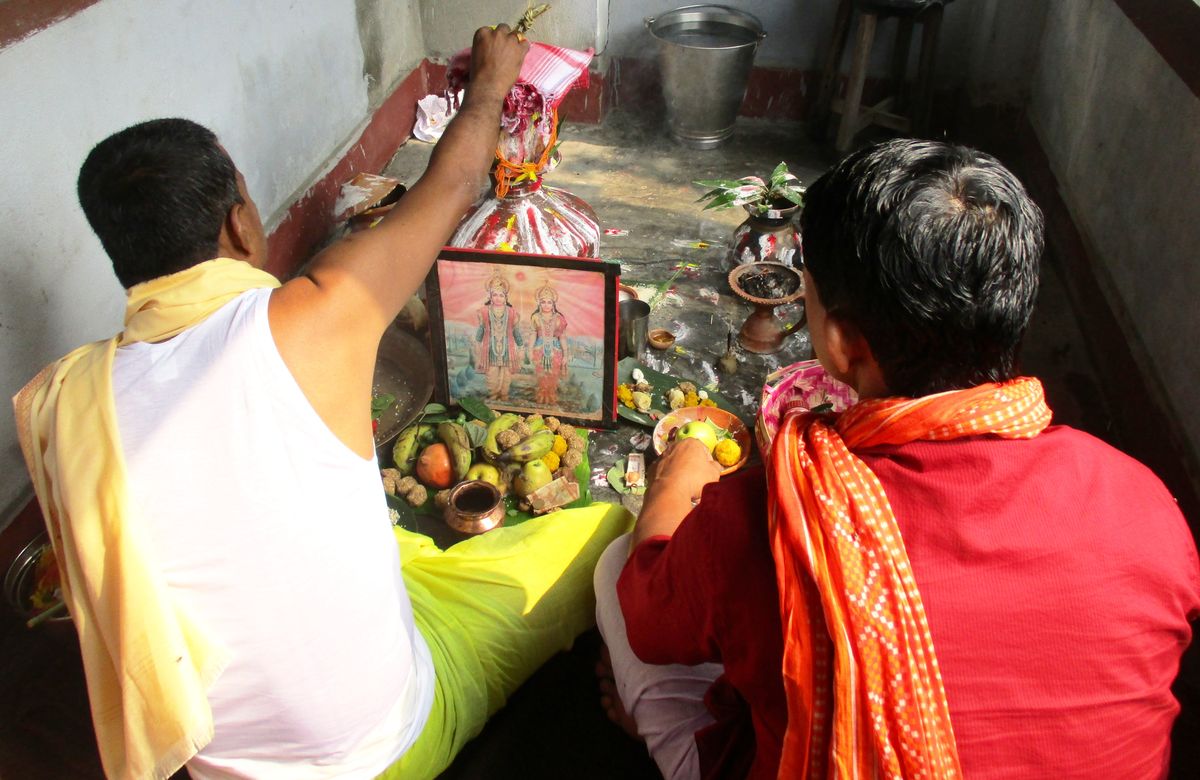
Margashirsha Purnima is the month's full-moon vrat, and for most households it means one thing: the Satyanarayan puja in the evening, after moonrise, with the katha read aloud and the prasad shared with everyone present. The photograph below is a home puja in progress — the framed picture of Satyanarayan and Lakshmi, the kalash, the fruit and laddoos laid out on leaves.
The katha comes from the Reva Khanda of the Skanda Purana. The frame is Suta telling the stories to the rishis gathered at Naimisharanya, and inside it Narada asks Vishnu how the suffering of people in Kali Yuga can be eased. Vishnu's answer is the vrat itself: a simple observance, open to anyone, of any means, with no need for elaborate ritual or expense. It can be done on any auspicious day, but Purnima is the day it is most often done.
There are five chapters, and they all turn on the same point: keep your word, and honour the prasad. A poor Brahmin of Kashi is told the vrat and keeps it every full moon until he attains moksha. A woodcutter sees him doing it, learns it, and his life changes. King Ulkamukha keeps it; a merchant named Sadhu promises to keep it if he is blessed with a child, gets a daughter, and keeps putting the promise off. The last two chapters are the warning, told twice so nobody misses it: Sadhu's son-in-law is imprisoned, a boatload of goods vanishes, King Tungadhwaja ignores the prasad offered by cowherds and loses his kingdom — and in every case the trouble lifts the moment the promise is kept and the prasad is taken.
The prasad itself is part of the teaching. It is sheera — equal measures of rava, milk, ghee, banana and sugar, cooked together into a paste — and the katha is not considered complete until it has been distributed and taken by everyone present. That is the rule the stories keep coming back to: the puja is not finished when the last verse is read. It is finished when the last person in the room has eaten.
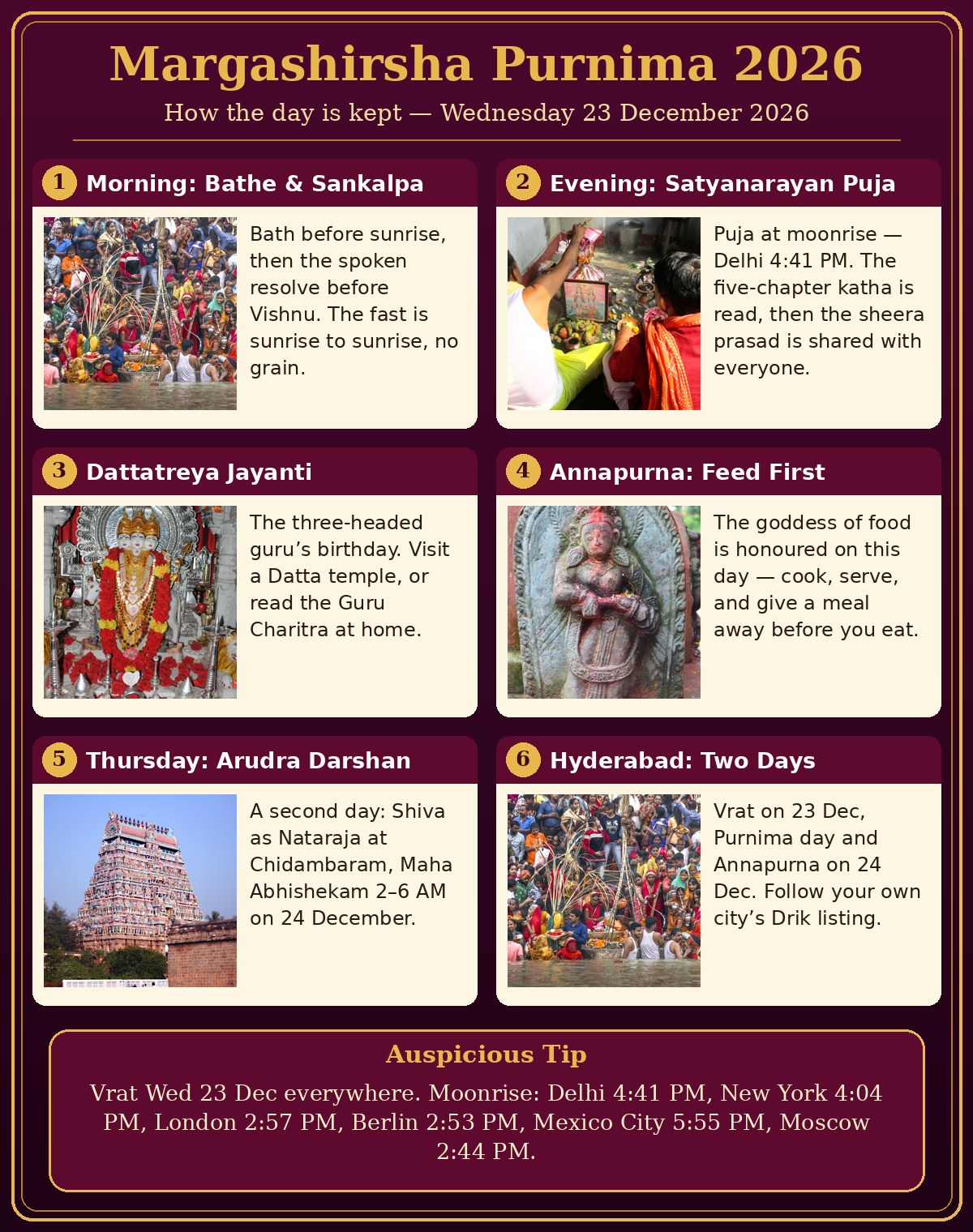
The fast is sunrise to sunrise, no grain, and the puja is done in the evening, once the Purnima is established — in Delhi, after the 4:41 PM moonrise. It is the same shape as the vrat in Utpanna Ekadashi and Mokshada Ekadashi, and anyone who kept those will recognise it: bathe, resolve, fast, read, offer the lamp, and break the fast the next morning after feeding someone first.
Dattatreya Jayanti: the guru with three faces
Dattatreya Jayanti is the same day, and it is not a coincidence. Tradition holds that Dattatreya was born on the Purnima of Margashirsha, which is why his birthday follows the full moon rather than a fixed solar date. Drik lists it on Wednesday 23 December in every city this article covers — Delhi, Hyderabad, New York, London, Berlin, Mexico City and Moscow. There is no day shift abroad on this one.
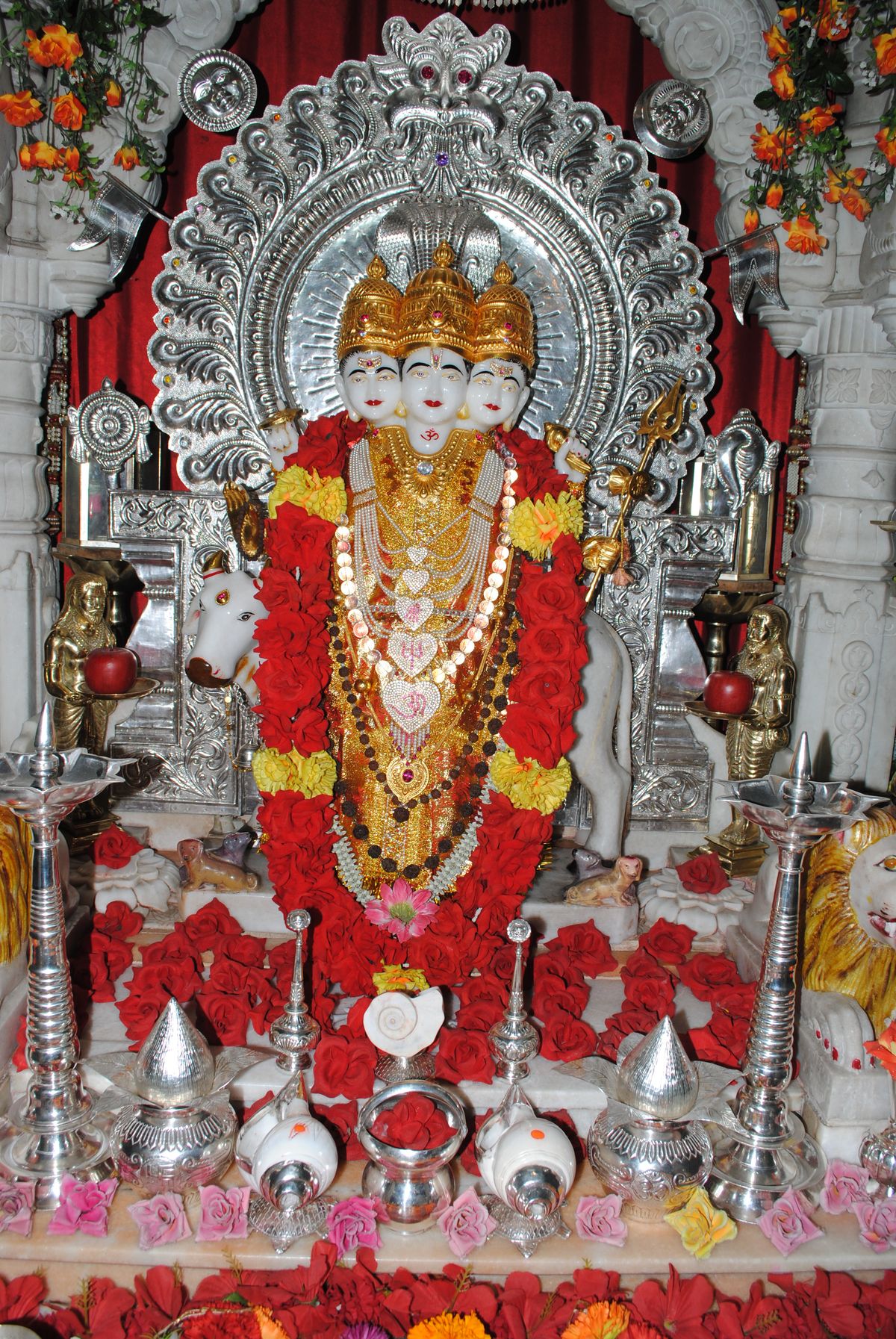
He is the son of the sage Atri and his wife Anasuya, and he is shown as one body with three heads and six hands — Brahma, Vishnu and Shiva combined into a single form. The story, as the Divine Life Society tells it from the tradition, is that the three gods came to test Anasuya's chastity, asking her to serve them food unclothed. She saw them not as men to fear but as infants to nurse, sprinkled them with the water used to wash her husband's feet, and the three became babies. When Atri returned, he embraced the three children and they became one child — two feet, one trunk, three heads, six hands — and the Trimurti appeared in their true form and named him Dattatreya: Datta, given, to Atri.
The four dogs at his feet stand for the four Vedas, and the cow behind him is Kamadhenu, Mother Earth. He is called the Adi Guru, the first teacher, and the reason is the strangest list of teachers in scripture. In the Bhagavata Purana, Krishna tells Uddhava how Dattatreya, speaking to King Yadu, said the Self alone was his guru — and yet he had learned wisdom from twenty-four others: the earth, water, fire, sky, moon, sun, a pigeon, a python, the ocean, a moth, the honey-bee, an elephant, a deer, a fish, the dancing-girl Pingala, a raven, a child, a maiden, a serpent, an arrow-maker, a spider and a beetle. He learned patience from the earth, detachment from the wind, single-minded focus from the arrow-maker. It is why the Datta tradition treats him as the most universal of gurus: he had no human teacher, and he learned from everything.
The day is kept with a fast, a visit to a Datta temple — Girnar in Gujarat, Mahur in Maharashtra, Gangapur in Karnataka, Narasimha Wadi near the Krishna river — and the reading of the Guru Charitra, the tradition's central text. In Maharashtra, Karnataka, Telangana and Gujarat the temples fill on this day; abroad, it is mostly a home observance, a lamp, the Datta mantra, and the 24 gurus read aloud, which is the part of the day that travels best.
Annapurna Jayanti: the goddess who feeds the world
Annapurna Jayanti is the appearance day of Annapurna, the form of Parvati who is the goddess of food and nourishment, and it falls on the same Purnima tithi. In Delhi and in all six of this article's cities Drik lists it on Wednesday 23 December; in Hyderabad it is Thursday 24 December, following the Purnima festival day there.
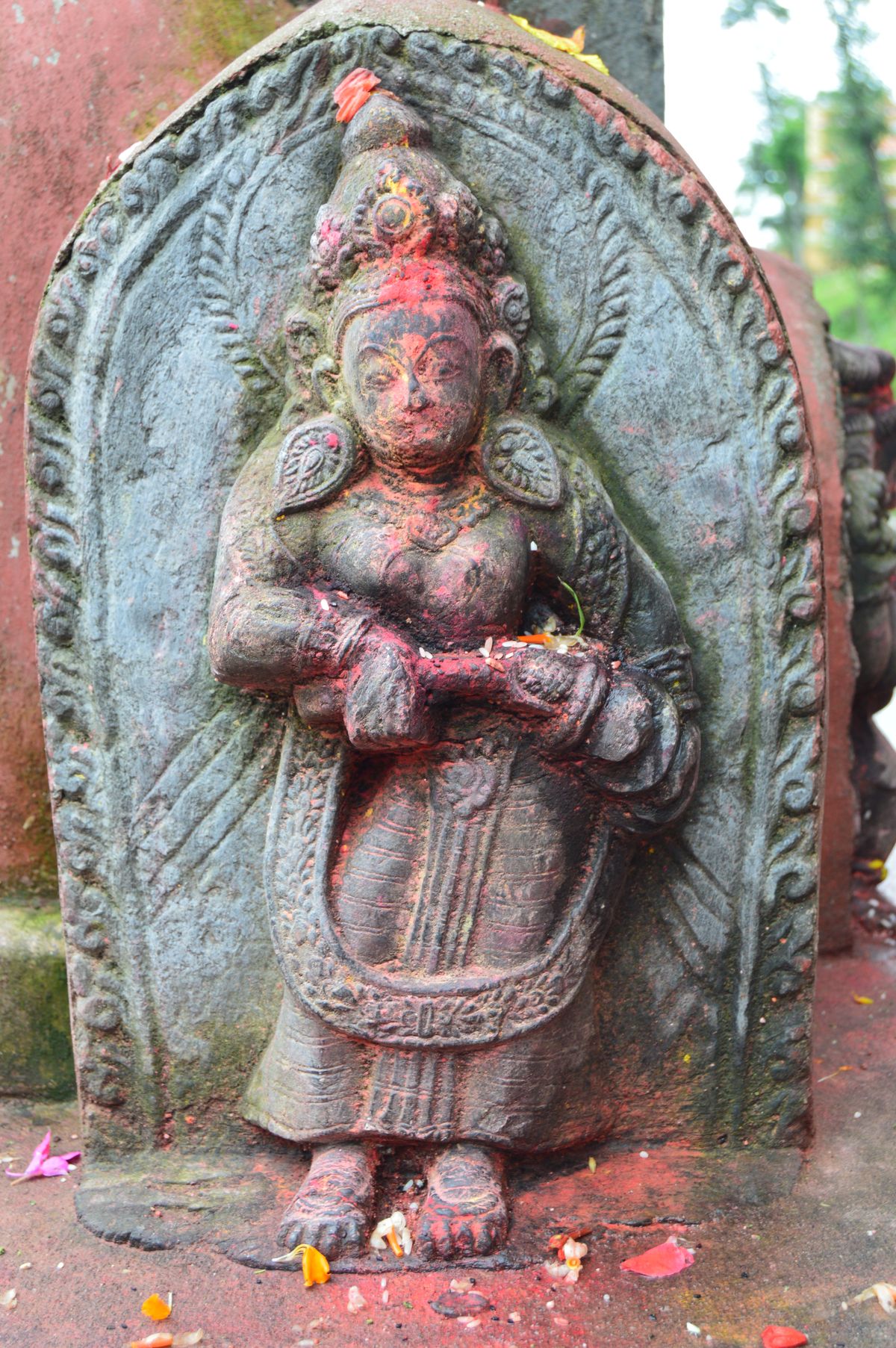
The story is the one Kashi tells. Shiva, so the telling goes, declared food to be maya, illusion — and Parvati, as Annapurna, disappeared, taking all food with her, until the world starved and Shiva himself stood before her with a begging bowl. She fed him, and the point of the story is the concession: food is not illusion. It is the condition of life, and the goddess who gives it is not a lesser deity but the mother of the world.
That is why the day is kept in the kitchen as much as in the temple. The hearth is cleaned and honoured, food is cooked with care, and — the part that matters — food is given away before it is eaten. In Kashi, where her great temple stands beside the Vishwanath, the day is one of the city's own. At home, the observance is simpler: cook well, serve generously, and give a meal to someone who needs one. Annapurna's Jayanti is the one day in this article where the offering is not a flower or a lamp. It is lunch.
Arudra Darshan: the next day, Thursday 24 December
One more festival rides on the back of this Purnima, and it belongs to the next day. Arudra Darshan — Thiruvathirai in Tamil — is Thursday 24 December 2026 in every city Drik lists, Delhi and Hyderabad included. It is not a second Purnima. It is the day the Ardra star falls in the Tamil month of Margazhi, and it honours Shiva as Nataraja, the cosmic dancer.
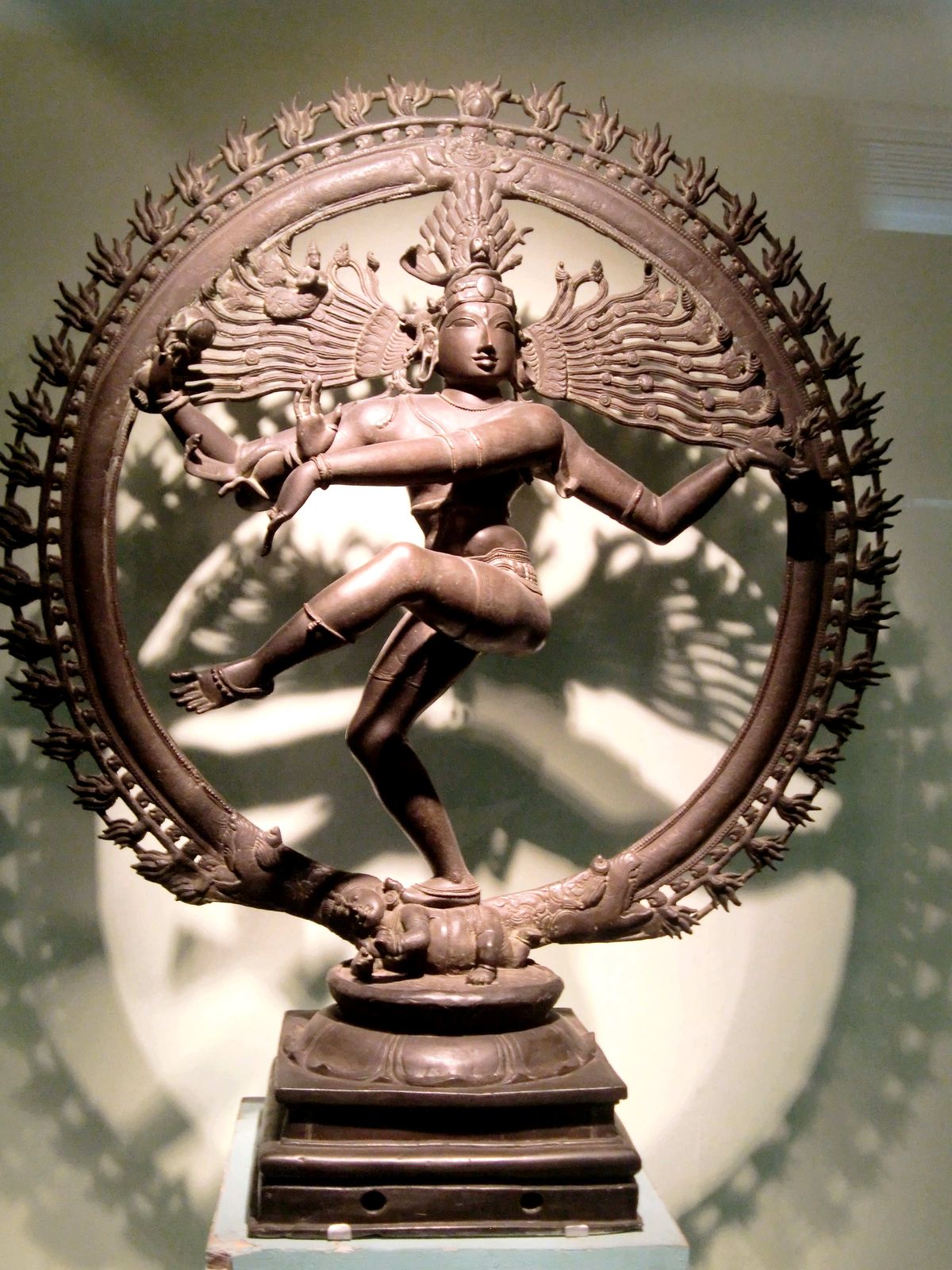
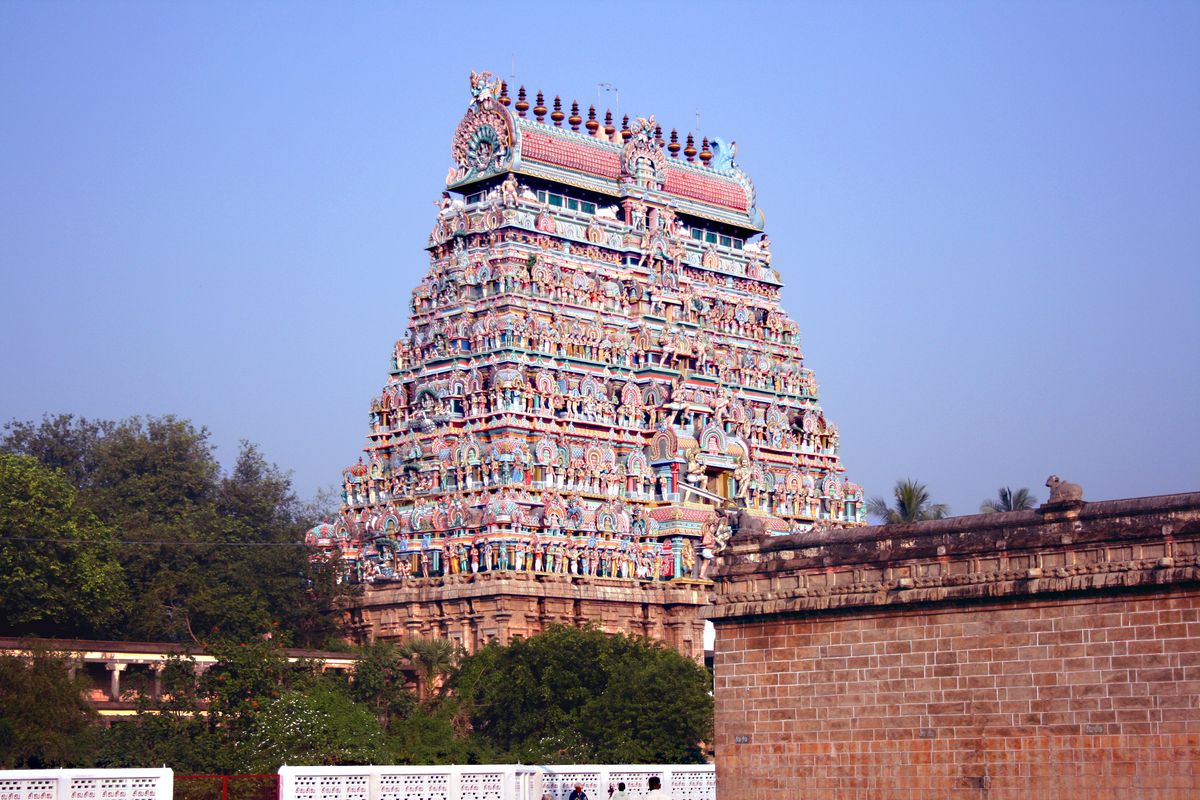
The centre of it is Chidambaram, the Thillai Nataraja temple in Tamil Nadu, where the Margazhi Brahmotsavam runs for twelve days and ends with Arudra Darshan. The chariot procession is on Wednesday 23 December; on Thursday morning, from 2 to 6 AM, the Maha Abhishekam is performed to Nataraja in the Raja Sabha, the thousand-pillared hall, and the god is then carried in procession to the golden hall for the darshan of the Ananda Tandava, the dance of bliss. The photograph below is the temple's great gopuram.
In Kerala the same day is kept as a women's vratam, Thiruvathira, for marital happiness, with the Thiruvathira kali — a sweet made of rice and jaggery — as the offering. At home, the observance is a lamp before Nataraja and the day kept quietly. If you are in Tamil Nadu, go to Chidambaram before dawn; the abhishekam is the heart of it, and it is over by 6 AM.
How the day is kept
The shape is the same shape as Utpanna Ekadashi and Mokshada Ekadashi, and anyone who kept those will recognise it. Bathe before sunrise on Wednesday and take the sankalpa, the spoken resolve, before the image of Vishnu. Keep the fast through the day — no grain — and in the evening, after moonrise, do the Satyanarayan puja: the kalash, the panchamrit, tulsi, fruit and flowers, the five chapters of the katha, and the sheera prasad shared with everyone present.
Dattatreya's part of the day fits around it. A visit to a Datta temple in the morning, or the Guru Charitra read at home, and the Datta mantra through the day. Annapurna's part is the kitchen: cook, serve, and give food away first. If your family keeps the Hyderabad reading, the Purnima bath and charity and Annapurna's puja move to Thursday morning, and the vrat itself stays on Wednesday.
Thursday is a second day, not an extension. Arudra Darshan is kept at dawn in Chidambaram and quietly at home elsewhere, and in Delhi the month itself turns: Drik lists Pausha Begins for the north on 24 December. The Purnima closes Margashirsha for the north, and the new month starts the next morning.
Margashirsha Purnima 2026 in India
The vrat is Wednesday, 23 December. The Purnima tithi runs 10:47 AM on Wednesday to 6:57 AM on Thursday, and moonrise on Wednesday is 4:41 PM in Delhi. Delhi's sunrise on the 23rd is 7:11 AM and sunset 5:30 PM, and the Brahma Muhurta runs 5:21 to 6:16 AM. Dattatreya Jayanti and Annapurna Jayanti are both on Wednesday in Delhi; Bhairavi Jayanti and Rohini Vrat are listed too.
The Hyderabad reading
Hyderabad keeps the vrat on Wednesday — Dattatreya Jayanti is Wednesday there, and the tithi window is identical to Delhi's — but the Purnima festival day is Thursday 24 December. Hyderabad's moonrise on Wednesday is 5:05 PM, sunrise 6:42 AM, sunset 5:48 PM. On Thursday, Purnima runs until 6:57 AM, sunrise is 6:43 AM, and the day's list is Annapurna Jayanti, Bhairavi Jayanti, Arudra Darshan and Margashirsha Purnima itself. If your family follows a south Indian panchang, Thursday is your Purnima day: the bath, the charity and Annapurna's puja all belong to it.
Where India goes on this day
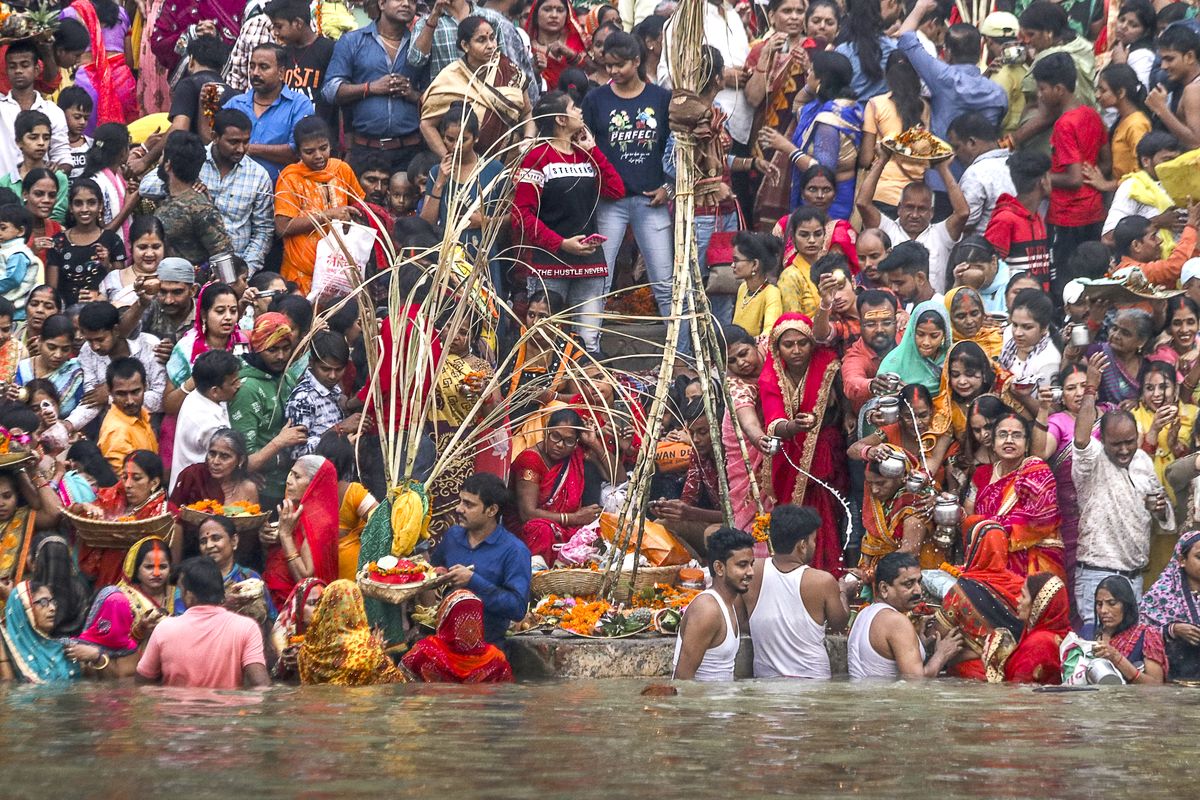
Kashi, for Annapurna — her temple beside the Vishwanath, and the ghats at moonrise, where the photograph at the top of this page was taken on a Purnima. Mahur, Girnar and Gangapur, for Dattatreya — his birthplace and his great shrines, which fill on this day. And Chidambaram, for Thursday: the Maha Abhishekam at 2 AM, which is the reason to be there before dawn rather than after breakfast.
Margashirsha Purnima 2026 in USA
The vrat is Wednesday, 23 December, the same day as India — no day shift on this one. The tithi runs 12:17 AM to 8:27 PM on Wednesday, so it spans the sunrise, and the kshaya problem does not arise here. New York's moonrise is 4:04 PM, sunrise 7:17 AM, sunset 4:33 PM, and the Brahma Muhurta is 5:19 to 6:18 AM. Dattatreya Jayanti and Annapurna Jayanti are both on Wednesday.
An evening puja that fits the American day
The moon is up at 4:04 PM, half an hour before sunset, so the evening puja can be done in the last of the daylight and the lamp lit as the light goes — the most forgiving version of this puja in the six cities. A video call home on Wednesday evening reaches India on Thursday morning, when Delhi families are waking to the last minutes of the tithi and Hyderabad families are beginning their Purnima day. Both ends of the call are keeping the same festival; they are just a day apart in how the calendars read it, and neither side is wrong.
Margashirsha Purnima 2026 in UK
The vrat is Wednesday, 23 December, the same day as India. The tithi runs 5:17 AM on Wednesday to 1:27 AM on Thursday, and moonrise is 2:57 PM — before sunset, which is 3:55 PM. London's sunrise on Wednesday is 8:05 AM, and the Brahma Muhurta runs 5:55 to 7:00 AM. Dattatreya Jayanti and Annapurna Jayanti are both on Wednesday.
The moon is up before dark
London's moonrise is the detail that catches people out: at 2:57 PM the moon is already up, an hour before the sun sets, so the evening puja happens in broad daylight and the lamp is lit while the sky is still pale. Do not wait for dark to begin — the puja is timed to the tithi and the moonrise, not to the night. The bath and the sankalpa, meanwhile, happen in full dark, the Brahma Muhurta ending more than an hour before the sun comes up. It is the same shape as the Mokshada Ekadashi fast in London, and the same advice holds: the reading is the part that travels best, a chapter with the morning tea, after the fast has begun.
Margashirsha Purnima 2026 in Germany
The vrat is Wednesday, 23 December, the same day as India. The tithi runs 6:17 AM on Wednesday to 2:27 AM on Thursday, and moonrise is 2:53 PM, again before the 3:55 PM sunset. Berlin's sunrise on Wednesday is 8:16 AM, and the Brahma Muhurta runs 6:05 to 7:10 AM. Dattatreya Jayanti and Annapurna Jayanti are both on Wednesday.
The shortest day of the series
Berlin's sun is up for less than eight hours, and the moon is up before it sets, so the whole day is compressed: a dark morning bath, a daylight moonrise, and an evening lamp in the middle of the afternoon. December in Berlin does not give you much sun to work with, and this vrat, which is mostly about a bath, a story and a lamp, is the one that minds least. The same note as in the Dhanurmasam article: Germany has Ruhezeiten, and a 6 AM alarm and a running tap are still working hours for the neighbours. The home puja is quiet by nature — a lamp, a verse, a bowl of sheera — which is one more reason this vrat travels better than the noisy ones.
Margashirsha Purnima 2026 in Mexico
The vrat is Wednesday, 23 December, the same day as India. The tithi runs 11:17 PM on Tuesday 22 December to 7:27 PM on Wednesday, and moonrise is 5:55 PM, after sunset. Mexico City's sunrise on Wednesday is 7:07 AM and sunset 6:04 PM, and the Brahma Muhurta is 5:22 to 6:15 AM. Dattatreya Jayanti and Annapurna Jayanti are both on Wednesday.
The longest light of the six cities
Mexico City gets the most generous December day of the six: sunrise 7:07 AM, sunset 6:04 PM, nearly eleven hours of light, and the moon comes up at 5:55 PM, just as the sun is going down — the only city in this article where the moonrise follows the sunset on the vrat day. The evening puja can be done properly at dusk, the lamp lit against a darkening sky, which is how the puja is meant to look. The Indian community in Mexico is small, and this is mostly a home observance there — which is fine, because a home observance is what this vrat mostly is, even in Kashi, once you step outside the temple courtyard.
Margashirsha Purnima 2026 in Russia
The vrat is Wednesday, 23 December, the same day as India. The tithi runs 8:17 AM on Wednesday to 4:27 AM on Thursday, and moonrise is 2:44 PM, more than an hour before the 3:59 PM sunset. Moscow's sunrise on Wednesday is 8:58 AM — seven hours of daylight, the shortest day in this article — and the Brahma Muhurta runs 6:42 to 7:50 AM. Dattatreya Jayanti and Annapurna Jayanti are both on Wednesday.
A vrat staged in the dark
Moscow's Brahma Muhurta ends more than an hour before the sun is up, and the sun, when it comes, is up for seven hours. The bath before sunrise happens in full dark, which is the traditional form anyway: the bath at dawn, in darkness, is how the old guides describe the start of a fast day. A Moscow December simply makes the description literal. The moon, at least, is up early — 2:44 PM — so the evening puja is done in daylight and the lamp lit in the middle of the afternoon, which honestly suits a lamp-lit puja.
The time zones offer their usual small mercy: a video call home after the evening lamp reaches India at around 8:30 PM IST, when Delhi families are sitting down to their own evening after a day that began four hours earlier. Both ends of the call are keeping Margashirsha Purnima on the same Wednesday — Moscow and Delhi agree on this one.
East of Moscow the timings shift with the time zones, as always. Your local temple or your own city's panchang is the authority there; Moscow's hours belong to Moscow.
What you'll need, roughly
A picture or idol of Vishnu as Satyanarayan — and of Dattatreya, if your family keeps him — flowers, tulsi, a lamp and oil, and a kalash. Rava, milk, ghee, banana and sugar in equal measure for the sheera prasad, fruit and panchamrit for the offering, and nothing with grain in it for the fast. A copy of the Satyanarayan katha, in print or on the phone, and the Guru Charitra if you keep Dattatreya's day properly. Something to give away first: a meal for someone who needs it, in Annapurna's name, and dana for the temple.
That is the entire list. Margashirsha Purnima is not a festival of shopping. It is a fast, a story, a guru and a meal given away — and a moon that, this year, belongs to no sunrise at all.
The Kartik–Margashirsha 2026 series: Diwali 2026 · Govardhan Puja 2026 · Bhai Dooj 2026 · Chhath Puja 2026 · Dev Uthani Ekadashi 2026 · Tulsi Vivah 2026 · Dev Diwali 2026 · Kalabhairav Jayanti 2026 · Utpanna Ekadashi 2026 · Margashirsha Amavasya 2026 · Vivah Panchami 2026 · Subrahmanya Shashthi 2026 · Dhanurmasam 2026 · Mokshada Ekadashi 2026 · Margashirsha Purnima 2026
Check your own city before you rely on any date here: the Hindu Panchang Calculator shows today’s tithi and festival dates for your location, the Hindu Date Converter converts between Gregorian and Hindu calendar dates, and this article on the astronomy behind the panchang explains how these calculations are actually made.
Photos: Kartika Purnima crowd at Manikarnika Ghat, Varanasi — Buiobuione, CC BY-SA 4.0; Home Satyanarayan puja — Subhmanish, CC BY-SA 4.0; Dattatreya murti, Datta Devasthan, Devgad — Usc2020, CC BY-SA 3.0; Annapurna murti, Gokarneshwor, Kathmandu — Suraj Belbase, CC BY-SA 4.0; Chola bronze Nataraja, National Museum — Miya.m, CC BY-SA 3.0; Thillai Nataraja Temple gopuram, Chidambaram — Lakshmanan, CC BY-SA 3.0; all via Wikimedia Commons.
Timings follow Drik Panchang's city pages for New Delhi, New York, London, Berlin, Mexico City, Moscow and Hyderabad, checked 15 November 2026 — festival pages for the tithi and moonrise, day-panchang pages for sunrise, sunset and Brahma Muhurta. The Hyderabad split is Drik's own: the Purnima dates list gives the festival day as 24 December for Hyderabad and 23 December for Delhi, and the day-panchang festival listings agree. Dattatreya Jayanti dates come from Drik's festival page and day-panchang listings; Annapurna Jayanti from Drik's festival page, which places it on the Margashirsha Purnima tithi. The Satyanarayan katha is told in the Reva Khanda of the Skanda Purana; the Dattatreya birth story as told by the Divine Life Society, and the 24 gurus as in the Bhagavata Purana, Canto 11. The Arudra Darshan nakshatra window and Chidambaram timings are from secondary sources (rudraksha-ratna; temple schedule) — Drik lists only the festival day. Your local temple's announcement overrides any website, including this one.