
Margashirsha Maas 2026: The Month Krishna Called His Own
Margashirsha Maas 2026 begins on Wednesday 25 November in North India and on Wednesday 9 December in Maharashtra, Gujarat and the South. Key dates, the two calendars explained, the Gita reading plan, Maharashtra's Mahalakshmi Thursdays, and the start dates for the USA, UK, Canada, UAE and Australia.
Margashirsha Maas 2026 begins on Wednesday 25 November in North India, and on Wednesday 9 December in Maharashtra, Gujarat and the South. Both dates are correct. India keeps two lunar calendars, and Margashirsha is the month where the gap between them is impossible to miss — the same moon, the same month, a fortnight apart.
The northern month runs to Wednesday 23 December, the full moon that closes it. The southern and western month runs to Thursday 7 January 2027. Between those two spans sits the whole of Margashirsha: the month Krishna claimed for himself in the Bhagavad Gita, the month of cold dawns and early lamps, of a chapter of the Gita a day, and of the Thursdays that half of Maharashtra organises its December around. It is less a festival season than a discipline — which is rather the point of it.
Two calendars, two Margashirshas
The difference is where you tear the page. In the purnimanta calendar of North India, a month runs from full moon to full moon. Margashirsha therefore opens on the morning after Kartik Purnima — Wednesday 25 November, the first day of the dark fortnight — and it ends on its own full moon, Margashirsha Purnima, on 23 December.
In the amanta calendar of Maharashtra, Gujarat, Andhra Pradesh, Telangana and Karnataka, a month runs from new moon to new moon. By that count, the fortnight after 25 November is still Kartik. Amanta Margashirsha opens the day after Margashirsha Amavasya (Tuesday 8 December) — so, Wednesday 9 December — and it closes on the next new moon, Thursday 7 January 2027, a day the North has already renamed Pausha Amavasya and Tamil Nadu keeps as Margazhi Amavasya.
Neither side has made an error, and neither is "the real" Margashirsha. The festivals inside the month fall on the same Gregorian days in both counts — a tithi is a tithi in any calendar. What changes is only which days get called Margashirsha, and that decides practical things: which Thursdays are the Mahalakshmi Thursdays, and when your month of Gita reading starts. If you are converting dates for family in another state, our Hindu Date Converter shows both reckonings side by side, and the Hindu Panchang Calculator gives the tithi for your own city.
The month in Krishna's own words
Halfway through the Bhagavad Gita, in the tenth chapter, Arjuna asks Krishna to name his glories — the places in the world where he can be found most directly. Krishna answers with a list of superlatives: of the Sama Veda's hymns he is the greatest hymn, of metres he is the Gayatri, of seasons he is the spring. And in the middle of the verse, almost casually:
Bṛhat-sāma tathā sāmnāṁ, gāyatrī chandasām aham; māsānāṁ mārga-śīrṣo'ham, ṛtūnāṁ kusumākaraḥ. — "Of months, I am Margashirsha." (Bhagavad Gita 10.35)
It is the only month he names. The tradition has taken the hint ever since: Margashirsha is treated as the most meritorious month of the year for Vishnu and Krishna worship, the month above even Kartik in some tellings, because Kartik is the month devotees praise and Margashirsha is the month Krishna praises. Its older name, Agrahayana, remembers a much older arrangement in which the year itself was once counted from here.
The month also holds the anniversary of its own scripture. The Gita was spoken, by tradition, on the Ekadashi of this month's bright fortnight — which is why Gita Jayanti and Mokshada Ekadashi are the same day, and why reading the Gita is not an optional extra in Margashirsha. It is the month's main event, spread out over weeks.
Margashirsha 2026 in India: the key dates
These are the days that structure the month, on Drik Panchang's reckoning for India. The weekday is given so you can plan around work; the calendar column is there because, as established, it matters.
| Date | Day | What it is |
|---|---|---|
| 25 November | Wednesday | Margashirsha begins — purnimanta (North India) |
| 1 December | Tuesday | Kalabhairav Jayanti — Krishna Ashtami; the month's fierce Shiva day, and its Masik Krishna Janmashtami |
| 4 December | Friday | Utpanna Ekadashi — the dark fortnight's Ekadashi |
| 8 December | Tuesday | Margashirsha Amavasya — the new moon that turns the amanta calendar |
| 9 December | Wednesday | Margashirsha begins — amanta (Maharashtra, Gujarat, the South) |
| 14 December | Monday | Vivah Panchami — the wedding of Ram and Sita, kept grandly in Mithila and Janakpur |
| 15 December | Tuesday | Champa Shashthi — Khandoba's day in Maharashtra; Subrahmanya Shashthi in the South |
| 16 December | Wednesday | Dhanu Sankranti — the sun enters Sagittarius; Tamil Margazhi begins |
| 20 December | Sunday | Mokshada Ekadashi, Gita Jayanti and Vaikuntha Ekadashi — one tithi, three names |
| 22 December | Tuesday | Hanuman Jayanti in the Kannada calendar |
| 23 December | Wednesday | Margashirsha Purnima, Dattatreya Jayanti, Annapurna Jayanti — the northern month closes |
| 24 December | Thursday | Arudra Darshan in Tamil Nadu; Pausha begins in the North |
| 7 January 2027 | Thursday | The amanta month closes — last Mahalakshmi Thursday; Tamil Hanumath Jayanthi |
Three of these days deserve a word of their own. The first is 1 December: Kalabhairav Jayanti, the birthday of Shiva in his most uncompromising form, kept with a night vigil and the feeding of dogs, who are Bhairav's own. A month that opens gently gets its thunder early.
The second is Sunday 20 December, when three observances land on a single tithi. It is Mokshada Ekadashi, the fast kept for one's own liberation and one's ancestors'. It is Gita Jayanti, the day the Gita is held to have been spoken at Kurukshetra — the Ekadashi tithi runs from 10:09 pm on 19 December to 8:14 pm on 20 December, IST. And because it falls after the sun's entry into Sagittarius on 16 December, South India's Vaishnava temples keep it as Vaikuntha Ekadashi, the day the Vaikuntha Dwaram at Tirumala is opened. One lunar day, three traditions, no arguments — each is simply reading a different line of the same date.
And the third is the full moon that ends the northern month. Margashirsha Purnima, on Wednesday 23 December, is also Dattatreya Jayanti — the birthday of the three-faced guru, a major day in Maharashtra, Karnataka and Gujarat — and Annapurna Jayanti, kept in the kitchen as much as the temple. The Purnima tithi itself is a kshaya tithi that touches no sunrise, and Hyderabad reads the festival day a day later than Delhi; our Purnima article walks through that wrinkle in full.
How the month is kept
The daily shape. Margashirsha observance is built for winter. You rise in the Brahma Muhurta, the dark hour before dawn, and bathe — in a river if your geography allows it, under a shower with a tulsi leaf in the water if it doesn't. The Puranas praise the Margashirsha snan the way they praise Kartik's: a cold bath before sunrise, in the coldest weeks of the year, taken as an offering rather than a hygiene routine. Then Vishnu or Krishna puja, tulsi offered, a lamp lit, and the same lamp again at dusk. That is the whole of it, done daily. The month rewards regularity, not spectacle.
The Gita, a chapter a day. The classic Margashirsha project is to read the entire Bhagavad Gita across the month — eighteen chapters, roughly twenty minutes each, entirely manageable if you start on day one and faintly humiliating if you start on day twenty. Two ways to time it. Start on your month's first day (25 November in the North, 9 December in the amanta count) and you finish with days to spare. Or count backwards from the festival: begin on Thursday 3 December, and the eighteenth chapter lands exactly on Gita Jayanti, Sunday 20 December. Many families read a chapter aloud after the evening lamp, which has the side effect of the whole house hearing it whether they signed up or not.
The Thursdays. In Maharashtra, Margashirsha belongs to Mahalakshmi as much as to Krishna. Every Thursday of the amanta month is kept as the Margashirsha Guruvar vrat: a kalash is set up as the goddess, decorated and dressed, the Mahalakshmi vrat katha — the Guruvarchi Kahani, the story of the goddess who came as an old woman and tested a proud queen — is read aloud, and the fast is broken after the evening puja. Because this year's amanta month is a long one, it holds five Thursdays: 10, 17, 24 and 31 December, and 7 January 2027. The last is the udyapan, the formal close, when married women are invited for haldi-kumkum and given the vrat book as a gift — though since 7 January is also the Amavasya, many families sensibly complete the udyapan a week early, on 31 December. North Indian families who keep the same vrat on the purnimanta count get four Thursdays: 26 November and 3, 10 and 17 December.
Giving, and eating. The month's charity has a season's logic: anna daan, the gift of food, first — and in the North, where Margashirsha nights are the coldest of the year, blankets and warm clothes given to people sleeping rough are the classic Margashirsha donation. The kitchen follows the same logic. This is the month of til and gur, sesame and jaggery, of bajra rotis and moong khichdi and hot turmeric milk — food that warms, in a month whose whole devotional programme is about getting up in the cold and doing it anyway.
Margashirsha Maas 2026 in the USA
America gets both start dates, because America has both calendars and, this year, two Purnimas. Kartik Purnima's tithi runs from 1:12 pm EST on Monday 23 November to 9:53 am EST on Tuesday 24th. On the East Coast it is still running at sunrise on the 24th, so Purnima is kept on Tuesday 24 November and Margashirsha begins on Wednesday 25 November, exactly as in Delhi. On the West Coast the tithi ends before sunrise on the 24th, and most panchangs there settled Purnima on Monday 23 November — so the month begins on Tuesday 24 November. The amanta month, for Gujarati and Marathi families, begins on Wednesday 9 December, and its five Mahalakshmi Thursdays are the same Thursdays as in India: 10, 17, 24 and 31 December and 7 January.
One date genuinely splits in the USA. For Mokshada Ekadashi, Drik's New York pages list the Smarta fast on Saturday 19 December and the Vaishnava fast on Sunday 20 December — Gita Jayanti events at most temples are held on the Sunday, which is also the convenient answer. Check which line your temple follows before you plan the fast; both are being kept, an hour apart, in the same time zone. And note the month's full moon, Wednesday 23 December, lands in the middle of the Christmas shutdown — the one week of the American year when taking a day for a Satyanarayan puja costs nobody anything.
Margashirsha Maas 2026 in the UK
Britain keeps India's northern dates. The Purnima tithi is running at London sunrise on Tuesday 24 November, so Kartik Purnima stays on the 24th and Margashirsha begins on Wednesday 25 November, ending with the full moon on Wednesday 23 December.
But the UK's Hindu population is heavily Gujarati and Marathi, which makes the second start date the one that fills temples: the amanta month from Wednesday 9 December, with the five Guruvar Thursdays running to 7 January. In Leicester and Wembley, December's Thursday-evening Mahalakshmi katha gatherings are as much a fixture as anything in Nashik — the vrat travelled well. Sunrise in late-December London is after 8 am, which makes the Brahma Muhurta bath the easiest act of devotion in this entire article: the sacred pre-dawn hour in London is when most people are waking up anyway.
Margashirsha Maas 2026 in Canada
Canada splits the way the continent splits. Toronto follows the eastern pattern — Purnima on Tuesday 24 November, Margashirsha from Wednesday 25 November. Vancouver follows the Pacific pattern, with Purnima settled on Monday 23 November and the month beginning Tuesday 24 November. The amanta start, Wednesday 9 December, and the five Thursdays apply in both.
The Canadian wrinkle is the cold, which is also, honestly, the Canadian opportunity. Margashirsha is a month designed around the holiness of a pre-dawn bath in winter; nowhere in the diaspora takes winter more seriously. Toronto's sunrise in mid-December is around 7:45 am, so the Brahma Muhurta falls near 6 am — an hour Delhi's grandmothers would consider a lie-in. The discipline the month asks for was calibrated for an Indian December. In a Canadian one, it mostly asks you to be awake before a perfectly ordinary sunrise, with the snow doing the atmospheric work for free.
Margashirsha Maas 2026 in the UAE
The Gulf keeps the northern count without drama: the Purnima tithi is up well before Dubai's sunrise on Tuesday 24 November, so Margashirsha begins on Wednesday 25 November and closes on Wednesday 23 December, and amanta families begin on Wednesday 9 December.
For working families in Dubai and Abu Dhabi, the month runs on a weekend rhythm — the daily lamp and Gita chapter at home, and the congregational weight carried by the temples in Bur Dubai and Jebel Ali on Saturdays and Sundays. Gita Jayanti falling on Sunday 20 December suits the Gulf perfectly. The one adjustment the Emirates demand is the opposite of Canada's: dawn in a Dubai December comes around 7 am, the weather is mild, and nobody's pre-dawn bath requires courage. The month's austerity has to be found somewhere else — most people find it in the reading.
Margashirsha Maas 2026 in Australia
Australia begins with India: at Sydney's sunrise on Tuesday 24 November the Purnima tithi is already running, so Kartik Purnima is the 24th and Margashirsha opens on Wednesday 25 November, with the amanta month following on Wednesday 9 December.
Everything else is inverted, and cheerfully so. Margashirsha is a winter month being kept in high summer: sunrise in Sydney is before 5:45 am, so the Brahma Muhurta bath happens at an hour when the day is already warm, and the evening lamp is lit after an 8 pm sunset. Temples in Sydney and Melbourne programme the month around the school holidays, and the full moon on Wednesday 23 December arrives inside the Christmas break, when a Dattatreya Jayanti visit does not have to be squeezed before work. Australian Hindus keeping a month of cold dawns in December heat are not doing it wrong. They are doing the diaspora's oldest trick — keeping the tithi, and letting the season be whatever it is outside the window.
One month, two calendars, one instruction
Strip the calendar argument away and Margashirsha makes a single, modest request: an hour a day, in the dark, for a month. A bath, a lamp, a chapter. The festivals — Bhairav's night on 1 December, the Gita's birthday on the 20th, the full moon on the 23rd — are just the month's furniture. The month itself is the practice, which is presumably why, asked to name his own glories, Krishna did not name a festival at all. He named a stretch of ordinary days, and said: that one is mine.
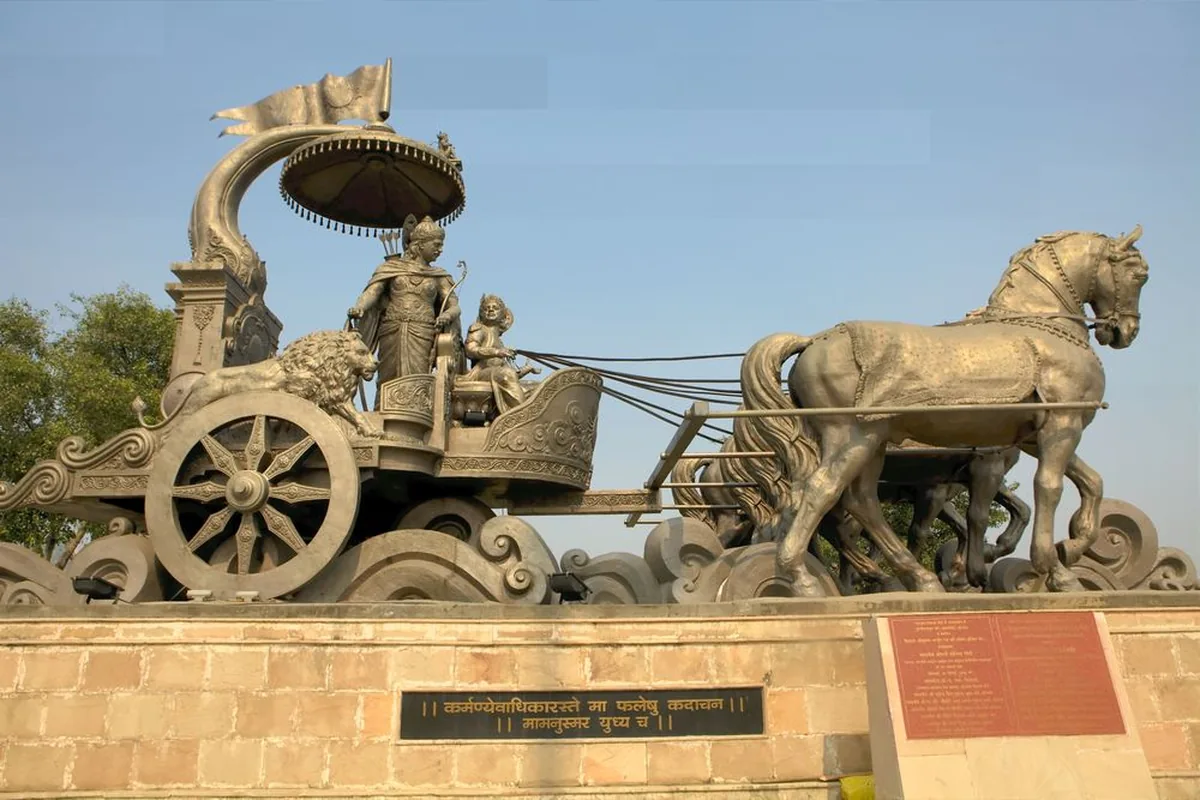
Featured image: "Arjuna and Krishna at the Kurukshetra Mahabharata war, Gita" by Devajyoti Sarkar, CC BY-SA 2.0, via Wikimedia Commons.