Makaravilakku 2027 is Thursday, 14 January — the light on the hill at Sabarimala
Makaravilakku 2027 is Thursday, 14 January at Sabarimala — deeparadhana 6:30 PM, the flame seen three times on Ponnambalamedu. Dates and timings for India and abroad.
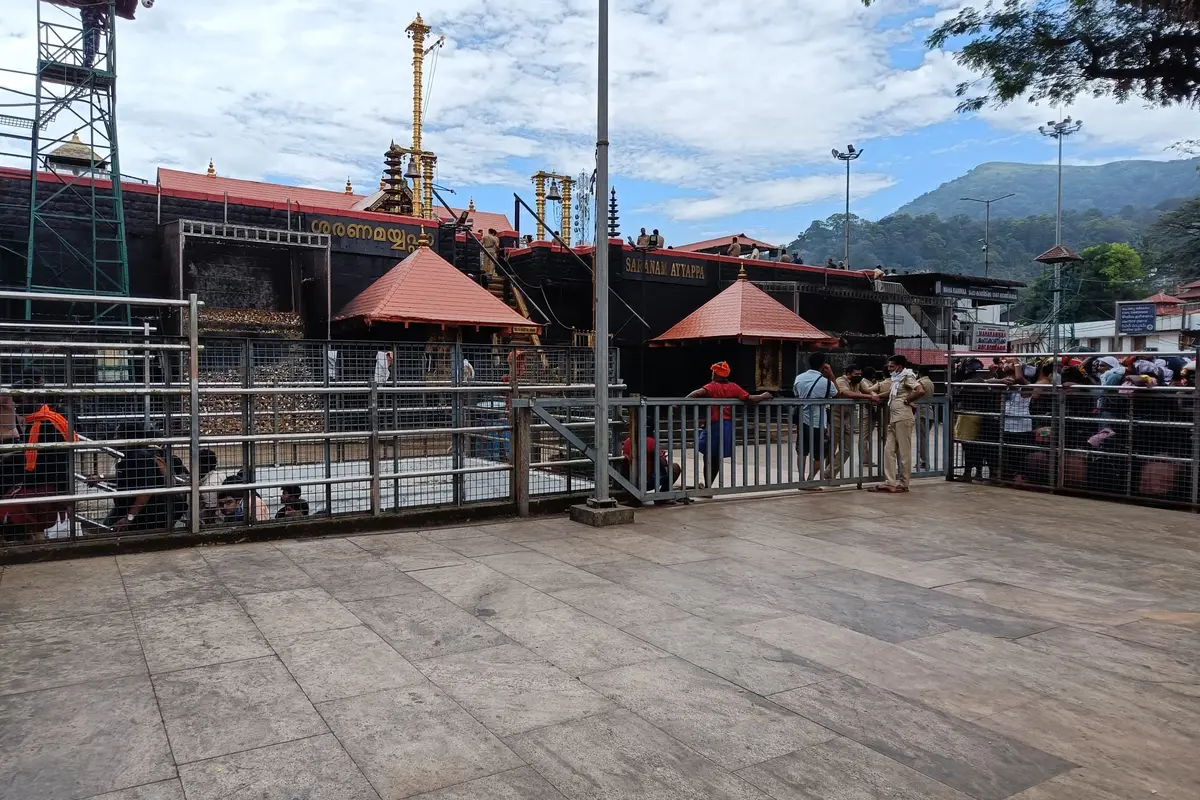
Makaravilakku 2027 falls on Thursday, 14 January, at the Sabarimala temple in Kerala. The evening's deeparadhana is at 6:30 PM IST, with the Lord adorned in the Thiruvabharanam — the gold ornaments carried on foot from Pandalam over three days — and then the flame is seen three times on Ponnambalamedu hill, across the valley from the shrine. That is the whole festival in one sentence: gold arrives, the lamp is lit, and a hill full of people watches a light appear on another hill.
One thing to get out of the way before anything else, because your panchang will disagree with this page. Drik Panchang puts the Sun's entry into Makara at 9:14 PM IST on 14 January — after sunset — so Drik observes Makar Sankranti on Friday, 15 January in India. Sabarimala does not. The temple follows Makaram 1 on its own calendar, and the festival is on the evening of the 14th. Both are honest reckonings, and this page follows the temple, because the festival belongs to the temple. If you keep Sankranti by Drik, your Sankranti is the 15th; if you keep Makaravilakku, your evening is the 14th. They are not the same day this year, and pretending otherwise would be the first lie in the article.
Makaravilakku 2027 at a glance
| Makaravilakku | Thursday, 14 January 2027, Sabarimala Sree Dharma Sastha Temple, Kerala |
| The evening | Deeparadhana 6:30 PM IST, Lord adorned in the Thiruvabharanam; the flame seen three times on Ponnambalamedu, roughly 6:15–6:50 PM |
| The season | Temple reopens Wed 30 Dec 2026, 5 PM; closes Wed 20 Jan 2027, ~6:30 AM |
| The procession | Thiruvabharanam leaves Pandalam Tue 12 Jan; reaches Sannidhanam on the 14th |
| Daily pilgrim cap | 80,000 (Travancore Devaswom Board, 2026–27 season); Virtual-Q booking mandatory |
| Delhi (Sankranti Fri 15 Jan) | Sunrise 7:15 AM, sunset 5:46 PM; Brahma Muhurta 5:27–6:21 AM |
| New York (Sankranti Thu 14 Jan) | Sunrise 7:18 AM, sunset 4:52 PM; Brahma Muhurta 5:23–6:20 AM |
| London (Sankranti Thu 14 Jan) | Sunrise 8:00 AM, sunset 4:19 PM; Brahma Muhurta 5:55–6:58 AM |
| Berlin (Sankranti Fri 15 Jan) | Sunrise 8:10 AM, sunset 4:22 PM; Brahma Muhurta 6:03–7:07 AM |
| Mexico City (Sankranti Thu 14 Jan) | Sunrise 7:13 AM, sunset 6:18 PM; Brahma Muhurta 5:30–6:21 AM |
| Moscow (Sankranti Fri 15 Jan) | Sunrise 8:50 AM, sunset 4:28 PM; Brahma Muhurta 6:39–7:44 AM |
| The Sankranti moment | One instant: 15:44 UTC, Thu 14 Jan — Delhi 9:14 PM, New York 10:44 AM, London 3:44 PM, Berlin 4:44 PM, Mexico City 9:44 AM, Moscow 6:44 PM |
| After the 14th | Darshan till Tue 19 Jan; the ornaments return to Pandalam and the temple closes Wed 20 Jan |
The name itself is the description: Makaravilakku means the lamp of Makara. It is the climax of the whole Sabarimala season — the Mandala Pooja on 27 December ended the forty-one days, the temple closed for three days, and it reopened on 30 December for this one evening. Everything since November has been walking towards 6:30 PM on 14 January.
The one-day difference — 14 or 15 January?
It is worth two minutes, because this is the question that will arrive in every family WhatsApp group, and the wrong answer sounds confident.
The Sun enters Makara at a single instant: 15:44 UTC on Thursday, 14 January 2027. In Delhi that is 9:14 PM — after sunset. Drik's rule is that when a Sankranti falls after sunset, all Punya Kaal activities are postponed to the next sunrise, so Drik observes Makar Sankranti on Friday, 15 January in India, with Punya Kaal running 7:15 AM to 5:46 PM. In New York the same instant is 10:44 AM, in London 3:44 PM, in Mexico City 9:44 AM — all in daylight on the 14th — so Drik observes it on Thursday the 14th there. Berlin and Moscow, like Delhi, get the 15th.
Sabarimala's festival does not follow that rule. The temple's calendar is set by the Malayalam month — Makaram 1 — and the Travancore Devaswom Board's season calendar puts Makaravilakku on Thursday, 14 January. Two computed calendars agree with Drik rather than the temple: the Malayalam calendar site lists Makaravilakku 2027 on 15 January, and so does one popular festival guide. The temple observes the 14th anyway, and has done for years — in 2026 the festival was on 14 January too, with the Sankranti moment at 3:13 PM that year.
So: if someone tells you Makaravilakku is on the 15th, they are reading a computed calendar, and they are not lying. They are just not reading the temple. For the festival itself, the temple is the authority. For your own Sankranti bath and daan, your city's Drik date is the authority — which is why the table above gives both, and why the Makar Sankranti 2027 article works through the split in full. London readers should note their Punya Kaal is only thirty-five minutes long this year, 3:44 to 4:19 PM, because the moment falls just before sunset.
What the light is, and what it isn't
Two things happen on that hill in the same minutes, and people mix them up every year, so here they are, kept apart.
The Makaravilakku is a flame. After the deeparadhana, with the Lord adorned in the Thiruvabharanam, a flame is seen three times on Ponnambalamedu, the hill across the valley from the Sannidhanam. Three times, not once — the repetition is part of the ritual, and the crowd chants with each sighting.
The Makara Jyothi is a star. It is the star that appears in the sky that evening — the guides identify it with Sirius — and it is a different thing from the flame. The flame is on the hill; the star is in the sky. When someone says "I saw the Jyothi", ask which one they mean. Most of the time they mean the flame, and the distinction only matters until you are standing there, when it matters a great deal.
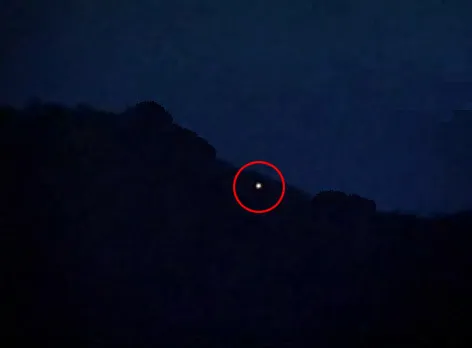
Now the honest part, which this page will not dodge. In 2011, the Travancore Devaswom Board acknowledged before the Kerala High Court that the Makaravilakku flame is lit as a ritual — a human-lit fire on the hill, not a miraculous occurrence. That is the board's own statement, on the record, and it is in this article because hiding it would be worse than saying it.
For many devotees it changes nothing, and that is also worth saying plainly. A lamp lit with devotion on a sacred hill, seen by a vast crowd chanting the same name at the same moment, is a ritual worth being present for. The belief is that Ayyappa's presence is in the light; the official account is that the light is lit by human hands. Both can be written down in the same paragraph without either being mocked, and that is what this page does. Go with that understanding, and the evening is no less moving for it.
Two more details of the evening, from the temple's own festival accounts. The arrival of Malikapurathamma on an elephant marks the beginning of the Makarajyothi festival, and the procession goes on to the Pathinettam Padi, the eighteen divine steps. And Kuruthi Puja is one of the rituals observed during the Makarajyothi festival. They are named here so that a first-timer is not surprised by them; the evening has more in it than the single moment of the light.
Three days on foot: the Thiruvabharanam
The gold does not arrive by road. It walks.
The Thiruvabharanam — the sacred gold ornaments of Lord Ayyappa — are kept through the year at the Srambickal Palace in Pandalam, the home of the royal family that has guarded them for generations. For Makaravilakku they are carried to Sabarimala in three wooden boxes, on the heads of a team of about thirty devaswom members, along the old village and forest route. The distance is about eighty-three kilometres, and the journey takes three days.
The season calendar puts the departure on Tuesday, 12 January. On the morning of departure the boxes are brought from the palace to the Valiyakoickal temple at about four in the morning, and the procession sets out at about one in the afternoon — after the Krishnaparunthu, the Brahminy kite, is seen circling above the temple. Devotees believe the kite is Garuda, accompanying the ornaments. Whether you read that as a sign or as a very good omen, the procession does not leave until the bird has been seen.

The route is the old one, and the villages along it treat the passing of the boxes as a festival of their own. On the first day the procession is received at Kulanada Devi temple and at Ullannoor, where the three boxes are opened for darshan, then passes through Kurianappally, Kidangannur, Aranmula, Punnamthottam, Pampadimon and Cherukol, and halts for the night at Ayroor Puthiyakavu Devi temple. On the second day it is received at Idappavoor, Vadasserikara, Madamon and Perunad, and halts at the Laha Forest rest house.
On the third day — 14 January — the team leaves Laha at four in the morning, is received at Plappally and Nilakkal, halts at noon at Pamba-Valiyanavattom, and sets out again at three in the afternoon for the climb. At Saramkuthi, the traditional reception point, the devaswom team leads the procession to the temple, and the thantri receives the Thiruvabharanam in front of the sreekovil. The ornaments are adorned on the idol, and the deeparadhana follows at 6:30 PM.
The exact 2027 schedule is announced by the Travancore Devaswom Board, and the dates above follow the season calendar as published in the Malayalam press. If you are planning to see the procession on the way — and many families do, at Aranmula or at Pamba — confirm the hours with the board before you travel. The route is fixed; the hours can shift.
The evening itself at Sabarimala
The day of the 14th is not only the evening. The temple's season calendar runs like this: Erumeli Petta Thullal on Monday, 11 January; the Thiruvabharanam leaves Pandalam on the 12th; Pamba Vilakku and Pamba Sadya on Wednesday the 13th; and on the 14th, the Makara Sankrama Pooja through the day and the deeparadhana at 6:30 PM, with the Makarajyothi darshan. The day after, the Ambalappuzha group's karpoorazhi is at 4 PM and the Alangad group's thalam procession at 5 PM. Neyyabhishekam ends on Monday the 18th, with Kalabhabhishekam by the royal representative. Darshan runs until 10 PM on Tuesday the 19th, with Guruthi at Malikappuram after the pilgrimage closes. On Wednesday the 20th the Thiruvabharanam begins its return journey at 5 AM, and the temple closes at about 6:30 AM, after the royal representative's darshan.
Through the season the temple is open roughly 3 AM to 1 PM and 3 PM to 11 PM — about eighteen hours a day — and the hill is at its fullest on the 14th. Some guides advise reaching Sabarimala twenty-four to forty-eight hours in advance to secure a vantage point for the Jyothi darshan, and warn of three-to-six-hour delays in the queue on the day. That is not an exaggeration to frighten you; it is what the 14th is like.
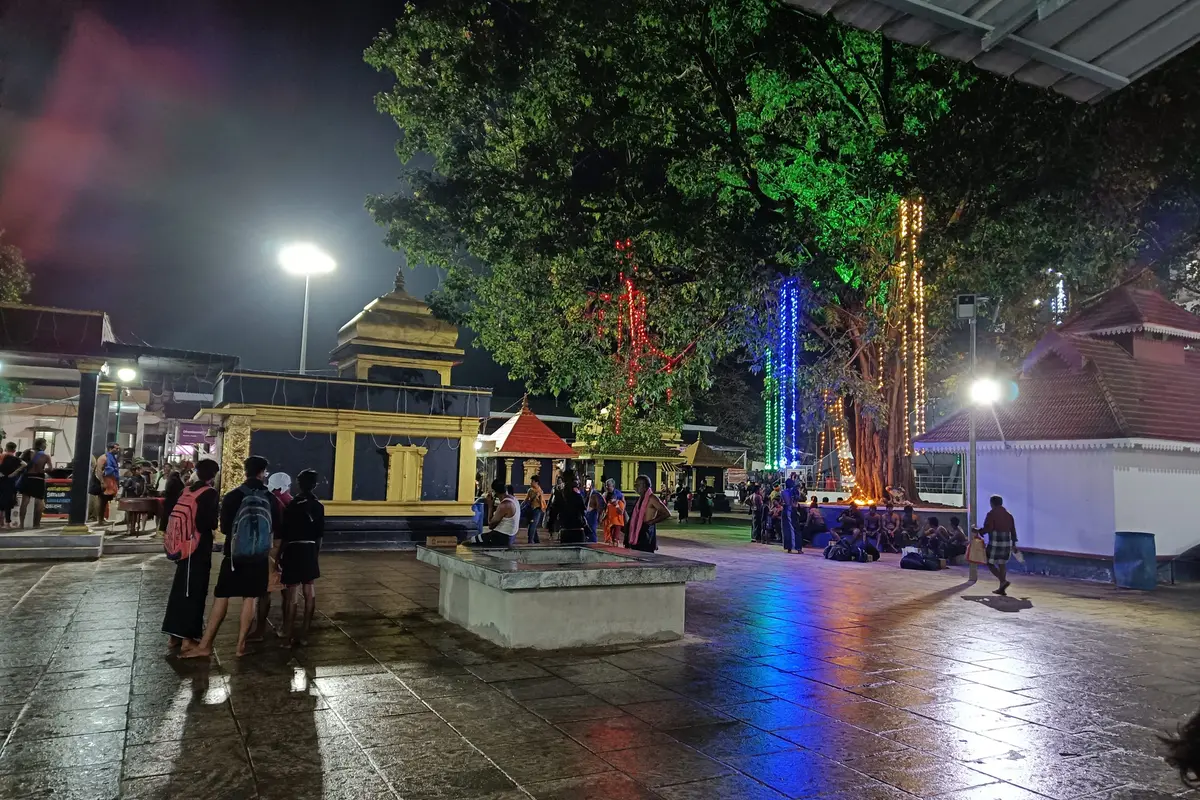
The flame is seen from the designated viewpoints notified by the police and the board each year. Stay inside them, and follow the volunteers. The crowd and the dark make it dangerous to climb trees or wander onto unmarked slopes for a better view, and every year someone tries.
One practical note for anyone who cannot be on the hill on the 14th itself: the caps after the festival are higher than on the day, and the temple stays open until the 20th. Last year the cap on the 14th was 30,000 and on the days after it was 50,000 a day. Older pilgrims and families with children may find the 15th to the 18th kinder. The Lord is the same on every one of them.
Going there: bookings, caps and the cut-offs
The Virtual-Q booking is mandatory, and it is capped lower around Makaravilakku than on ordinary days. Around the 2026 festival the High Court-set caps were 35,000 on 13 January and 30,000 on 14 January, then 50,000 a day from 15 to 18 January, with spot booking at 5,000 a day. The season's ordinary daily cap is 80,000. The 2026–27 caps will be announced by the board and the High Court — book as early as booking opens, and do not count on spot booking. The booking portal is sabarimalaonline.org, and the booking comes before the travel, not after.
The restrictions are announced fresh every year, but last year's pattern is a fair warning of what to expect. On Makaravilakku day in 2026, pilgrim movement from Nilakkal to Pamba was stopped from 10 AM, and from Pamba to Sannidhanam from 11 AM, until the procession was over. Private parking at Hilltop in Pamba was banned from 12 to 15 January. The forest routes closed earlier than usual: Erumeli stopped on the evening of 13 January, Azhuthakadavu after 8 AM and Mukkuzhi after 10 AM on the 14th, and Pulmedu entry after 4 PM, though viewing was allowed.
The practical lesson is to be where you want to be well before the cut-offs. Once movement stops, it stops. Travel light, carry your original ID and your coupon, carry a raincoat because rain is possible, and keep your regular medicines with you. Free annadanam is available at Sabarimala, Pamba, Nilakkal and Erumely. Re-read the irumudi and pilgrim rules, including the plastic ban, before you pack — and remember that private vehicles stop at Nilakkal.
One thing to say plainly, because readers will ask. By long temple custom, women between the ages of 10 and 50 do not make the climb to Sabarimala. The restriction has been before the courts, and as of October 2026 no judgment on it had been delivered. The custom stands for this season. Check the temple's own notices before travelling, as with everything else on this page.
Makaravilakku 2027 in India
The observance is Thursday, 14 January at Sabarimala — the temple's date, not Drik's. Your Sankranti, if you keep it by Drik, is Friday, 15 January, with Punya Kaal 7:15 AM to 5:46 PM and Maha Punya Kaal 7:15 to 9:00 AM. Delhi's sunrise on the 15th is 7:15 AM and sunset 5:46 PM, and the Brahma Muhurta runs 5:27 to 6:21 AM. The Sunsign changes from Dhanu to Makara at 9:14 PM on the 14th — that is the moment itself, and it is why the two dates exist.
So the honest shape of the week for a family in India is: Thursday evening, the deeparadhana at 6:30 PM and the light, watched on the news or the livestream; Friday morning, the Sankranti bath and daan in Drik's window. The Pongal 2027 article covers the same split from the Tamil side, and Lohri 2027 is the night before the local Sankranti.
Where India goes on the day
Sabarimala itself, for those who kept the vratham and hold a Virtual-Q slot. The Magh Mela 2027 opens at Prayagraj on Friday the 15th with its first snan, so some families do both — the light on Thursday evening, the snan on Friday morning. For everyone else the day is kept at home or at the local Ayyappa temple: a lamp in the evening, the Sri Ayyappa Pancharatna Stotram, and Harivarasanam to close. That is the whole home observance, and it needs nothing bought and nothing booked.
Makaravilakku 2027 in USA
The observance is Thursday, 14 January — and here, unusually, the local Sankranti agrees with the temple. New York's Sankranti is Thursday the 14th, with Punya Kaal 10:44 AM to 4:52 PM and Maha Punya Kaal 10:44 AM to 12:20 PM. Sunrise is 7:18 AM, sunset 4:52 PM, and the Brahma Muhurta runs 5:23 to 6:20 AM.
The deeparadhana at 6:30 PM in Kerala is 8:00 AM in New York on Thursday morning — early enough to watch the livestream with breakfast, and early enough that the evening gathering at your temple is the real event of the day, not the screen.
Where America gathers
The United States has the strongest Ayyappa network outside India, and two temples have published 2027 programmes. The Sai Datta Peetham in Edison, New Jersey, holds its Makara Jothi Celebration on Thursday, 14 January 2027, closing a second Mandalam that runs from 1 December to 10 January, with Irumudi Kattu on Saturday 9 January and the climb of the Holy 18th Steps on Sunday 10 January. The Sri Ayyappa Swami Temple in Plainfield, Illinois, lists Makara Vilakku on 14 January, inside a season that runs from 16 November to 14 January, with its Mandala Mahotsavam on 26 December and Irumudi Kettunira on 29 November, 13 and 26 December, and on 14 January itself.
The wider network is the one from the Mandala Pooja article, and it is still the map: the Sri Siva Vishnu Temple in Lanham, Maryland — the Sabarimala of the West, with its sanctified eighteen steps; the Sri Ayyappa Temple of Tampa, Florida, the first dedicated Ayyappa temple in the country; the Westchester Ayyappa Swami Temple in White Plains, New York, the only standalone Ayyappa temple in the Northeast; the Sri Guruvayurappan Temple of Dallas, with North Texas's first holy eighteen steps; Chicago's Ayyappa Seva Sangham, Atlanta's Sastha Atlanta Sabha, and the Bay Area's Ayyappa Samaaj at the SVCC temple in Fremont.
No 2027 hour-by-hour programme was found published for these temples at the time of writing, so this page will not invent one. The pattern from past years is an evening gathering on the 14th — bhajans, the deeparadhana on screen or in the shrine, Harivarasanam to close — and your temple's own notice is the authority for the hours. One caution worth carrying over from the Mandala article: the New Jersey temple's calendar differs from Sabarimala's own — its first Mandalam runs 10 November to 20 December, not 17 November to 27 December — so follow your temple for its own dates, and Sabarimala for the hill's.
Makaravilakku 2027 in UK
The observance is Thursday, 14 January, and London's Sankranti agrees with the temple too. London's Punya Kaal is 3:44 to 4:19 PM — thirty-five minutes, because the moment falls at 3:44 PM and sunset is at 4:19 PM — and the Maha Punya Kaal is the same thirty-five minutes. Sunrise is 8:00 AM, sunset 4:19 PM, and the Brahma Muhurta runs 5:55 to 6:58 AM.
The deeparadhana at 6:30 PM in Kerala is 1:00 PM in London — the middle of the day, and a reasonable time to step away from work for half an hour if your employer allows it.
Harrow, and the miniature steps
Britain's Ayyappa centre is the Sree Ayyappan Temple in Harrow, north-west London, the first Ayyappan temple in the UK, with a miniature set of eighteen steps. It is where London's devotees take the mala, keep the weekly bhajans through the season, and do the kettunira. No 2027 Makara Jyothi programme was found published for Harrow at the time of writing; the pattern is the evening gathering on the 14th, and the temple's own notice is the authority. If you are in the Midlands, the Shri Venkateswara Temple at Tividale has a Lord Ayyappan shrine, and the London Sri Murugan Temple in Manor Park lists Sri Ayyappan among its deities — neither had published a 2027 programme either.
The London version of the day has one practical shape worth naming. The Sankranti window is thirty-five minutes in the afternoon, and the Kerala evening is one o'clock in London. A family that wants both does the Punya Kaal acts at 3:44 PM and watches the deeparadhana at one — or, more honestly, watches the recording in the evening, when everyone is home. A recording of the light is still the light, and nobody at the temple would tell you otherwise.
Makaravilakku 2027 in Germany
The observance is Thursday, 14 January at Sabarimala — but Berlin's Sankranti, like Delhi's, is Friday, 15 January. The moment is 4:44 PM on the 14th, after sunset, so Punya Kaal runs 8:10 AM to 4:22 PM on the 15th, with Maha Punya Kaal 8:10 to 9:32 AM. Sunrise on the 15th is 8:10 AM, sunset 4:22 PM, and the Brahma Muhurta runs 6:03 to 7:07 AM.
The deeparadhana at 6:30 PM in Kerala is 2:00 PM in Berlin on Thursday afternoon.
No Ayyappa temple — and saying so matters
No dedicated Ayyappa temple was found in Germany, and this page will not invent one. Berlin has the Sri Mayurapathy Murugan Temple, founded in 1991, and the Sri Ganesha Tempel in Neukölln, consecrated in June 2026 — but neither publishes an Ayyappa Makaravilakku programme. So in Germany the day is, for most devotees, a home observance, and this festival travels well as one: the evening is a lamp, a stotram, and Harivarasanam, and none of it needs a temple hall.
The German wrinkle is the same as India's, a day apart: Thursday at two in the afternoon is the light, Friday morning is the Sankranti. If your local Tamil temple does stage a Makara Jyothi gathering, go; if it doesn't, the vow is still complete at home. And the same note as in the Dhanurmasam 2026 article applies to any early-morning observance: Germany has Ruhezeiten, and the home puja is quiet by nature — a lamp, a name, a small offering — which is one more reason this festival travels better than the noisy ones.
Makaravilakku 2027 in Mexico
The observance is Thursday, 14 January at Sabarimala, and Mexico City's Sankranti agrees: Thursday the 14th, with Punya Kaal 9:44 AM to 6:18 PM and Maha Punya Kaal 9:44 to 11:35 AM. Sunrise is 7:13 AM, sunset 6:18 PM, and the Brahma Muhurta runs 5:30 to 6:21 AM.
The deeparadhana at 6:30 PM in Kerala is 7:00 AM in Mexico City — breakfast time, and the most civilised hour of the six cities to watch it live.
The longest light, and the smallest community
No Ayyappa temple was found in Mexico, and the Indian community there is small, so this is almost entirely a home observance — which suits this festival better than most. The day is the lamp in the evening, the Pancharatna Stotram, and Harivarasanam. Mexico City gives you the one thing the European cities don't: a dawn bath in actual morning light, a full Sankranti day in the sun, and then the Kerala evening arriving at seven in the morning, before the day has properly started.
If you are keeping the day in Mexico, the useful link is a screen and a phone call. A video call home after the evening lamp reaches India at around 9 PM IST, when the deeparadhana is over and the hill is still full of people. Both ends of the call are keeping the same festival, on the same day, and neither side is wrong about the date.
Makaravilakku 2027 in Russia
The observance is Thursday, 14 January at Sabarimala — but Moscow's Sankranti, like Delhi's and Berlin's, is Friday, 15 January. The moment is 6:44 PM on the 14th, after sunset, so Punya Kaal runs 8:50 AM to 4:28 PM on the 15th, with Maha Punya Kaal 8:50 to 10:06 AM. Sunrise on the 15th is 8:50 AM, sunset 4:28 PM, and the Brahma Muhurta runs 6:39 to 7:44 AM.
The deeparadhana at 6:30 PM in Kerala is 4:00 PM in Moscow — late afternoon, and the easiest of the European hours to catch live.
A vow kept in the dark
No Ayyappa temple was found in Russia, so this is a home observance too, and Moscow gives it the hardest version of the season's central demand. The Brahma Muhurta ends more than an hour before the sun comes up, so the bath and the lamp happen in full dark, and the sun, when it comes, is up for less than eight hours. A Moscow January simply makes the description literal — up early, bathed, at the altar while the stars are still out, which is the traditional form anyway.
The evening puja is the same as everywhere else, and the time zones offer their usual small mercy: a video call home after the evening lamp reaches India at around 8:30 PM IST, when Delhi families are sitting down to their own evening. Both ends of the call are keeping the same festival on the same Thursday. East of Moscow the timings shift with the time zones, as always. Your local temple or your own city's panchang is the authority there; Moscow's hours belong to Moscow.
Keeping it at home
Not everyone needs to be on the hill on the 14th itself, and most devotees never will be. The home observance is short, and it is the whole festival in miniature: light a lamp in the evening, recite the Sri Ayyappa Pancharatna Stotram, and close with Harivarasanam. That is what the guides prescribe, and it needs nothing bought and nothing booked.
What you will need, if you are keeping the season rather than only the evening, is what the Mandala Pooja article lists in full: a mala taken from a guru swami or a priest, black clothes, a picture or idol of Ayyappa, a lamp and oil, flowers, and sandal paste or vibhuti for the forehead. Some temples abroad run a second Mandalam that ends on Makaravilakku itself — the New Jersey temple's runs from 1 December to 10 January — so if your temple counts it that way, your forty-one days end at the light, not at the Mandala Pooja. Your guru swami's count is the one that governs you, not a website's.
The Kartik–Margashirsha 2026 series: Diwali 2026 · Govardhan Puja 2026 · Bhai Dooj 2026 · Chhath Puja 2026 · Dev Uthani Ekadashi 2026 · Tulsi Vivah 2026 · Dev Diwali 2026 · Kalabhairav Jayanti 2026 · Utpanna Ekadashi 2026 · Margashirsha Amavasya 2026 · Vivah Panchami 2026 · Subrahmanya Shashthi 2026 · Dhanurmasam 2026 · Mokshada Ekadashi 2026 · Margashirsha Purnima 2026 · Akhuratha Sankashti Chaturthi 2026 · Sabarimala Mandala Pooja 2026 · Saphala Ekadashi 2027 · Magh Mela 2027 · Lohri 2027 · Makar Sankranti 2027 · Pongal 2027 · Makaravilakku 2027
Check your own city before you rely on any date here: the Hindu Panchang Calculator shows today’s tithi and festival dates for your location, the Hindu Date Converter converts between Gregorian and Hindu calendar dates, and this article on the astronomy behind the panchang explains how these calculations are actually made.
Photos: Sannidhanam at Sabarimala in daylight, Sannidhanam at night, and the Periyar welcome board — Dhinakar01, CC BY-SA 4.0; the Makara Jyothi over the hill — Harhar2008, CC BY 3.0; the 18 holy steps and Sabaripeedam — Sailesh, CC BY-SA 3.0; all via Wikimedia Commons.
Dates follow the Travancore Devaswom Board's 2026–27 season calendar as reported when the temple opened on 16–17 November 2026 (sabarimala.com, newkerala.com, urbanacres.in, tryambakmedia.in), and the Makaravilakku guides of ssbhakthi.com, hindupad.com and sreeayyappatemple.com. Sankranti moments, Punya Kaal and sunrise/sunset/Brahma Muhurta times are from Drik Panchang's Makar Sankranti festival page and day panchang for 14–15 January 2027 for New Delhi, New York, London, Berlin, Mexico City and Moscow, re-verified live on 20 November 2026. The Thiruvabharanam route follows hindu-blog.com and the 2026 procession reports; the 2011 court acknowledgement and the 2026 caps and restrictions follow ssbhakthi.com. Diaspora programmes follow the temples' own published pages (Sai Datta Peetham, Edison NJ; Sri Ayyappa Swami Temple, Plainfield IL) and HinduTone's Ayyappa Deeksha Abroad 2026–27 guide. Where sources disagree — the temple's 14 January against Drik's 15 January in India, the season's closing hour on 20 January — this page says so and says which source it follows and why. Your local temple's announcement overrides any website, including this one.