
Makar Sankranti 2027 is Thursday 14 January abroad, Friday 15 January in India — one moment, two days
Makar Sankranti 2027 is Thursday 14 January in New York, London and Mexico City and Friday 15 January in Delhi, Berlin and Moscow — one moment, 15:44 UTC on 14 January, with Punya Kaal, Uttarayan kites, Poush pithas and the Magh Mela opening.
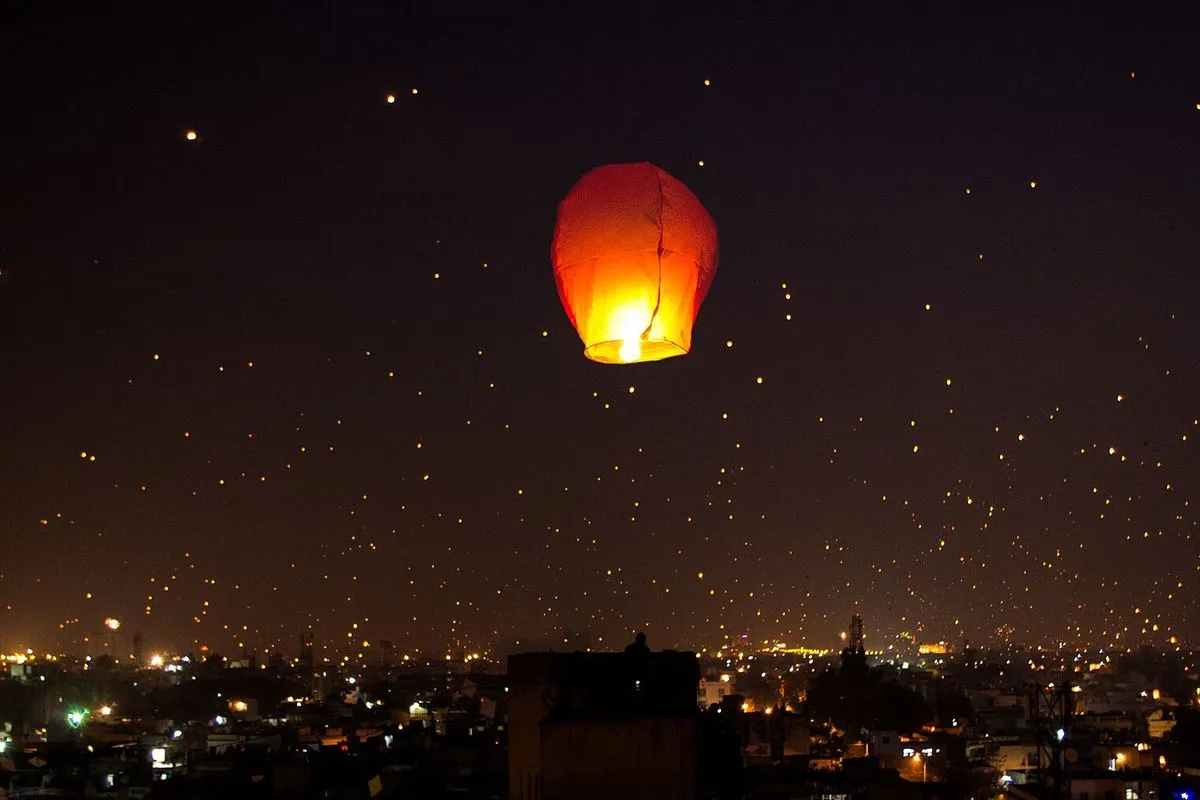
Makar Sankranti 2027 falls on Thursday, 14 January in New York, London and Mexico City, and on Friday, 15 January in Delhi, Berlin and Moscow. The Sun enters Makara at one single instant — 15:44 UTC on Thursday, 14 January, which is 9:14 PM in Delhi, 10:44 AM in New York, 3:44 PM in London — and the date splits because the moment falls after sunset in India, Germany and Russia, so the whole observance moves to the next morning. This page gives you your city's date, your Punya Kaal window, and what to actually do in it: the dawn bath, the arghya to the rising Sun, the til and gur, the khichdi, the kites in Gujarat and the pithas in Bengal.
Makar Sankranti 2027 at a glance
| Makar Sankranti, New York / London / Mexico City | Thursday, 14 January 2027 |
| Makar Sankranti, Delhi / Berlin / Moscow | Friday, 15 January 2027 |
| The Sankranti moment | 14 January everywhere — Delhi 9:14 PM, Moscow 6:44 PM, Berlin 4:44 PM, London 3:44 PM, New York 10:44 AM, Mexico City 9:44 AM (15:44 UTC) |
| Punya Kaal, Delhi | 7:15 AM–5:46 PM on Fri 15 Jan; Maha Punya Kaal 7:15–9:00 AM |
| Punya Kaal, New York | 10:44 AM–4:52 PM on Thu 14 Jan; Maha Punya Kaal 10:44 AM–12:20 PM |
| Punya Kaal, London | 3:44–4:19 PM on Thu 14 Jan — only 35 minutes |
| Punya Kaal, Berlin | 8:10 AM–4:22 PM on Fri 15 Jan; Maha Punya Kaal 8:10–9:32 AM |
| Punya Kaal, Mexico City | 9:44 AM–6:18 PM on Thu 14 Jan; Maha Punya Kaal 9:44–11:35 AM |
| Punya Kaal, Moscow | 8:50 AM–4:28 PM on Fri 15 Jan; Maha Punya Kaal 8:50–10:06 AM |
| The night before | Lohri — Wed 13 Jan in New York, London, Mexico City; Thu 14 Jan in Delhi, Berlin, Moscow |
| The morning after, in India | The Magh Mela 2027 opens at Prayagraj, Friday 15 January |
| Also called | Uttarayan in Gujarat, Poush Sankranti in Bengal, Pongal in Tamil Nadu, Maghi in Punjab, Khichdi Parv in Uttar Pradesh |
Three honest wrinkles before anything else. First, the split is real and it is Drik's own: the festival page for every city gives the same moment, 14 January, and then observes it on the 14th where the moment falls in daylight and on the 15th where it falls after sunset. If your family group chat says "Sankranti is the 14th" and your cousin in Delhi says "the 15th", both of you are right, for your own cities. Second, Gujarat does not follow Drik here. The kites go up on 14 January whatever the almanac says, and the 15th is Vasi Uttarayan — more on that below. Third, the Ganga Sagar Mela's main bath is listed as Friday, 15 January by most sources, but at least one festival listing gives Thursday, 14 January. This page follows Drik, which puts the observance on the 15th in India, and names the disagreement: if you are travelling to Sagar Island, check the West Bengal administration's current notice before you fix your dates.
One more, smaller than the others. Drik's day panchang for 15 January in Delhi lists no festival name at all in the text as fetched — only "Makara" as a rashi and a lagna. The dedicated Makar Sankranti festival page is the authority this page follows, and the day panchang corroborates it independently: on 14 January in every city the Sunsign changes from Dhanu to Makara at exactly the moment the festival page gives, and the sunrise and sunset on each observance day match the Punya Kaal start and end to the minute.
What Makar Sankranti actually is
It is the one big Hindu festival that follows the Sun, not the Moon. Most festivals move around the calendar because they are tied to tithis; this one lands on 14 or 15 January almost every year because it is the day the Sun enters Makara, Capricorn, and begins Uttarayan — its six-month northward journey. The days get longer from here. That is the whole festival, really: the light coming back, the coldest month ending, the winter harvest in, and a morning built around the Sun itself.
Drik puts it plainly on the festival page: the forty ghatis — roughly sixteen hours — from the Sankranti moment are Punya Kaal, and the bath, the offering to Surya, the charity, the shraddha and the breaking of a fast should all be done inside it. And because the moment falls after sunset in India this year, all of that is postponed to the next sunrise. That is why Delhi's Punya Kaal runs from sunrise to sunset on Friday the 15th, and why the Maha Punya Kaal — the most auspicious slice, five ghatis after sunrise — runs 7:15 to 9:00 AM that morning. Where the moment falls in the daytime, the window opens at the moment itself: New York's runs 10:44 AM to sunset, Mexico City's 9:44 AM to sunset, London's 3:44 PM to sunset. London's sunset is 4:19 PM, which is why London gets thirty-five minutes and Mexico City gets eight and a half hours. Same festival, same moment, wildly different mornings.
The Dhanurmasam ends with it, and Kharmas lifts the same morning — which is why the wedding calendar starts moving again the same week. The month of Magh begins, and with it the Magh Mela at Prayagraj, which opens on Friday the 15th with the first snan of the season.
The morning: snan, arghya, daan
The day starts before dawn, in the Brahma Muhurta. The bath is the first act, and it is a sesame bath: a pinch of black sesame seeds in the water, a few drops of Ganga water if you have any. In India the bath is taken in a river wherever one is near — the Ganga at Prayagraj, where the Magh Mela opens that morning; the Ganga at Sagar Island, where the Ganga Sagar Mela draws one of the largest pilgrim gatherings in the country; the river confluences all over the country, where devotees were photographed bathing at dawn on Sankranti morning. Abroad, the bath is at home, with the sesame and the Ganga water in the tub. Nobody in Prayagraj will check. The sesame is the point.
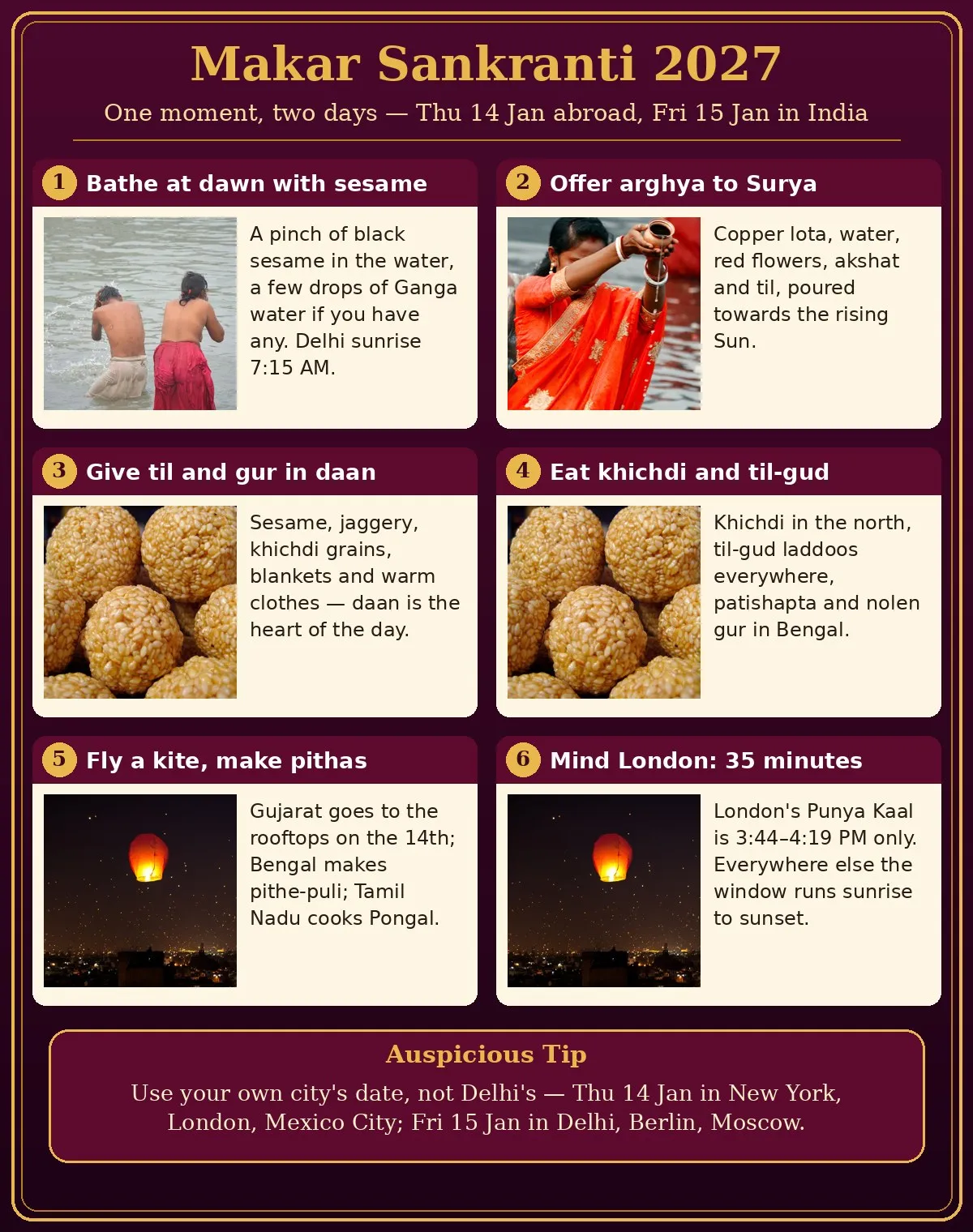
Then the arghya. A copper lota of water, red flowers, unbroken rice grains, kumkum and a pinch of til, held up with both hands and poured in a thin stream towards the rising Sun, while the Gayatri or a Surya mantra is said. The photograph below is a woman offering water at a river confluence on Sankranti morning — the gesture is the same whether the river is the Subarnarekha or the tap in your bathroom, and the Sun is the same one.
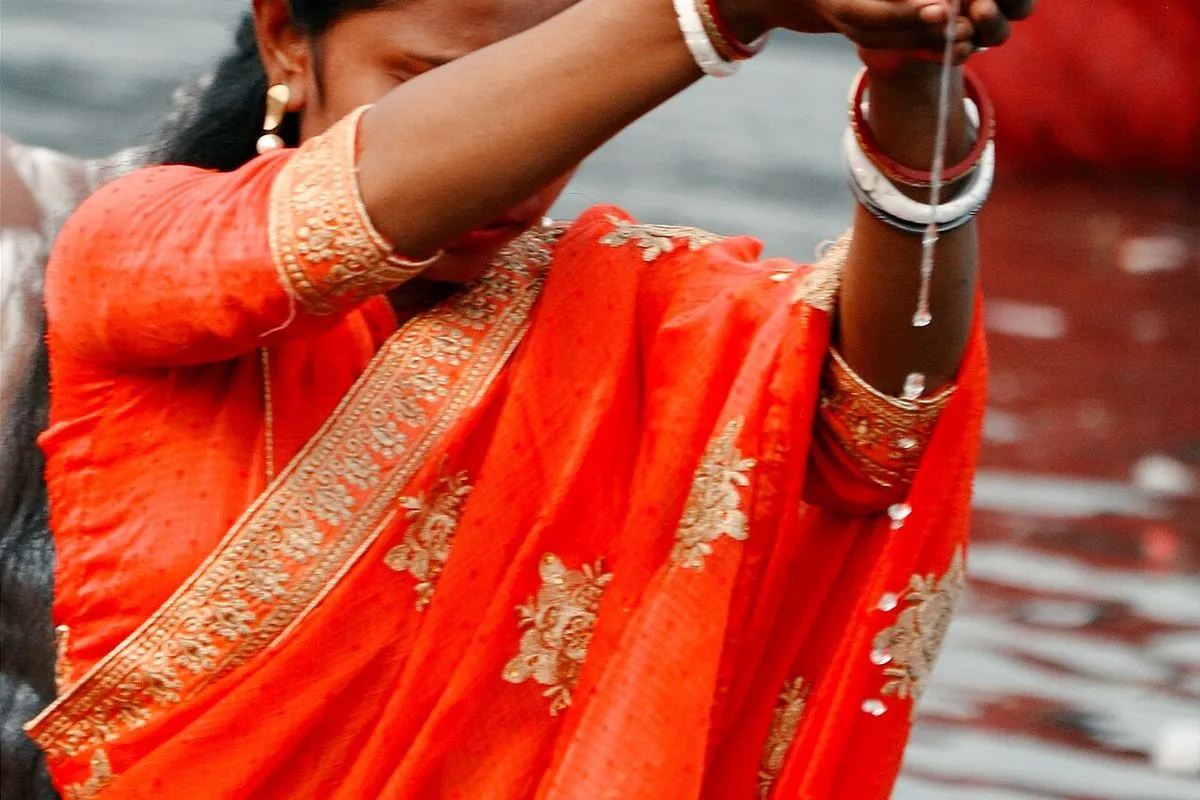
Then daan, which is the heart of the day. Sesame and jaggery first — til and gur, the two things the whole festival is made of — then khichdi grains, raw rice and dal for someone else's pot, then warmth: blankets, bedding, warm clothes, because this is the coldest month of the year. The texts say the charity of Sankranti is repaid many times over, and they prize the secret kind most: giving without display, so the recipient never knows who gave it. If you give one thing, give warmth. If you give two, add the sesame.
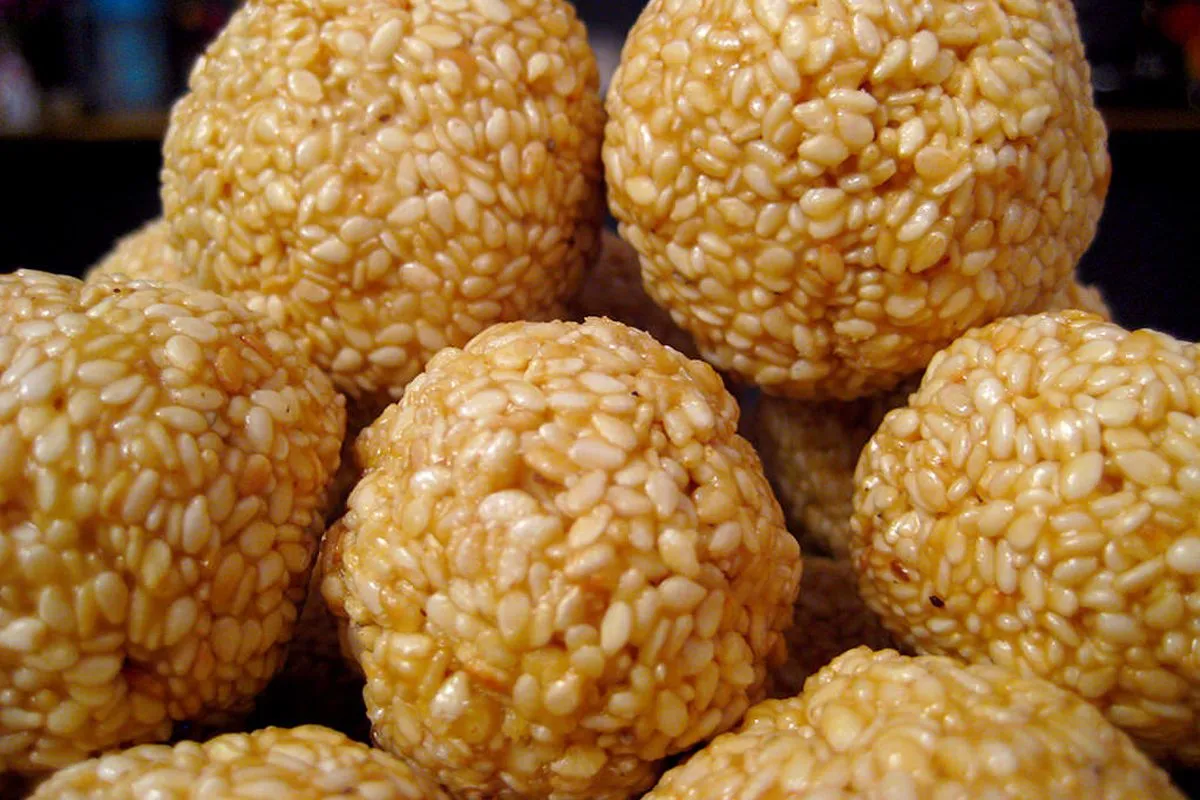
The photograph above is the sweet itself: til ke laddu, roasted sesame bound with jaggery, the sweet that carries the whole day in two ingredients. In Maharashtra the exchange comes with the greeting everyone knows — til-gul ghya, god god bola: take the sesame and jaggery, and speak sweetly. It is the only festival greeting that is also a recipe and a piece of advice.
Uttarayan in Gujarat — the sky becomes the festival
In Gujarat the festival is called Uttarayan, and it is kept with kites. From sunrise to past sundown, the rooftops of Ahmedabad, Surat, Vadodara and Rajkot fill with families flying patang, cutting each other's strings with shouts of "Kai Po Che!", and watching the lanterns go up after dark. The International Kite Festival, run by Gujarat Tourism at the Sabarmati Riverfront since 1989, brings kite masters from around the world in the days before, with giant and sometimes very strange kites over the river. The Patang Bazaar near Raipur stays open all night in the days leading up to it.
Here is the wrinkle, and it is worth saying plainly. In 2027 the Sun enters Makara at about 9 PM on 14 January, after sunset, so Drik — and the panchangs that follow the same rule — puts Makar Sankranti on Friday the 15th in India. Gujarat does not move its kites for this. The roofs fill on 14 January, and the 15th is Vasi Uttarayan, the second day of flying, whatever the almanac says. So if you are in Ahmedabad, the kites are on the 14th and the Punya Kaal is on the 15th, and both are right: the kites follow the custom, the bath and the daan follow the panchang. Do the kites on the 14th and the bath on the 15th, and you have kept both.
Poush Sankranti in Bengal — the pithas
In Bengal the same day is Poush Sankranti, the last day of the month of Poush, and it is a festival of rice cakes. The new aman paddy is in, the date-palm jaggery — nolen gur, the liquid gold of the Bengali winter — is flowing, and every kitchen turns into a small sweet factory. The pithas are the festival: patishapta, thin rice-flour crepes rolled round coconut and jaggery; puli pitha, crescent dumplings stuffed with coconut and jaggery, steamed or fried, or simmered in sweetened milk as dudh puli; gokul pithe, deep-fried rice balls in jaggery syrup; and nolen gurer payesh, rice pudding made with Gobindo Bhog rice and date-palm jaggery. There are said to be over a hundred varieties, and the women of the house make them together, which is the point as much as the eating.
The day is also kept as a harvest puja — Baharlaxmi Puja, the worship of the goddess near the granaries, and in rural Bengal as Aauni Bauni, honouring Lakshmi for the crop. And at the southern tip of Sagar Island, where the Hooghly spreads into the Bay of Bengal, the Ganga Sagar Mela gathers for the Punya Snan at the Gangasagar Sangam, with darshan at the Kapil Muni Temple. The mela runs for about a week around Sankranti, roughly 10 to 17 January, with the main bath on Friday the 15th — though one festival listing gives Thursday the 14th, as noted above, so check the administration's notice if you are going.
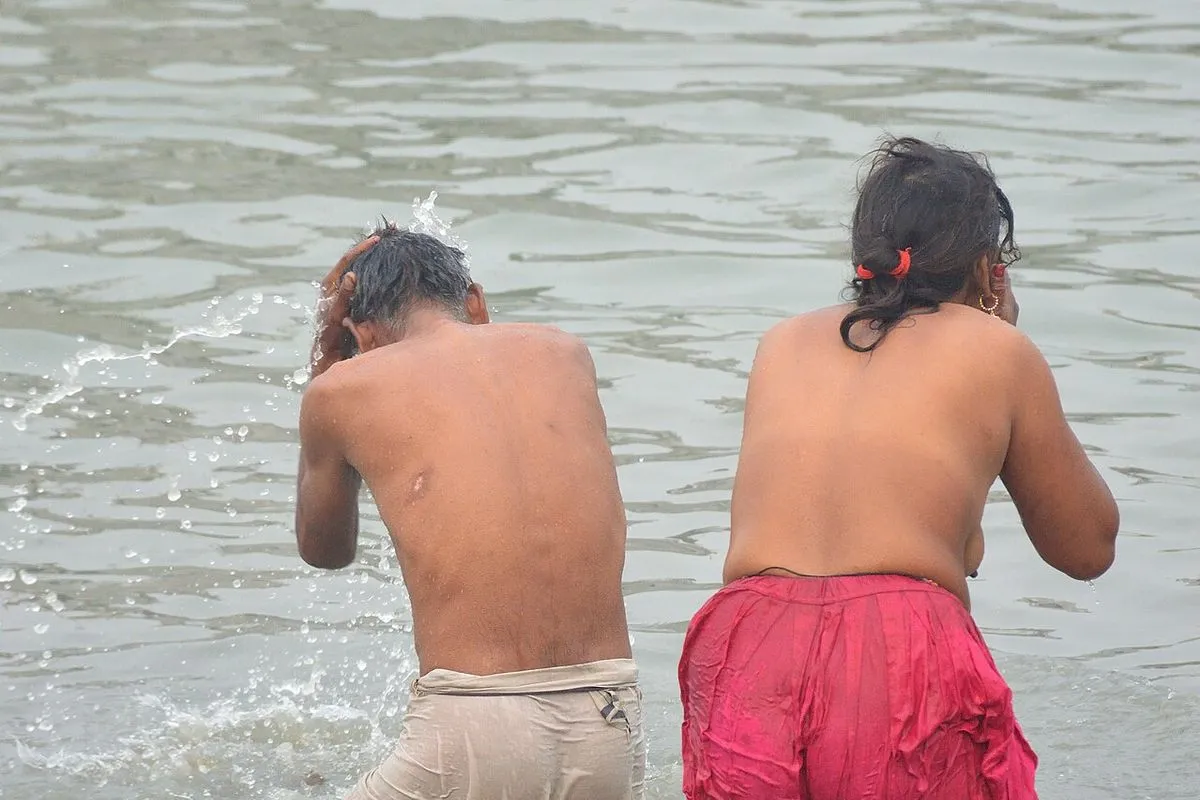
The photograph below is the other great bath of the day: devotees taking the holy dip in the Ganga at Kolkata on Sankranti morning, the same snan kept at Sagar Island on a far larger scale.
Pongal in Tamil Nadu, and the rest of the map
In Tamil Nadu the same day is Pongal, and it is a four-day festival, not one: Bhogi on the 14th, Thai Pongal — the day itself — then Mattu Pongal and Kaanum Pongal. The dish is pongal, rice cooked with milk and jaggery and offered to the Sun, and the festival has its own article in this series, coming next — the dates and the four days are verified there. In Assam it is Magh Bihu, or Bhogali Bihu, the feast Bihu, kept with til pitha and the meji bonfires. In Punjab and Haryana it is Maghi, and the night before is Lohri, which has its own article here. In Uttar Pradesh it is Khichdi Parv, and the khichdi is cooked and offered in temples and fed to the poor. One Sun, one crossing, half a dozen names, and every one of them is the same day.
Makar Sankranti 2027 in India
Makar Sankranti is Friday, 15 January. The moment is 9:14 PM on Thursday, 14 January, after sunset, so everything moves to the Friday morning: Punya Kaal 7:15 AM to 5:46 PM, Maha Punya Kaal 7:15 to 9:00 AM. Delhi's sunrise on the 15th is 7:15 AM and sunset 5:46 PM, and the Brahma Muhurta runs 5:27 to 6:21 AM — the window the whole morning is built around.
Where India keeps it
Everywhere, differently. In Gujarat the kites are up on Thursday the 14th, Vasi Uttarayan on Friday the 15th, and the bath and daan follow Drik's Friday window. In Bengal the pithas are made on the 15th and the Ganga Sagar snan is taken that morning, with the mela running through the week. In Tamil Nadu the Pongal sequence runs across the same days. In Uttar Pradesh the khichdi is cooked and given. And at Prayagraj the Magh Mela opens on Friday the 15th with the first snan of the season, and the month of Magh begins in earnest — six snan days, a month of Kalpvas inside it, and the Dhanurmasam finally over. If you are in India on the 15th, the morning is the festival: bath at dawn, arghya at sunrise, daan before noon, khichdi and til-gud for lunch, kites or pithas in the afternoon.
Makar Sankranti 2027 in USA
Makar Sankranti is Thursday, 14 January — a day earlier than India, because the moment falls at 10:44 AM in New York, in full daylight. Punya Kaal runs 10:44 AM to 4:52 PM, Maha Punya Kaal 10:44 AM to 12:20 PM. New York's sunrise on the 14th is 7:18 AM and sunset 4:52 PM, and the Brahma Muhurta is 5:23 to 6:20 AM.
The kites move to the weekend
The practical shape abroad is the one the Gujarati community has settled on: the bath and the arghya and the daan on the Thursday, in the window Drik gives, and the kites on the Saturday closest to 14 January, when the Gujarati Samaj chapters — Edison in New Jersey, Houston, Chicago, Atlanta, the Bay Area — run daytime kite-flying events at large public parks. It is the same split as the festival itself: the panchang on the Thursday, the party on the Saturday. The Indian grocers stock til-gud laddoos, gajak and rewari from early January, and the khichdi is cooked at home. A video call home on Thursday evening reaches Delhi on Friday morning, before their bath: your Sankranti is already done, and theirs is just beginning. Both are the same festival, on different days, and neither side is wrong.
Makar Sankranti 2027 in UK
Makar Sankranti is Thursday, 14 January, a day earlier than India, like New York. The moment is 3:44 PM, and here is the number to remember: Punya Kaal is 3:44 to 4:19 PM — thirty-five minutes, because the Sun sets at 4:19 PM. Maha Punya Kaal is the same thirty-five minutes. London's sunrise on the 14th is 8:00 AM and the Brahma Muhurta runs 5:55 to 6:58 AM.
Thirty-five minutes, so plan them
This is the sharpest practical detail in the whole article, and it belongs to London alone. Every other city gets hours; London gets half an hour, at the end of the working day, in the middle of January. If you are keeping it properly, take the afternoon off, or arrange to be home by half past three: the bath can be taken in the morning, but the arghya and the daan belong inside that 3:44 to 4:19 window, and there is no second chance that day. The sweets are the easy part — til-gud laddoos, gajak and rewari from the Indian grocers, khichdi cooked at home — and the temples run Sankranti programmes in the evening. The kites, if your family flies them, go up at the weekend, in a park, like everywhere else abroad.
Makar Sankranti 2027 in Germany
Makar Sankranti is Friday, 15 January, the same day as India — Berlin is on the Delhi side of the split. The moment is 4:44 PM on Thursday, 14 January, and Punya Kaal runs 8:10 AM to 4:22 PM on Friday, with Maha Punya Kaal 8:10 to 9:32 AM. Berlin's sunrise on the 15th is 8:10 AM and sunset 4:22 PM, and the Brahma Muhurta runs 6:03 to 7:07 AM.
A quiet Friday morning
Germany's Indian community is smaller than London's or New York's, and the celebration is usually a family or temple affair, indoors. The same note from the Lohri article applies here too: Germany has Ruhezeiten, and a festival that starts before dawn is not a neighbourly proposition at full volume. The bath is quiet, the arghya is offered at the window or the balcony facing the rising Sun, the daan is given through the temple or a charity, and the khichdi and til-gud are cooked at home. If your temple stages a Sankranti programme, it will be a temple affair, indoors, and the neighbours will never know. The morning goes on either way.
Makar Sankranti 2027 in Mexico
Makar Sankranti is Thursday, 14 January, a day earlier than India, like New York and London. The moment is 9:44 AM, and Punya Kaal runs 9:44 AM to 6:18 PM — the longest window of the six cities, eight and a half hours. Maha Punya Kaal is 9:44 to 11:35 AM. Mexico City's sunrise on the 14th is 7:13 AM and sunset 6:18 PM, and the Brahma Muhurta runs 5:30 to 6:21 AM.
The most generous morning of the six
Mexico City gets the easiest version of the festival: more than eleven hours of daylight, a 6:18 PM sunset, and a mild January morning. The Indian community is small, so the celebration is usually a family gathering or a temple programme, but the observance itself is the least constrained of any city in this article — the bath at dawn, the arghya at sunrise, the daan before lunch, the khichdi and the til-gud, and nobody freezing and nobody watching the clock. It is the one city where the whole day fits comfortably into the day, and the video call home on Thursday evening reaches Delhi on Friday morning, before their bath.
Makar Sankranti 2027 in Russia
Makar Sankranti is Friday, 15 January, the same day as India — Moscow is on the Delhi side of the split. The moment is 6:44 PM on Thursday, 14 January, and Punya Kaal runs 8:50 AM to 4:28 PM on Friday, with Maha Punya Kaal 8:50 to 10:06 AM. Moscow's sunrise on the 15th is 8:50 AM — the latest of the six — and sunset is 4:28 PM, so the Sun is up for less than eight hours. The Brahma Muhurta runs 6:39 to 7:44 AM.
A bath in the dark, a lamp at the window
A Moscow January is the closest any city in this article comes to the winter morning the festival describes, and the bath is taken indoors, with the sesame and the Ganga water in warm water, before a sunrise that does not come until nearly nine. The arghya is offered at the window, facing a Sun that rises low and late, and the daan is given through the temple or a charity, because the blankets and warm clothes the festival asks for are not an abstraction in Moscow in January — they are what the city is wearing. The khichdi is cooked at home, the til-gud is shared, and the video call home after the morning reaches India at around midday, when Delhi families are sitting down to their own lunch after the bath. Both ends of the call are keeping Sankranti on the same day — Moscow and Delhi agree on the 15th — and the Sun on the screen is the same Sun, a day's warmth carried across four time zones.
East of Moscow the timings shift with the time zones, as always. Your local temple or your own city's panchang is the authority there; Moscow's hours belong to Moscow.
What you'll need, roughly
Sesame seeds and jaggery, for the bath, the arghya, the sweets and the daan — buy them in one bag, they do the whole day. A copper lota, red flowers, unbroken rice and kumkum for the arghya. Rice and dal for the khichdi, and something extra for the giving: blankets or warm clothes if you can, because the festival asks for warmth before anything else. In Bengal, rice flour, coconut and nolen gur for the pithas. In Gujarat, a kite and a spool of manjha, and a rooftop or a park. And a phone, charged, for the video call home, because the bath in Prayagraj and the bath in your bathroom are the same festival, and the call is how you stand at both.
That is the entire list. Makar Sankranti is not a festival of shopping. It is a bath, an offering to the Sun, something sweet given away — and a winter morning kept in the company of people who know what the sesame is for.
The Kartik–Margashirsha 2026 series: Diwali 2026 · Govardhan Puja 2026 · Bhai Dooj 2026 · Chhath Puja 2026 · Dev Uthani Ekadashi 2026 · Tulsi Vivah 2026 · Dev Diwali 2026 · Kalabhairav Jayanti 2026 · Utpanna Ekadashi 2026 · Margashirsha Amavasya 2026 · Vivah Panchami 2026 · Subrahmanya Shashthi 2026 · Dhanurmasam 2026 · Mokshada Ekadashi 2026 · Margashirsha Purnima 2026 · Akhuratha Sankashti Chaturthi 2026 · Sabarimala Mandala Pooja 2026 · Saphala Ekadashi 2027 · Magh Mela 2027 · Lohri 2027 · Makar Sankranti 2027
Check your own city before you rely on any date here: the Hindu Panchang Calculator shows today’s tithi and festival dates for your location, the Hindu Date Converter converts between Gregorian and Hindu calendar dates, and this article on the astronomy behind the panchang explains how these calculations are actually made.
Photos: Night of Uttarayan, Ahmedabad, 14 January 2015 — Bhavishya Goel, CC BY 2.0; Til ke laddu — Soniya Goyal, CC BY-SA 2.0; Devotees bathing in the Ganga, Kolkata, Makar Sankranti 2018 — Biswarup Ganguly, CC BY 3.0; Woman offering water at a river confluence, Jamshedpur, Makar Sankranti 2025 — Sumita Roy Dutta, CC BY-SA 4.0; all via Wikimedia Commons.
Timings follow Drik Panchang's Makar Sankranti festival page for New Delhi, New York, London, Berlin, Mexico City and Moscow, checked 19 November 2026, with sunrise, sunset and Brahma Muhurta from Drik's day-panchang pages for the observance day in each city. The day panchangs corroborate the Sankranti moment independently: on 14 January in every city the Sunsign changes from Dhanu to Makara at exactly the moment the festival page gives. The day panchang text as fetched lists no festival name for 15 January in Delhi; the dedicated festival page is the authority followed here. Gujarat's kite custom (14 January, Vasi Uttarayan 15 January) follows the state's own practice, which differs from Drik's observance date in India. The Ganga Sagar Mela's main bath is listed as Friday, 15 January by most sources, with at least one festival listing giving Thursday, 14 January; this page follows Drik and names the disagreement. The Pongal sequence (Bhogi, Thai Pongal, Mattu Pongal, Kaanum Pongal) is covered in full in the Pongal article in this series. Your local temple's announcement overrides any website, including this one.