
Magh Mela 2027 runs Friday 15 January to Saturday 6 March — and Makar Sankranti splits, Thursday in America and London, Friday in India
Magh Mela 2027 runs 15 January to 6 March at Prayagraj's Triveni Sangam. Six snan days city by city — Makar Sankranti splits 14 vs 15 January, Mauni Amavasya is 6 February everywhere — Kalpvas, Magh snan at home, and daan.
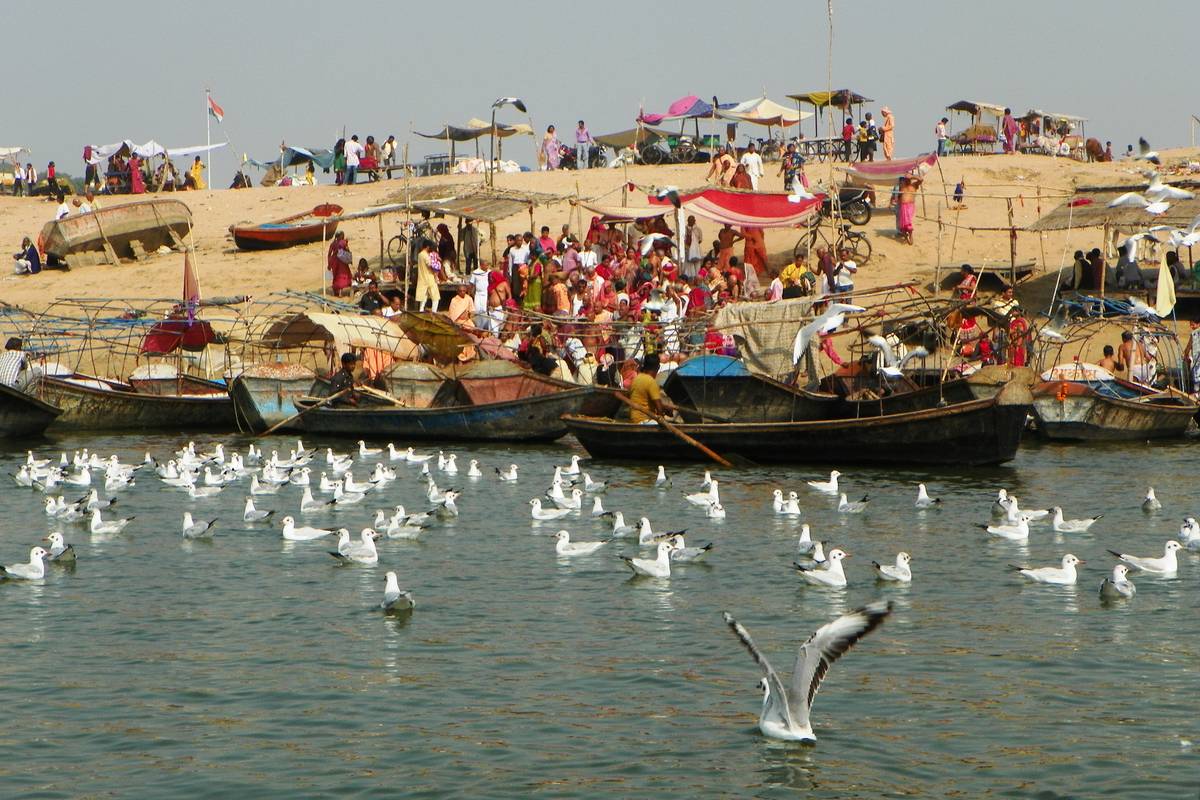
The Magh Mela 2027 runs from Friday, 15 January to Saturday, 6 March at the Triveni Sangam in Prayagraj, and the first bath already splits the world in two: Makar Sankranti falls on Thursday, 14 January in New York, London and Mexico City, and on Friday, 15 January in Delhi, Berlin and Moscow. Six great snan days frame the season, a month of Kalpvas sits inside it, and if you live abroad, here is the honest version — a dawn bath at home, with Ganga water and sesame if you have them. The mela itself is in Prayagraj, and no video call gets you to the Sangam.
Magh Mela 2027 at a glance
| Mela | Friday, 15 January – Saturday, 6 March 2027, Triveni Sangam, Prayagraj |
| Makar Sankranti | Thu 14 Jan (New York, London, Mexico City) / Fri 15 Jan (Delhi, Berlin, Moscow); the moment is 14 Jan everywhere |
| Paush Purnima, Kalpvas begins | Fri 22 Jan (Thu 21 Jan in Mexico City) |
| Mauni Amavasya | Sat 6 Feb, all six cities |
| Vasant Panchami | Thu 11 Feb, all six cities |
| Magha Purnima, Kalpvas ends | Sat 20 Feb, all six cities |
| Maha Shivratri, final snan | Sat 6 Mar, all six cities |
| Kalpvas | 22 January – 20 February 2027 |
| The month (Purnimanta count) | Magh, 23 January – 20 February |
| Not a Kumbh year | Maha Kumbh was at Prayagraj in 2025; the 2027 Kumbh cycle is Haridwar and Nashik |
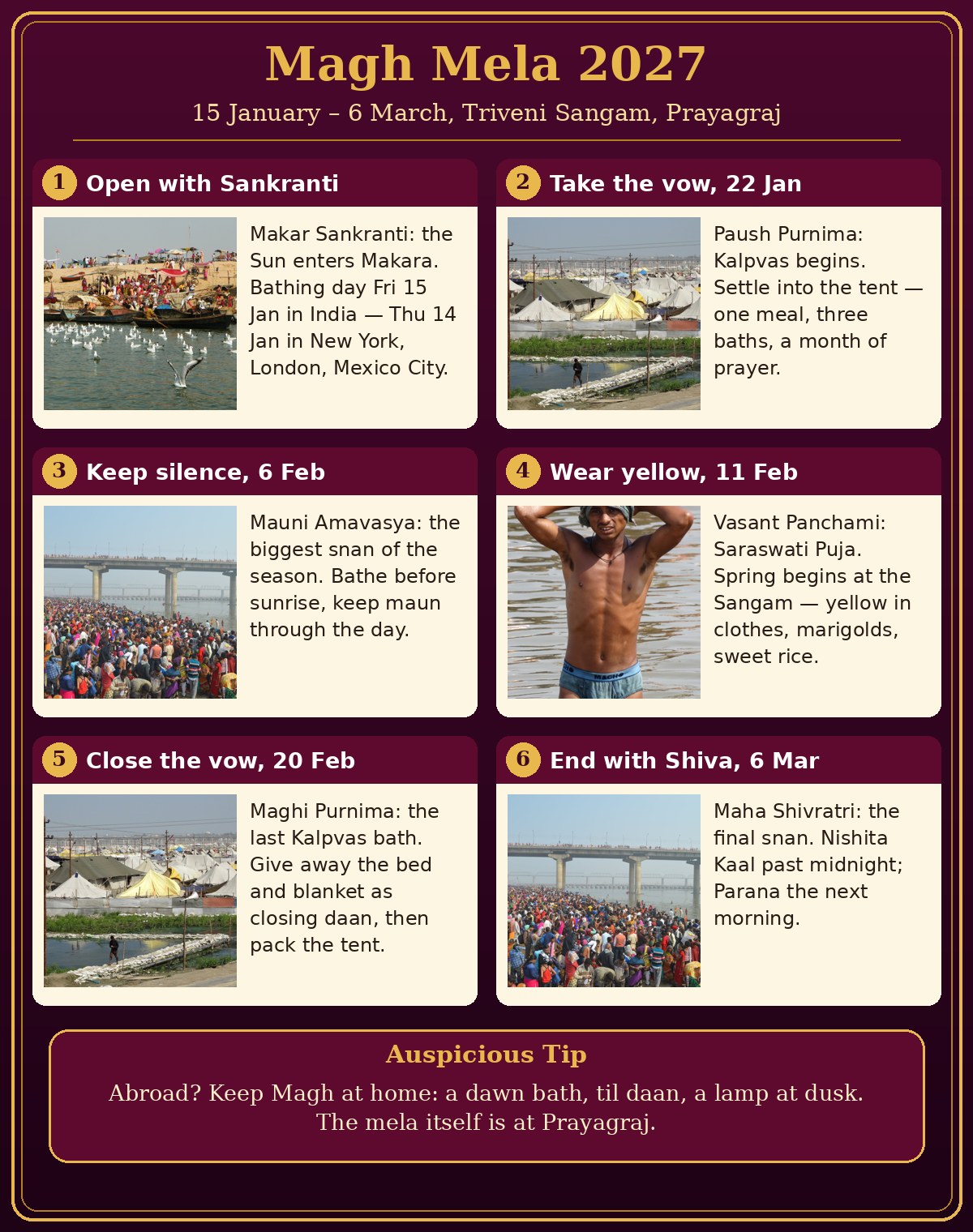
Four wrinkles before anything else, because two of them will catch people out. First, the Makar Sankranti split above: the Sun enters Makara on 14 January in every city — 9:14 PM in Delhi, 10:44 AM in New York, 3:44 PM in London, 4:44 PM in Berlin, 9:44 AM in Mexico City, 6:44 PM in Moscow — and the observation day splits because Drik's Punya Kala falls on the following morning in Delhi, Berlin and Moscow. London gets the shortest version of the day: its Punya Kala runs 3:44 to 4:19 PM, thirty-five minutes, because the sun sets at 4:19 PM.
Second, Paush Purnima splits in Mexico City only. It is Thursday, 21 January there, and Friday, 22 January in the other five cities. New York is the borderline case worth naming: its main Purnima date is Friday 22 January, but Drik lists its Pausha Purnima Upavasa on Thursday 21 January, so a New York family keeping the fast should check which their temple follows.
Third, the one that does not split. Mauni Amavasya is Saturday, 6 February in all six cities, even though the Amavasya tithi begins on 5 February everywhere. The day panchang settles it: 5 February lists no Mauni Amavasya in any of the five cities abroad — New York and Mexico City list Darsha Amavasya instead, London, Berlin and Moscow list only yogas — and 6 February lists Mauni Amavasya in every city. If your calendar app says the 5th, it is reading the tithi start, not the day.
Fourth, two things Drik does not give. It lists no puja window for either Purnima — only the tithi and the moonrise — so this page quotes those and invents no window. And for Maha Shivratri, the Parana in New York and Mexico City is listed as a single time, 6:21 AM and 6:51 AM on 7 March, with no end time shown, unlike the other four cities. That is stated as listed, not filled in.
One more small thing about 6 February: Drik's Delhi day panchang also lists an annular solar eclipse, a Surya Grahan, on the same day as Mauni Amavasya. It is not visible from India, and it is not the story of the day — the silence and the bath are — but if someone asks why their panchang app shows an eclipse that morning, that is why.
What the mela actually is
The Magh Mela is the annual gathering at the Triveni Sangam, where the Ganga and the Yamuna meet the invisible Saraswati. It is not a Kumbh. The Maha Kumbh was at Prayagraj in 2025, and the 2027 Kumbh cycle sits at Haridwar and Nashik. The Magh Mela happens every single winter without interruption, and it is the older, quieter habit: a tent city rises on the floodplain, people come for a day or a month, and the river does the work.
The month is the point. Magh is the lunar month named for the Magha nakshatra, and the tradition holds it as the best month of the year for bathing, charity and simple discipline. The Padma Purana says so plainly, and the Prayaga Mahatmya — the old praise of Prayaga — says that bathing through Magh is the finest of austerities. In the Padma Purana's Uttara Khanda, the sage Bhrigu teaches King Dilipa that a Magha bath destroys accumulated sin and increases merit, and that even those who cannot manage severe penance gain greatly from the simple acts: bathing in sacred water, feeding the poor, listening to sacred lore. The Mahabharata calls Prayaga the foremost of pilgrimage sites, and says a single bath there in an auspicious time grants merit equal to great sacrifices.
By the Purnimanta count used across the north, Magh runs from the morning after Paush Purnima, 23 January, to Magha Purnima, 20 February — and that is exactly the Kalpvas month, which is not a coincidence. The Amanta calendars used in the south run it a fortnight later, 7 February to 8 March. The mela itself runs longer than either count, because it opens with Makar Sankranti and closes with Shivratri, and the ground stays up for both.
The six snan days
The season has six great baths, and they are the skeleton of the whole thing. Makar Sankranti, Friday 15 January in India, opens it: the Sun enters Makara, Uttarayan begins, and Dhanurmasam ends — Kharmas lifts the same morning, which is why the wedding calendar starts moving again the same week. Paush Purnima, Friday 22 January, is the full moon on which Kalpvas begins. Mauni Amavasya, Saturday 6 February, is the new moon of Magh and the biggest day of the mela by a wide margin — it also falls on a Saturday this year, so it is a Shani Amavasya too, which many devotees keep with special daan.
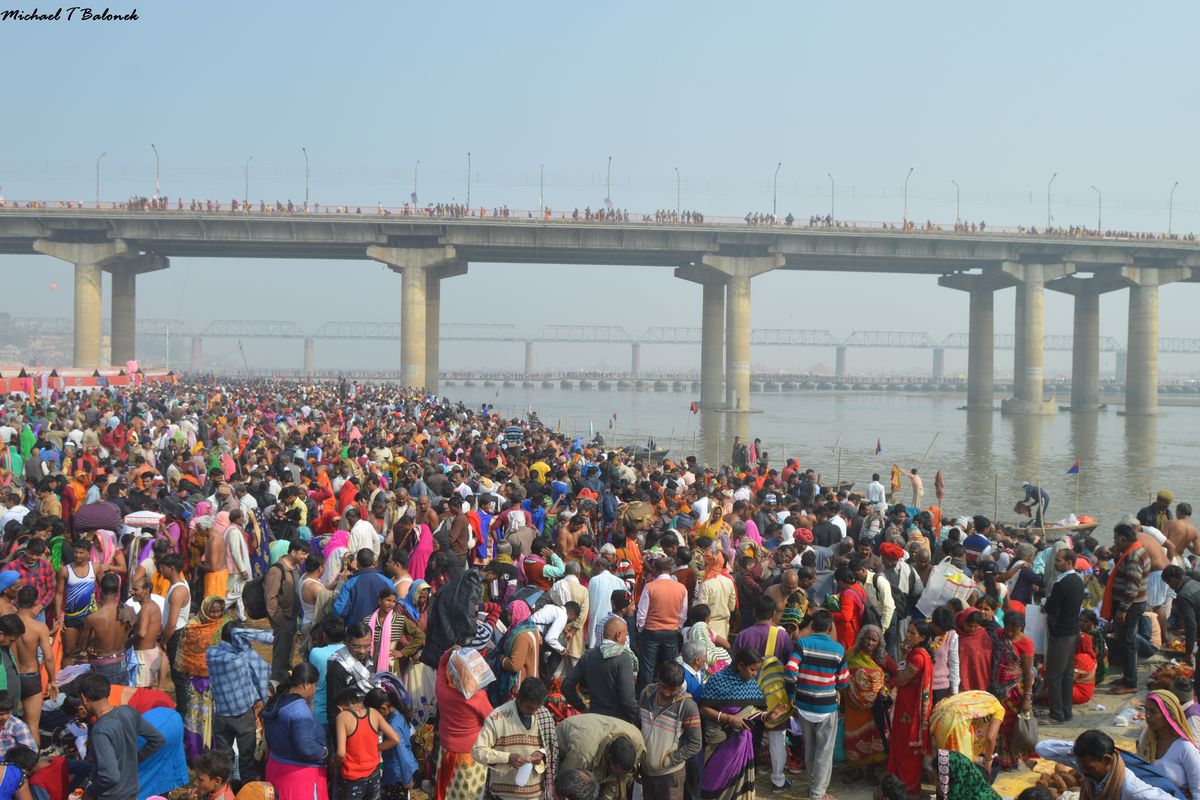
Vasant Panchami, Thursday 11 February, is Saraswati's day and the first breath of spring: yellow appears in clothes, in marigolds, in the sweet rice cooked in the camps. Maghi Purnima, Saturday 20 February, is the full moon of Magh and the last day of Kalpvas — the kalpvasis bathe, complete their vows, and many give away the few things they lived with, a bed, a blanket, utensils, as closing daan. And Maha Shivratri, Saturday 6 March, is the night of Shiva and the final snan, which closes the mela. The photograph below is what the biggest of these days looks like from the bank — dense crowds at the Ganga with the Shastri Bridge behind them, at the Kumbh Mela of 2019, which is the same river and the same sand.
Kalpvas: a month on the sand
Kalpvas is the heart of the mela, and it is also the part that sounds impossible until you meet someone who has done it. The word joins kalpa, a sacred span of time, and vas, dwelling: to dwell for a sacred span. A kalpvasi is not a sadhu. He or she is a farmer, a teacher, a retired clerk, a grandmother, very often a couple keeping the month together. For one lunar month, from Paush Purnima to Maghi Purnima — 22 January to 20 February in 2027 — they live on the mela ground in a tent, bathe at the Sangam before sunrise every day, eat once, sleep on the ground, keep celibacy, speak gently, and spend the day in prayer, satsang and daan.
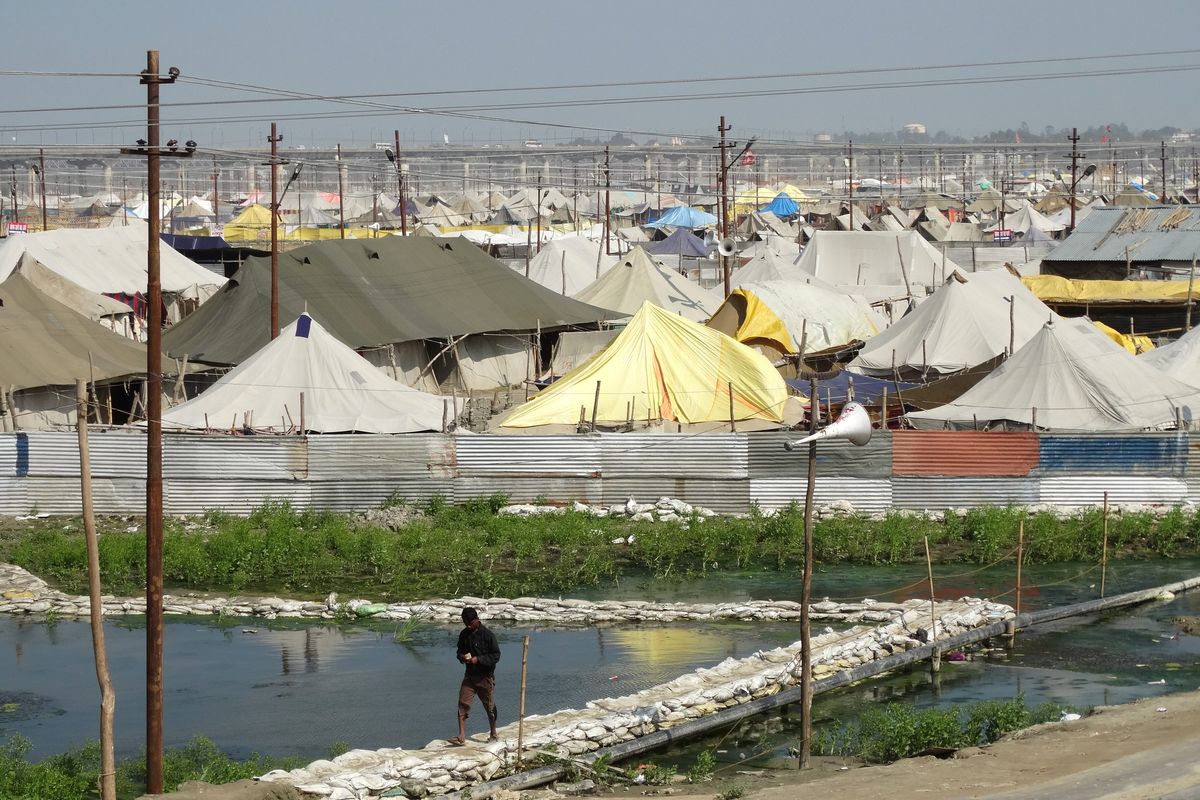
The photograph below is their home for the month: rows of tents on the floodplain, a sandbag causeway, a man walking to the water. The discipline has a shape the tradition counts as twenty-one rules from the Padma Purana, and its broad outline is this: three baths a day in the river — before sunrise, at midday, at twilight — one sattvic meal, cooked by your own hand, after the midday bath, and the hours between filled with katha, kirtan and discourses that run in camps across the ground from morning to night.
It is an austere rhythm, and also a deeply social one. Neighbours in the tent lines share tea, news and blankets. Old kalpvasi friendships pick up each January exactly where the previous February left them. Tradition holds the practice in special esteem when it is kept for twelve consecutive years, and the mela ground is full of elderly men and women counting their tenth or eleventh winter. There are families whose kalpvas is older than the road that brought them.
The closing is a small ceremony of its own. On Maghi Purnima the kalpvasis bathe, return to their huts, listen to the Satyanarayan Katha and perform a havan. Then they offer daan to their tirthpurohits according to their capacity, the barley sown at the start of the month is immersed in the Ganga, and the tulsi plant kept in the hut is taken home as a blessing. Then the tents begin to fold. Nobody polices the vow — many people keep a week or ten days within the month, and the tradition honours whatever is kept sincerely — but the full month is the thing, and the people who keep it will tell you the cold dawn bath is the easy part. The hard part is going home.
Magh snan at home, abroad
This is the part of the article that matters most to most of its readers, because most of them will never sleep in a tent on the Sangam's sand. The mela is a place-based event. What travels is the month: Magh snan, the dawn bath, kept at home, at your own river or your own bathroom, for the month of Magh.
The photograph below is the bath itself — a young man standing in the Yamuna at the Magh Mela, fresh from the dip, the gamchha still on his head. At home the form is simpler and the tradition is explicit about the substitute: bathe before sunrise, and if you have Ganga water, mix a little of it — and a few sesame seeds — into the bathing water. Sesame is the seed of the month, warming and sacred to Surya, and it is the one ingredient the old guides insist on.

The shape of a home Magh is small enough to keep. A dawn bath, every day of the month if you can, on the snan days if you cannot. A lamp at dusk — deep daan, the gift of a lamp floated on water or set in the temple, which the tradition says removes the darkness of ignorance from the soul. Sesame and jaggery eaten and given. And the snan days kept as the mela keeps them: Makar Sankranti, Paush Purnima, Mauni Amavasya, Vasant Panchami, Maghi Purnima, Maha Shivratri — the same six dates, in your own city, on the days Drik gives for your city, which are in the country sections below. A video call home on Mauni Amavasya reaches India on the same Saturday, because this is the one great day that does not split — all six cities agree on 6 February, and both ends of the call are keeping it together.
Daan, and the lamp on the water
If the bath is the first half of Magh, daan is the second, and the month is unusually specific about what to give. Food first: annadanam, the gift of food, is called Mahadaan, the great donation, and feeding the hungry during Magh is the act the texts return to most often. Then warmth, because the month is the coldest of the year: blankets, bedding, warm clothes, given to people who need them. Then sesame and jaggery — til-gul — the seeds sacred to Surya, given as seeds and as sweets, and eaten too, because sesame is warming and the month is winter.
Then oil and ghee, and the lamp. Deep daan, the donation of a lamp, is the month's most distinctive gift: a lamp floated on the river or set in the temple in the evening, which is said to remove the darkness of life and bring happiness, peace and positivity into the house. And finally the quietest one, which the texts prize most: secret charity, gupt daan, given without display, so that the recipient does not even know who gave it. Such charity, the tradition says, removes the ego and brings special grace — which is a better reason than most to give without telling anyone.
What not to give is as simple as what to give. The month asks for sattvic food and gentle speech, and the guides are blunt about the rest: no tamasic food, no harsh words. A month kept with a lamp, a bath and a quiet mouth is a month kept.
Magh Mela 2027 in India
The mela runs Friday, 15 January to Saturday, 6 March. Makar Sankranti is Friday, 15 January: the moment is 9:14 PM on Thursday, 14 January, with Punya Kala 7:15 AM to 5:46 PM and Maha Punya Kala 7:15 to 9:00 AM. Delhi's sunrise that day is 7:15 AM and sunset 5:46 PM, and the Brahma Muhurta — the window the whole month is built around — runs 5:27 to 6:21 AM.
Paush Purnima, when Kalpvas begins, is Friday, 22 January: the tithi runs 9:29 PM on Thursday, 21 January to 5:46 PM on Friday, and the moon rises at 5:50 PM. Sunrise is 7:14 AM, sunset 5:52 PM, Brahma Muhurta 5:27 to 6:20 AM. Mauni Amavasya is Saturday, 6 February: the tithi runs 7:05 PM on Friday, 5 February to 9:25 PM on Saturday, sunrise 7:07 AM, sunset 6:04 PM, Brahma Muhurta 5:22 to 6:14 AM. Vasant Panchami is Thursday, 11 February, with the Saraswati Puja Muhurat 7:03 AM to 12:36 PM; sunrise 7:03 AM, sunset 6:08 PM, Brahma Muhurta 5:20 to 6:11 AM. Magha Purnima is Saturday, 20 February: the tithi runs 7:59 AM on Saturday to 4:52 AM on Sunday, the moon rises at 5:46 PM, sunrise 6:55 AM, sunset 6:15 PM, Brahma Muhurta 5:14 to 6:05 AM. Maha Shivratri is Saturday, 6 March, with Nishita Kaal 12:07 to 12:57 AM on Sunday, 7 March and Parana 6:40 AM to 1:46 PM on Sunday; sunrise 6:41 AM, sunset 6:24 PM, Brahma Muhurta 5:03 to 5:52 AM.
Where India goes in this season
Prayagraj, obviously, if you can go — and if you go, go for Mauni Amavasya on 6 February or not at all on the great days, because the crowds on that Saturday are the largest of the season and the administration runs one-way bathing routes, so fix a meeting point with your group and carry only essentials to the river. January and February on the river are genuinely cold, with night temperatures often in single digits and dense fog on many mornings, so pack in layers and keep the dawn bath short when the fog is heavy.
If you cannot go, the month still belongs to you. It sits a fortnight after Saphala Ekadashi, which opened the year, and it closes with Shivratri in March — the whole first quarter of 2027, one long season of bathing and giving, with the mela at its centre.
Magh Mela 2027 in USA
Makar Sankranti is Thursday, 14 January — a day earlier than India, the first of the two splits. The moment is 10:44 AM, with Punya Kala 10:44 AM to 4:52 PM and Maha Punya Kala 10:44 AM to 12:20 PM. New York's sunrise on the 14th is 7:18 AM and sunset 4:52 PM, and the Brahma Muhurta is 5:23 to 6:20 AM. The 15th is not Sankranti in New York at all: Drik's day panchang for 15 January lists Mattu Pongal, Magh Bihu and Banada Ashtami, and no Makara Sankranti.
The fast-day wrinkle, and the day that does not split
Paush Purnima is Friday, 22 January as the main date, with the tithi running 10:59 AM on Thursday, 21 January to 7:16 AM on Friday and the moon rising at 5:30 PM — but Drik separately lists the Pausha Purnima Upavasa on Thursday, 21 January for New York. If your family keeps the fast, ask your temple which day it follows; the two listings are both Drik's, and this page will not pick one for you.
Mauni Amavasya is Saturday, 6 February, the same day as India. The tithi runs 8:35 AM on Friday, 5 February to 10:55 AM on Saturday, sunrise is 7:01 AM, sunset 5:20 PM, and the Brahma Muhurta is 5:11 to 6:06 AM. Vasant Panchami is Thursday, 11 February, with the Saraswati Puja Muhurat 6:55 AM to 12:11 PM. Magha Purnima is Saturday, 20 February: the tithi runs 9:29 PM on Friday, 19 February to 6:22 PM on Saturday, and the moon rises at 5:37 PM. Maha Shivratri is Saturday, 6 March, with Nishita Kaal 11:42 PM to 12:32 AM on Sunday, 7 March; the Parana is listed as a single time, 6:21 AM on Sunday, with no end time shown on Drik's New York page — take the morning, and check your temple for the close of the window.
The practical shape that works: the month is long, and nobody abroad keeps all of it perfectly. Keep the six snan days, keep Mauni Amavasya properly — it is a Saturday, which helps — and keep the lamp at dusk. A video call home on 6 February reaches India on the same Saturday, when Delhi families are bathing at the same hour you are. Both ends of the call are keeping Mauni Amavasya, on the same day, and neither side is wrong.
Magh Mela 2027 in UK
Makar Sankranti is Thursday, 14 January — a day earlier than India, like New York. The moment is 3:44 PM, and here is the catch: the Punya Kala runs 3:44 to 4:19 PM, thirty-five minutes, because the sun sets at 4:19 PM that day. The Maha Punya Kala is the same thirty-five minutes. If you mean to keep the Sankranti bath in London, it has to be that half-hour, in the afternoon, in the dark — set an alarm, because there is no second window.
A month staged in the dark
Paush Purnima is Friday, 22 January: the tithi runs 3:59 PM on Thursday, 21 January to 12:16 PM on Friday, and the moon rises at 4:41 PM. Mauni Amavasya is Saturday, 6 February: the tithi runs 1:35 PM on Friday, 5 February to 3:55 PM on Saturday, sunrise 7:31 AM, sunset 4:59 PM, and the Brahma Muhurta is 5:35 to 6:33 AM. Vasant Panchami is Thursday, 11 February, with the Saraswati Puja Muhurat 7:22 AM to 12:15 PM. Magha Purnima is Saturday, 20 February: the tithi runs 2:29 AM to 11:22 PM on Saturday, and the moon rises at 5:08 PM. Maha Shivratri is Saturday, 6 March, with Nishita Kaal 11:46 PM to 12:37 AM on Sunday, 7 March and Parana 6:33 to 8:16 AM on Sunday.
London gives you the hardest version of the month's central demand: the Brahma Muhurta ends at 6:33 AM, more than an hour before the sun comes up, so the bath and the lamp happen in full dark, in the middle of the night by any honest description. The evening is short too — sunset at 4:59 PM on Mauni Amavasya — so the lamp and the daan begin in the middle of the afternoon, which honestly suits a lamp-lit puja. The month's own logic helps: Magh is a poem about bathing in the dark and giving in the cold, and a London February is the closest most of us will ever come to the winter morning it describes.
Magh Mela 2027 in Germany
Makar Sankranti is Friday, 15 January, the same day as India — Berlin is on the Delhi side of the split. The moment is 4:44 PM on Thursday, 14 January, with Punya Kala 8:10 AM to 4:22 PM and Maha Punya Kala 8:10 to 9:32 AM on Friday.
The shortest days of the series
Paush Purnima is Friday, 22 January: the tithi runs 4:59 PM on Thursday, 21 January to 1:16 PM on Friday, and the moon rises at 4:38 PM. Mauni Amavasya is Saturday, 6 February: the tithi runs 2:35 PM on Friday, 5 February to 4:55 PM on Saturday, sunrise 7:40 AM, sunset 5:01 PM, and the Brahma Muhurta is 5:43 to 6:41 AM. Vasant Panchami is Thursday, 11 February, with the Saraswati Puja Muhurat 7:31 AM to 12:21 PM. Magha Purnima is Saturday, 20 February: the tithi runs 3:29 AM on Saturday to 12:22 AM on Sunday, and the moon rises at 5:08 PM. Maha Shivratri is Saturday, 6 March, with Nishita Kaal 11:51 PM to 12:43 AM on Sunday, 7 March and Parana 6:40 to 9:16 AM on Sunday.
One practical note, the same one from the Dhanurmasam article: Germany has Ruhezeiten, and a 6 AM alarm and a running tap are still working hours for the neighbours. The home snan is quiet by nature — a bath, a verse, a small lamp — which is one more reason this month travels better than the noisy ones. If your temple stages a Magh programme, it will be a temple affair, indoors, and the neighbours will never know. The month goes on either way.
Magh Mela 2027 in Mexico
Makar Sankranti is Thursday, 14 January, a day earlier than India, and Mexico City gets the most generous version of the day: the moment is 9:44 AM, with Punya Kala 9:44 AM to 6:18 PM and Maha Punya Kala 9:44 to 11:35 AM. Sunrise on the 14th is 7:13 AM and sunset 6:18 PM, and the Brahma Muhurta is 5:30 to 6:21 AM.
The one city where the full moon moves
Paush Purnima is Thursday, 21 January in Mexico City — the only one of the six cities where it moves, and the second of the two splits. The tithi runs 9:59 AM on Thursday to 6:16 AM on Friday, and the moon rises at 5:48 PM. Kalpvas, for a Mexico City family keeping the month by Drik, begins on the 21st, not the 22nd. Say it to your temple before you assume otherwise.
Mauni Amavasya is Saturday, 6 February: the tithi runs 7:35 AM on Friday, 5 February to 9:55 AM on Saturday, sunrise 7:09 AM, sunset 6:32 PM, and the Brahma Muhurta is 5:28 to 6:19 AM. Vasant Panchami is Thursday, 11 February, with the Saraswati Puja Muhurat 7:07 AM to 12:51 PM — the longest Saraswati window of the six cities. Magha Purnima is Saturday, 20 February: the tithi runs 8:29 PM on Friday, 19 February to 5:22 PM on Saturday, and the moon rises at 6:42 PM. Maha Shivratri is Saturday, 6 March, with Nishita Kaal 12:23 to 1:12 AM on Sunday, 7 March; the Parana is listed as a single time, 6:51 AM on Sunday, with no end time shown on Drik's Mexico City page.
Mexico City gets the most generous winter day of the six: sunrise 7:09 AM, sunset 6:32 PM on Mauni Amavasya, more than eleven hours of light. The dawn bath can be unhurried, the lamp lit at a dusk that still feels like evening rather than the middle of the night. It is the only city in this article where the whole observance fits comfortably into daylight.
Magh Mela 2027 in Russia
Makar Sankranti is Friday, 15 January, the same day as India — Moscow is on the Delhi side of the split. The moment is 6:44 PM on Thursday, 14 January, with Punya Kala 8:50 AM to 4:28 PM and Maha Punya Kala 8:50 to 10:06 AM on Friday.
A month staged in the dark
Paush Purnima is Friday, 22 January: the tithi runs 6:59 PM on Thursday, 21 January to 3:16 PM on Friday, and the moon rises at 4:38 PM. Mauni Amavasya is Saturday, 6 February: the tithi runs 4:35 PM on Friday, 5 February to 6:55 PM on Saturday, sunrise 8:14 AM, sunset 5:14 PM, and the Brahma Muhurta is 6:14 to 7:14 AM. Vasant Panchami is Thursday, 11 February, with the Saraswati Puja Muhurat 8:04 AM to 12:44 PM. Magha Purnima is Saturday, 20 February: the tithi runs 5:29 AM on Saturday to 2:22 AM on Sunday, and the moon rises at 5:16 PM. Maha Shivratri is Saturday, 6 March, with Nishita Kaal 12:14 to 1:06 AM on Sunday, 7 March and Parana 7:06 to 11:16 AM on Sunday — the longest Parana window of the six cities.
Moscow's Brahma Muhurta ends more than an hour before the sun is up, and the sun, when it comes, is up for seven hours. The dawn bath happens before the sun is up, which is the traditional form anyway: the bath at dawn, in darkness, is how the old guides describe the start of a festival day. A Moscow February simply makes the description literal. And the evening puja is the same as everywhere else, and the time zones offer their usual small mercy: a video call home after the evening lamp reaches India at around 8:30 PM IST, when Delhi families are sitting down to their own evening after a day that began four hours earlier. Both ends of the call are keeping Magh on the same dates — Moscow and Delhi agree on all six snan days.
East of Moscow the timings shift with the time zones, as always. Your local temple or your own city's panchang is the authority there; Moscow's hours belong to Moscow.
What you'll need, roughly
A picture or idol of Vishnu or Surya — the month belongs to both — flowers, tulsi, a lamp and oil, and sesame seeds. Sesame and jaggery to eat and to give, blankets and warm clothes for daan, and food for someone who needs it, because annadanam is the month's great donation. Ganga water, if you have any, for the bath. A copy of the Padma Purana's Magha chapters to read or hear, if your family keeps them, and the story of Bhrigu and Dilipa to tell the children, because it is the one that says the month itself does the work.
That is the entire list. Magh is not a festival of shopping. It is a bath, a lamp, and something given away quietly — and a month kept in the coldest part of the year, when giving warmth means the most.
The Kartik–Margashirsha 2026 series: Diwali 2026 · Govardhan Puja 2026 · Bhai Dooj 2026 · Chhath Puja 2026 · Dev Uthani Ekadashi 2026 · Tulsi Vivah 2026 · Dev Diwali 2026 · Kalabhairav Jayanti 2026 · Utpanna Ekadashi 2026 · Margashirsha Amavasya 2026 · Vivah Panchami 2026 · Subrahmanya Shashthi 2026 · Dhanurmasam 2026 · Mokshada Ekadashi 2026 · Margashirsha Purnima 2026 · Akhuratha Sankashti Chaturthi 2026 · Sabarimala Mandala Pooja 2026 · Saphala Ekadashi 2027 · Magh Mela 2027
Check your own city before you rely on any date here: the Hindu Panchang Calculator shows today’s tithi and festival dates for your location, the Hindu Date Converter converts between Gregorian and Hindu calendar dates, and this article on the astronomy behind the panchang explains how these calculations are actually made.
Photos: Boats at Triveni Sangam — juggadery, CC BY-SA 2.0; Young man bathing at the Magh Mela and Tent city — Adam Jones, CC BY-SA 2.0; Pilgrim crowds at the Kumbh Mela 2019 — Michael T Balonek, CC BY-SA 4.0; all via Wikimedia Commons.
Timings follow Drik Panchang's city pages for New Delhi, New York, London, Berlin, Mexico City and Moscow, checked 18 November 2026 — festival pages for the snan days, day-panchang pages for sunrise, sunset and Brahma Muhurta. Where Drik gives no puja window for the two Purnimas, this page quotes the tithi and moonrise only and says so; where Drik lists the Maha Shivratri Parana as a single time in New York and Mexico City, this page quotes it as listed. The Magh month span follows the Purnimanta count (23 January to 20 February, from Drik's Paush and Magha Purnima dates); the Amanta count runs a fortnight later per the published panchang calendars. The Padma Purana account of Magha snan (Uttara Khanda, chapter 125, Bhrigu teaching Dilipa) and the Kalpvas closing rites follow the sources named in the text; the twenty-one rules are the Padma Purana's as reported by the mela guides. Your local temple's announcement overrides any website, including this one.