
Lohri 2027 is Wednesday 13 January abroad, Thursday 14 January in India — the bonfire night before Makar Sankranti
Lohri 2027 is Wednesday 13 January in New York, London and Mexico City and Thursday 14 January in Delhi, Berlin and Moscow — the bonfire night before Makar Sankranti, with Dulla Bhatti songs, rewari and gajak, and first Lohri for newborns and newlyweds.
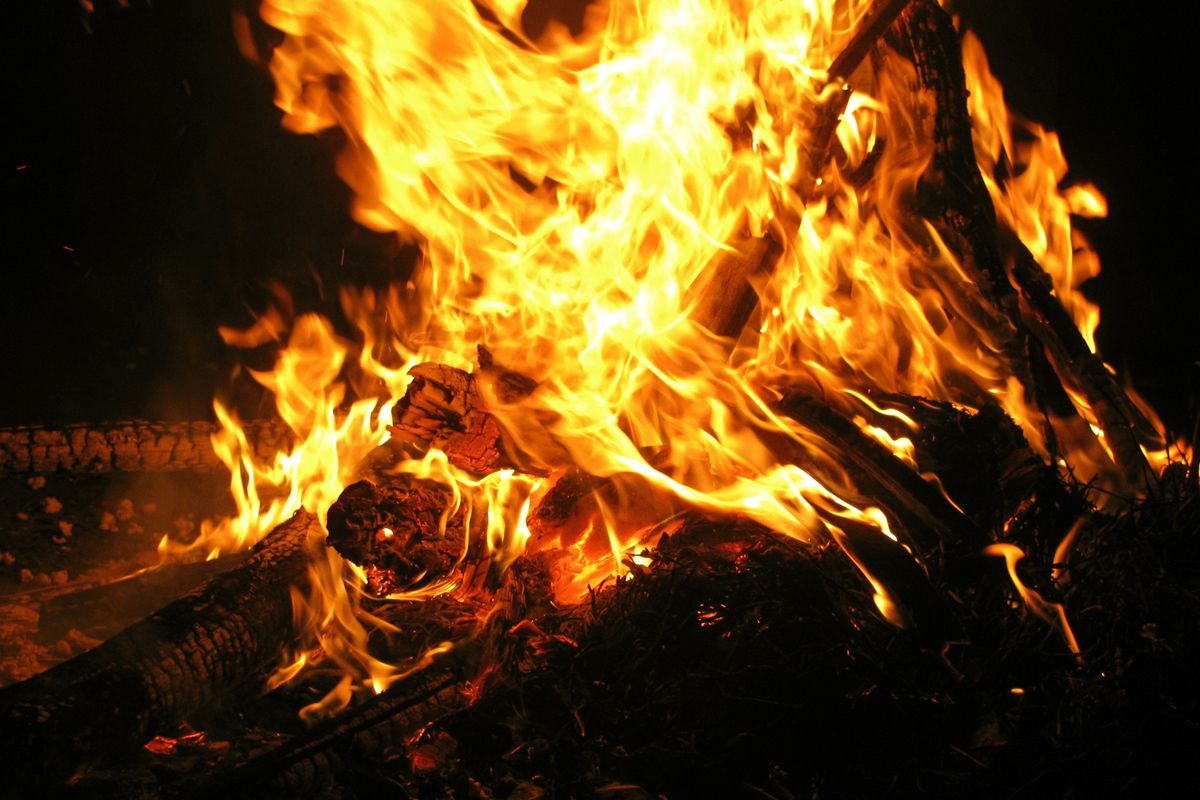
Lohri 2027 falls on Wednesday, 13 January in New York, London and Mexico City, and on Thursday, 14 January in Delhi, Berlin and Moscow. It is the bonfire night on the eve of Makar Sankranti — the Punjabi harvest fire that closes the coldest month of the year — and the date splits because Sankranti itself splits: the Sun enters Makara on 14 January everywhere, but it is observed on Thursday the 14th in America, London and Mexico City, and on Friday the 15th in India, Germany and Russia. So the fire is lit on different nights depending on which side of that line you live on, and this page gives you your city's night, your sunset, and what to throw in the flames.
Lohri 2027 at a glance
| Lohri, New York / London / Mexico City | Wednesday, 13 January 2027 |
| Lohri, Delhi / Berlin / Moscow | Thursday, 14 January 2027 |
| The Sankranti moment | 14 January everywhere — Delhi 9:14 PM, Moscow 6:44 PM, Berlin 4:44 PM, London 3:44 PM, New York 10:44 AM, Mexico City 9:44 AM |
| Makar Sankranti observed | Thu 14 Jan (New York, London, Mexico City) / Fri 15 Jan (Delhi, Berlin, Moscow) |
| Bonfire time | After sunset — Drik lists no muhurat for Lohri, so the sunset is the guide |
| The fire | Til, gur, rewari, gajak, peanuts and popcorn into the flames |
| The song | Sundar Mundriye — the Dulla Bhatti song |
| Dinner after the fire | Sarson da saag and makki di roti, with white butter and lassi |
| First Lohri | The first Lohri after a wedding or a birth — bigger fire, gifts, the new bride or baby honoured at the flames |
Two honest wrinkles before anything else. First, Drik gives no bonfire time for Lohri at all — no muhurat window, for any city, only the date and the Sankranti moment. So this page quotes the sunset for your city and says the fire is lit after it, and invents no window. Second, Drik's own day panchang does not list Lohri on either date, in any city: 13 January lists only Skanda Sashti, 14 January lists only Bhogi Pandigai. The dedicated Lohri festival page is the authority this page follows — it is Drik's own festival page, checked city by city — but the omission is worth knowing, because if your panchang app shows nothing on the 13th, that is why. The day panchangs do corroborate the Sankranti moment independently: on 14 January in every city the Sunsign changes from Dhanu to Makara at exactly the moment the festival page gives.
One more disagreement, and it matters if you live in Canada. The Ottawa Hindu Temple's own panchang engine lists Lohri 2027 as Thursday, 14 January for Ottawa — but Drik lists Wednesday, 13 January for New York, in the same Eastern time zone. Two engines, two nights. This page follows Drik, the standing authority for this series, and says so plainly: if you are in Ottawa or anywhere in Canada, ask your temple which night it is keeping before you light anything.
What Lohri actually is
Lohri is Punjab's winter fire. It falls on the last day of Poh — the month of Paush, the coldest of the year — and it is a harvest festival in the plainest sense: the rabi crop is in, the sugarcane has been pressed to fresh gur, the mustard is in the fields, and the bonfire is both thanksgiving and a farewell to the cold. The days get longer from here, which is the whole point of the fire: you stand in the dark of mid-January and burn something, and the season turns.
It is a Punjabi festival, kept by Punjabi Hindus and Sikhs alike, and it is older than any single story attached to it. There is no temple at the centre of it, no priest required, no fast. A family, a courtyard, a pile of wood, and the neighbours. That is the whole apparatus, and it is why the festival travels so well — it needs almost nothing except people and a fire, which is also why it is the festival that breaks most often against a foreign city's fire rules. More on that below.
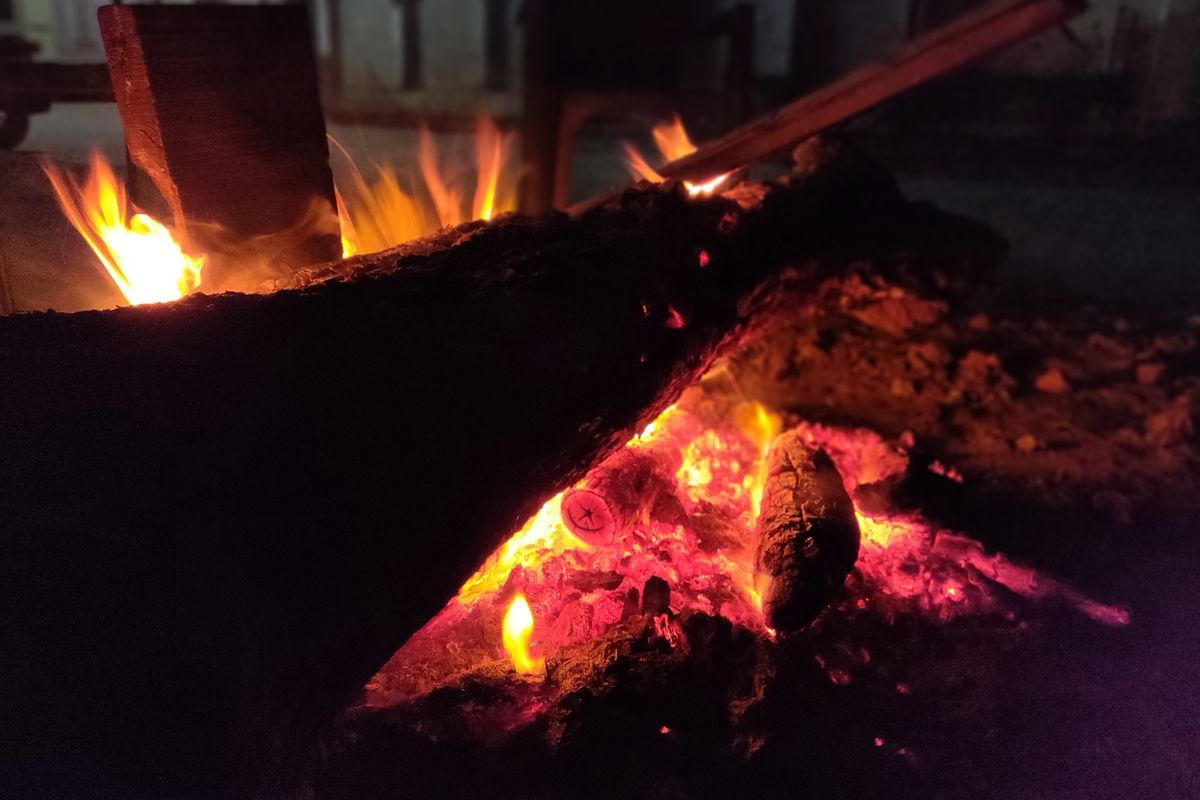
The photograph below is a Lohri fire in Patiala, burning down to embers — the fire is the festival, before the songs and the food.
The bonfire, and what goes into it
The fire is lit after sunset. Families and whole neighbourhoods gather round it, walk around it, and throw the offerings in: sesame seeds (til), jaggery (gur), rewari, gajak, peanuts and popcorn. The offerings are a tribute to Agni and to Surya, and a prayer for the harvest — the sesame is the point, the warming seed of winter, and it goes into the fire and into the sweets in the same handful.
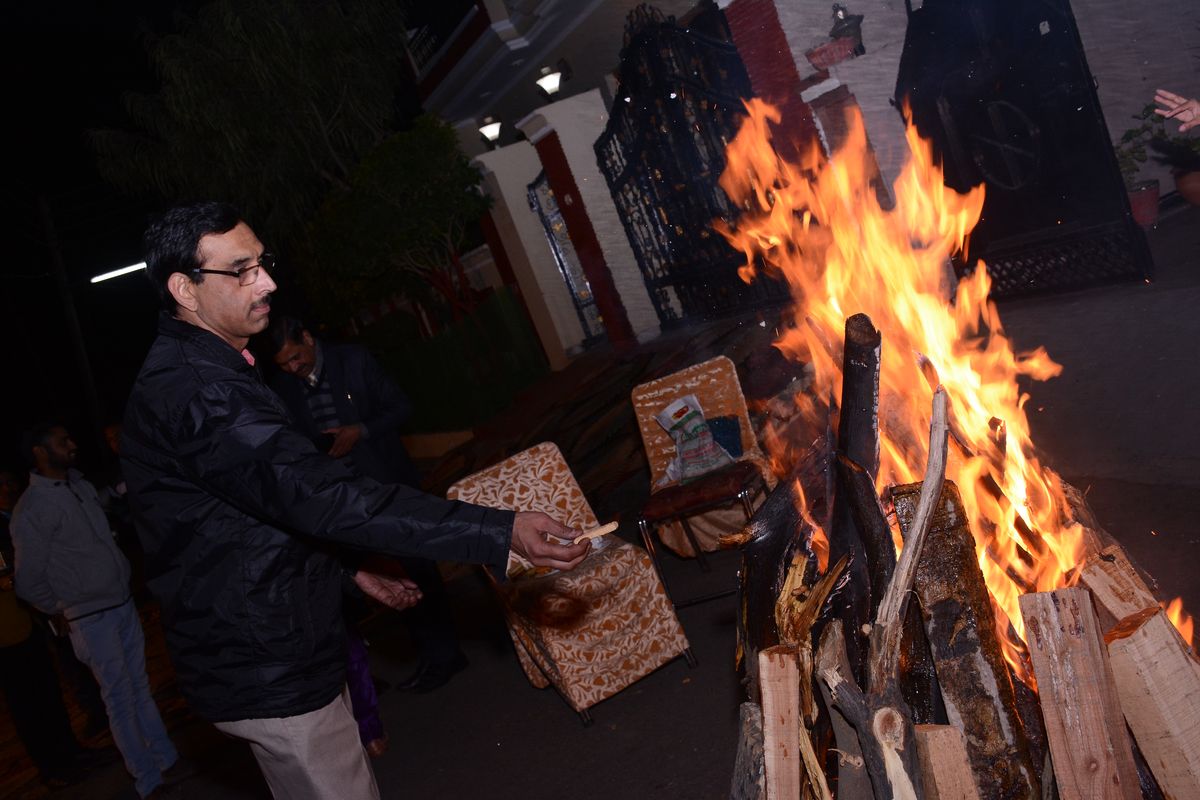
The photograph below is the offering itself, mid-gesture: a man at a courtyard bonfire, throwing something into the flames. The chairs behind him are pulled up close, because the fire is also the heating, and everyone stands near it until it dies down.
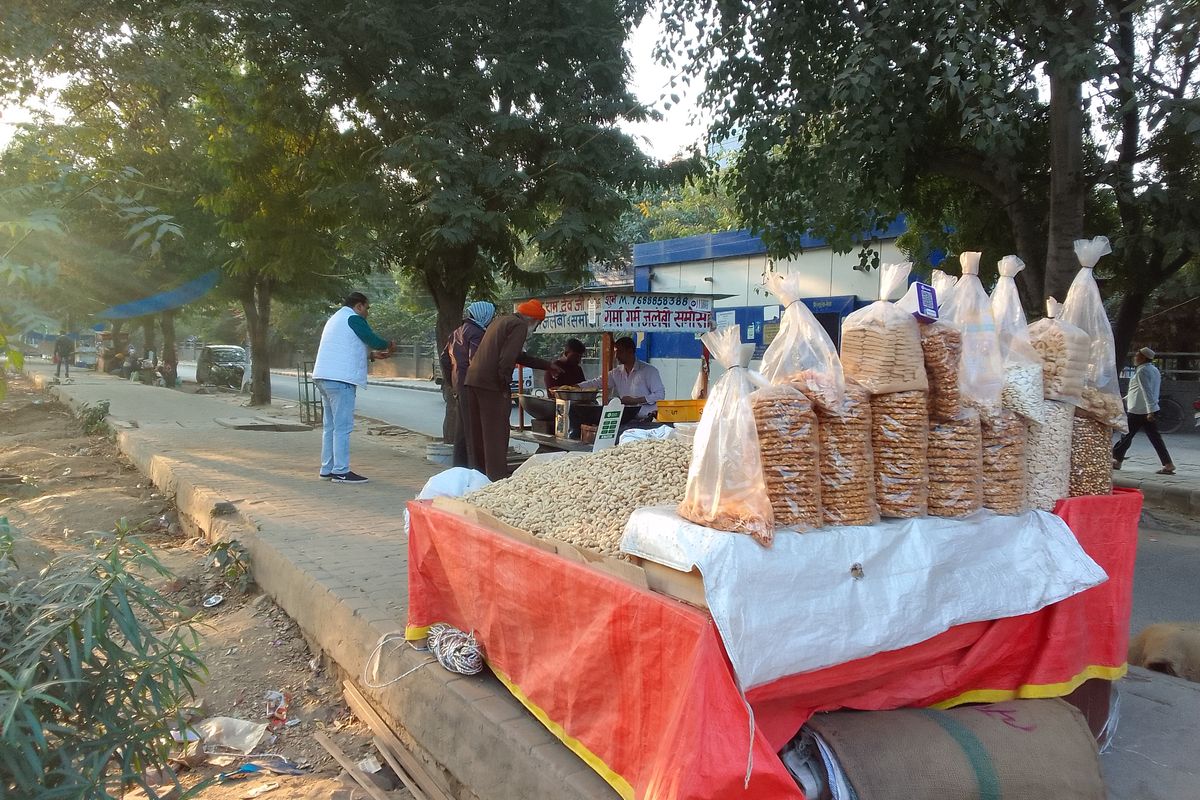
Rewari and gajak are the two sweets to know. Rewari is small hard drops of jaggery or sugar coated with sesame seeds; gajak is brittle slabs or rolls of sesame cooked into jaggery. The photograph below is a street stall in the days before Lohri, bags of gajak and rewari and peanuts stacked on a red cloth — the festival, bought by the kilo, on an ordinary pavement.
Dinner comes after the fire, and it is the same every year: sarson da saag and makki di roti, with white butter and lassi. The mustard greens are the winter crop on the plate. Nobody improves on it, and nobody needs to.
Sundar Mundriye, and Dulla Bhatti
The song sung round the fire is Sundar Mundriye, and it is about Dulla Bhatti. He was a real man — Rai Abdullah Bhatti, a Punjabi rebel of the sixteenth century, in Emperor Akbar's reign, whose father and grandfather were local chiefs who resisted the Mughal land-revenue system and were executed in Lahore, and who carried on the revolt until he was executed in Lahore too. The history is real. The story sung at Lohri is a folk legend, and it should be told as one.
In the story, a poor Brahmin's daughter — in many tellings two girls, Sundri and Mundri — is threatened by a powerful landlord, and her family is too frightened to go ahead with her wedding. Dulla steps in, stands in as her father, and has her married with dignity, and the wedding is placed on Lohri night. That is why the song is sung at a winter bonfire, and why it is sung for girls: the hero of Lohri is remembered for rescuing girls from abduction and arranging their marriages, and for robbing the rich to pay for it. A Punjabi Robin Hood, in the plain telling, and the song is the part of the festival children learn first.
Men dance bhangra to the dhol round the fire; women dance gidda, with clapping and boliyan, the traditional verses. In Jammu, Lohri has its own dance, the Chajja, performed mainly by boys carrying decorated winnowing baskets. The dancing is not a performance for an audience. It is what a bonfire does to a crowd that has been standing in the cold.
First Lohri — the one that matters most
The first Lohri after a wedding or the birth of a child is celebrated on a larger scale than any other. The fire is bigger, the extended family is invited, sweets are shared round the street, and the new bride or the baby is the guest of honour at the flames. A new bride is welcomed into the circle round the fire in her husband's home; a baby is brought to the fire, well wrapped, and blessed by the elders. Maternal grandparents and relatives arrive with gifts and sweets, and the family distributes lohri — gifts of rewari, gajak and sweets — to the neighbourhood.
It is the part of the festival that most often gets kept abroad, because it is the part with a reason to gather. A banquet hall in Chicago or a gurudwara in Richmond will host a community Lohri, and the families with a first Lohri that year are the ones the evening is built around: gift hampers for the newlyweds, a blessing for the newborn, the dhol and the bhangra, and the food from a local caterer.
One thing about first Lohri is changing, and it is worth saying plainly. Lohri was long celebrated mainly for the birth of a son. That is no longer the whole story. Punjab villages, panchayats and district officials have held Lohri functions for newborn girls — The Tribune has reported such events in Amritsar — and in the UK, sweetshops supply pink ladoos for girls' Lohri as a gender-equality campaign. If your family is keeping a first Lohri for a daughter this year, you are not breaking the tradition. You are keeping the part of it that is still growing.
Lohri abroad — the fire rules are the festival
Abroad, Lohri is a negotiation with the fire department, and every diaspora family knows it. A backyard bonfire in Ottawa is a serious proposition in January, and it is allowed only within the city's open-air fire rules — check the bylaw and the day's conditions before you light anything. In London, bonfires are rarer still, and most families gather at home or in a community hall. The pattern everywhere is the same: where a real fire is not possible, the gathering matters more than the flame — the song, the sesame sweets shared, and the sense of winter's back breaking.
The gurudwara is the usual answer. In Richmond, Canada, the India Cultural Centre's Gurdwara Nanak Niwas has kept Lohri with kirtan and Gurbani, langar, and then a bonfire — a dhooni — at the back of the gurudwara premises, prepared by volunteers over several days. In Chicago, the Sikh Women Era community Lohri fills a banquet hall in Arlington Heights, with moongphali and gachak from local Indian grocers and gift hampers for the newlyweds and new parents. In north London, a public bonfire Lohri was organised in Harrow, with traditional musicians after the lighting. The Indian grocers stock Lohri goods from early January in every city with a Punjabi community — rewari, gajak, peanuts, popcorn — so the shopping is the easy part. The fire is the part that needs a plan.
If you are keeping it at home, keep it small and keep it legal. A fire pit where your council allows one, or a small fire in a metal brazier on a patio where it is permitted, or no fire at all and a lamp instead. Nobody in Punjab will check. The sesame goes in the flame if there is a flame; if there is not, it goes in the sweets, and the song is the same either way.
Lohri 2027 in India
Lohri is Thursday, 14 January. The Sankranti moment is 9:14 PM that evening, and Makar Sankranti itself is observed on Friday, 15 January — the morning after the fire. The sun sets at 5:45 PM on the 14th, so the bonfire is lit after that, in the early evening, and the night belongs to the fire. Delhi's sunrise on the 14th is 7:15 AM and the Brahma Muhurta runs 5:27 to 6:21 AM, but Lohri is an evening festival, and the morning figures are here only because they belong to the day.
Where India keeps it
Punjab, obviously, and Haryana, Himachal Pradesh, Delhi and Jammu, where Lohri is a major festival in its own right. If you are in Punjab on the 14th, the fire is in the courtyard or the field, the neighbours contribute the fuel, and the evening runs long. If you are in Delhi, the same fire is lit in a colony courtyard, smaller and closer, and the stall in the photograph is what the street looks like in the days before: gajak and rewari by the bag.
The next morning is Makar Sankranti, and the season turns from fire to bath. The Magh Mela 2027 opens at Prayagraj on Friday the 15th, with the first snan of the season, and the month of Magh begins in earnest. Lohri is the night that closes the old month; Sankranti is the morning that opens the new one.
Lohri 2027 in USA
Lohri is Wednesday, 13 January — a day earlier than India, because Makar Sankranti is observed on Thursday the 14th in New York. The Sankranti moment is 10:44 AM on Thursday, 14 January, so the fire is lit on the Wednesday evening, and Sankranti itself falls the next morning. The sun sets at 4:51 PM on the 13th in New York, so the bonfire is an early-evening affair, and it is dark by five.
The fire, and the hall
New York's sunrise on the 13th is 7:19 AM and the Brahma Muhurta runs 5:23 to 6:21 AM — again, morning figures for an evening festival, quoted because they belong to the day. The practical shape is the one the community has settled on: a backyard fire pit where the local rules allow it, and otherwise a community-hall or banquet Lohri, which is where the first Lohris are kept. The Chicago pattern is the model — a hall, a caterer, the dhol, gift hampers for the newlyweds and the new parents, moongphali and gachak from the local grocer — and it works because it does not need a fire permit. A video call home on the Wednesday evening reaches Delhi on Thursday morning, before their evening fire is lit: your family in India is still waiting for their evening, and you have already had yours. Both fires are Lohri, on different nights, and neither side is wrong.
Lohri 2027 in UK
Lohri is Wednesday, 13 January, a day earlier than India, like New York. The Sankranti moment is 3:44 PM on Thursday, 14 January, and Sankranti is observed on the Thursday. The sun sets at 4:17 PM on the 13th in London — the earliest sunset of the six cities — so the bonfire, where there is one, is lit in the middle of the afternoon and burns in full dark by half past four.
A fire in the dark, or a hall instead
London's sunrise on the 13th is 8:01 AM and the Brahma Muhurta runs 5:55 to 6:58 AM. The honest version is that most British Punjabi families do not light a bonfire at all: the cold snap, the fire rules, and a 4:17 PM sunset make the courtyard fire a hard thing to keep, and the celebration moves indoors, to a community hall or a family gathering at home. The public bonfire in Harrow is the exception that proves it — a big, organised fire, with musicians, put on by a community group, not a family. If your family is keeping a first Lohri this year, the hall is the sensible shape, and the pink ladoos for a daughter's first Lohri are available from the sweetshops that run the campaign. The fire is the symbol. The gathering is the festival.
Lohri 2027 in Germany
Lohri is Thursday, 14 January, the same night as India — Berlin is on the Delhi side of the split. The Sankranti moment is 4:44 PM on Thursday, 14 January, and Makar Sankranti is observed on Friday, 15 January. The sun sets at 4:20 PM on the 14th in Berlin, so the fire is lit in the early evening, in the dark, like London — but on the Thursday, not the Wednesday.
The quietest fire of the six
Berlin's sunrise on the 14th is 8:11 AM and the Brahma Muhurta runs 6:04 to 7:07 AM. Germany's Punjabi community is smaller than London's or New York's, and the celebration is usually a family or temple affair, indoors, with the bonfire replaced by a lamp or a small fire where the rules allow one. The same note from the Dhanurmasam article applies here too: Germany has Ruhezeiten, and a fire and a dhol at nine in the evening are not a neighbourly proposition. The home Lohri is quiet by nature — a lamp, a few sesame sweets, the song sung softly — which is one more reason this festival travels better than the noisy ones. If your temple stages a Lohri programme, it will be a temple affair, indoors, and the neighbours will never know. The evening goes on either way.
Lohri 2027 in Mexico
Lohri is Wednesday, 13 January, a day earlier than India, like New York and London. The Sankranti moment is 9:44 AM on Thursday, 14 January, and Sankranti is observed on the Thursday. The sun sets at 6:17 PM on the 13th in Mexico City — the latest sunset of the six cities, by a wide margin — so the bonfire is lit at a proper evening hour, and the fire burns in a dusk that still feels like evening rather than the middle of the night.
The most generous evening of the six
Mexico City's sunrise on the 13th is 7:13 AM and the Brahma Muhurta runs 5:30 to 6:21 AM. The city gets the easiest version of the festival: more than eleven hours of daylight, a 6:17 PM sunset, and a mild January evening. The Punjabi community is small, so the celebration is usually a family gathering or a temple programme, but the fire itself is the least constrained of any city in this article — a patio fire where the rules allow it, the sesame and the sweets, the song, and nobody freezing. It is the one city where the whole observance fits comfortably into the evening, and the video call home on Wednesday evening reaches Delhi on Thursday morning, before their fire is lit.
Lohri 2027 in Russia
Lohri is Thursday, 14 January, the same night as India — Moscow is on the Delhi side of the split. The Sankranti moment is 6:44 PM on Thursday, 14 January, and Makar Sankranti is observed on Friday, 15 January. The sun sets at 4:27 PM on the 14th in Moscow, so the fire is lit in the early evening, in the dark, in the cold.
A fire in the cold, indoors if it must be
Moscow's sunrise on the 14th is 8:51 AM — the latest of the six — and the Brahma Muhurta runs 6:39 to 7:45 AM. The sun, when it comes, is up for less than eight hours. A Moscow January is the closest any city in this article comes to the winter morning Lohri describes, and the bonfire is a practical impossibility outdoors for most families: the celebration is a temple or community-hall affair, with the fire replaced by a lamp, the sweets shared, and the song. The video call home after the evening reaches India at around 8:30 PM IST, when Delhi families are sitting down after their own fire. Both ends of the call are keeping Lohri on the same night — Moscow and Delhi agree on the 14th — and the fire on the screen is the same fire, a day's warmth carried across four time zones.
East of Moscow the timings shift with the time zones, as always. Your local temple or your own city's panchang is the authority there; Moscow's hours belong to Moscow.
What you'll need, roughly
Wood for the fire, if you are lighting one, and a place you are allowed to light it. Sesame seeds and jaggery, rewari and gajak, peanuts and popcorn — for the fire and for the eating, in the same bag. Sarson da saag and makki di roti for dinner, with white butter and lassi. Gifts and sweets for the neighbours, and something extra if it is a first Lohri — the new bride or the baby is the reason for the bigger fire. The song, Sundar Mundriye, which someone in the family will know by heart. And a phone, charged, for the video call home, because the fire in Punjab and the fire in your hall are the same festival, and the call is how you stand at both.
That is the entire list. Lohri is not a festival of shopping. It is a fire, a song, and something sweet thrown into the flames — and a winter night kept in the company of people who know the words.
The Kartik–Margashirsha 2026 series: Diwali 2026 · Govardhan Puja 2026 · Bhai Dooj 2026 · Chhath Puja 2026 · Dev Uthani Ekadashi 2026 · Tulsi Vivah 2026 · Dev Diwali 2026 · Kalabhairav Jayanti 2026 · Utpanna Ekadashi 2026 · Margashirsha Amavasya 2026 · Vivah Panchami 2026 · Subrahmanya Shashthi 2026 · Dhanurmasam 2026 · Mokshada Ekadashi 2026 · Margashirsha Purnima 2026 · Akhuratha Sankashti Chaturthi 2026 · Sabarimala Mandala Pooja 2026 · Saphala Ekadashi 2027 · Magh Mela 2027 · Lohri 2027
Check your own city before you rely on any date here: the Hindu Panchang Calculator shows today’s tithi and festival dates for your location, the Hindu Date Converter converts between Gregorian and Hindu calendar dates, and this article on the astronomy behind the panchang explains how these calculations are actually made.
Photos: Lohri bonfire — Satish Krishnamurthy, CC BY 2.0; Man offering to the Lohri bonfire — Benipal hardarshan, CC BY-SA 4.0; Gajak and rewari stall — Rrthakur22, CC BY-SA 4.0; Lohri fire, Patiala 2018 — Satdeep Gill, CC BY-SA 4.0; all via Wikimedia Commons.
Timings follow Drik Panchang's Lohri festival page for New Delhi, New York, London, Berlin, Mexico City and Moscow, checked 18 November 2026, with sunrise, sunset and Brahma Muhurta from Drik's day-panchang pages for the Lohri evening in each city. Drik lists no bonfire time or muhurat for Lohri in any city; this page quotes the sunset and invents no window. Drik's day panchang does not list Lohri on either date in any city — the dedicated Lohri festival page is the authority followed here. The Ottawa Hindu Temple's panchang engine lists Lohri as Thursday, 14 January 2027 for Ottawa, disagreeing with Drik's Wednesday, 13 January for New York in the same time zone; this page follows Drik and names the disagreement. The Dulla Bhatti account follows the folk tradition as reported by the sources named in the text; the rebel is a historical figure, the Sundri-Mundri rescue is a folk legend. Your local temple's announcement overrides any website, including this one.