
Vivah Panchami 2026 is on Monday, 14 December — Rama and Sita's wedding day, a day early in New York and Mexico City
Vivah Panchami 2026 is on Monday, 14 December in India, UK, Germany and Russia — and Sunday, 13 December in New York and Mexico City. Tithi times city by city, the Rama–Sita wedding story, Janakpur celebrations and how to keep it at home.
Vivah Panchami 2026 is on Monday, 14 December in India, the UK, Germany and Russia — and on Sunday, 13 December in New York and Mexico City. It is the wedding anniversary of Rama and Sita, the day the Ramayana's most famous wedding took place in Mithila, and the one day of the year when Janakpur in Nepal turns itself into a wedding venue.
The tithi is the same instant everywhere — Panchami begins at 11:17 UTC on Sunday 13 December and ends at 13:45 UTC on Monday 14 December — but the clocks disagree, so the day itself splits. If you live in New York or Mexico City, your Vivah Panchami is Sunday. Everywhere else in this article, it is Monday. That is the whole confusion, and it is worth settling before anything else, because a wedding you turn up to on the wrong day is a wedding you miss.
Vivah Panchami 2026 at a glance
| Date | Monday, 14 December 2026 — India, UK, Germany, Russia; Sunday, 13 December 2026 — New York, Mexico City |
| Panchami tithi, Delhi | 04:47 PM Sun 13 Dec – 07:15 PM Mon 14 Dec IST |
| Panchami tithi, New York | 06:17 AM Sun 13 Dec – 08:45 AM Mon 14 Dec EST |
| Panchami tithi, London | 11:17 AM Sun 13 Dec – 01:45 PM Mon 14 Dec GMT |
| Panchami tithi, Berlin | 12:17 PM Sun 13 Dec – 02:45 PM Mon 14 Dec CET |
| Panchami tithi, Mexico City | 05:17 AM Sun 13 Dec – 07:45 AM Mon 14 Dec CST |
| Panchami tithi, Moscow | 02:17 PM Sun 13 Dec – 04:45 PM Mon 14 Dec MSK |
| Also called | Ram Vivah Utsav; the divine wedding anniversary of Rama and Sita |
| The day's work | Morning puja to Rama and Sita, a symbolic wedding with garlands, reading the wedding episode, an evening procession or temple ceremony |
| No muhurat | Drik Panchang lists no festival-specific wedding-muhurat clock time beyond the tithi itself — the tithi window above is the timing |
One honest wrinkle before we go further. If you have another tab open, it may disagree with this page by more than a day. One blog lists Vivah Panchami 2026 as Monday 23 November; a travel site lists Tuesday 16 December. Neither matches Drik Panchang's city calendars, which agree with each other on 13/14 December, and this page follows Drik, the house source for this whole series. The 23 November date is simply wrong, and the 16 December one appears to be a different festival's date pasted into the wrong table. If your temple prints its own timings, follow your temple. That sentence is doing real work here, not being polite.
The wedding this day remembers
It falls six days after Margashirsha Amavasya, the quiet ancestors' day, and three weeks after Tulsi Vivah, the season's other divine wedding — the same shape of observance, a marriage of gods kept at home with garlands and a reading. The story is the one every Indian child knows, and it is worth telling straight, because the festival is the story.
Sita was the daughter of Janaka, king of Mithila, and Janaka had set one condition for her hand: whoever could lift and string the great bow of Shiva, Pinaka, could marry her. Kings and princes came from everywhere and failed — the bow would not move for them. Rama, the young prince of Ayodhya, had come to Mithila with his brother Lakshmana and the sage Vishwamitra. He picked the bow up, and as he drew the string it broke, with a sound the epics describe as shaking the three worlds.
That was the swayamvara. The wedding followed in Mithila, and the Ramayana — Valmiki's in the Bala Kanda, Tulsidas's Ramcharitmanas in its own telling — treats it as the great royal wedding of its age: the four brothers of Ayodhya married to the four daughters of Mithila, Rama to Sita, Lakshmana to Urmila, Bharata to Mandavi, Shatrughna to Shrutakirti. Vivah Panchami is the anniversary of that day, kept on Margashirsha Shukla Panchami, the fifth day of the bright half of Margashirsha.
There is a second fact about this day that most festival guides bury, and it deserves to be said plainly. In Mithila and across much of North India, Vivah Panchami is considered an inauspicious day for actual human weddings. The reason given is the hardships Sita faced after her marriage — the exile, the separation, the fire ordeal. So the day is kept as a divine anniversary and a day of prayer for married life, but families generally do not fix a lagna on it. It is a wedding you celebrate, not a wedding you copy. Your own region and family custom may differ, and if they do, follow them — but if your grandmother says no weddings on Vivah Panchami, this is why.
Janakpur, where the city becomes the mandap
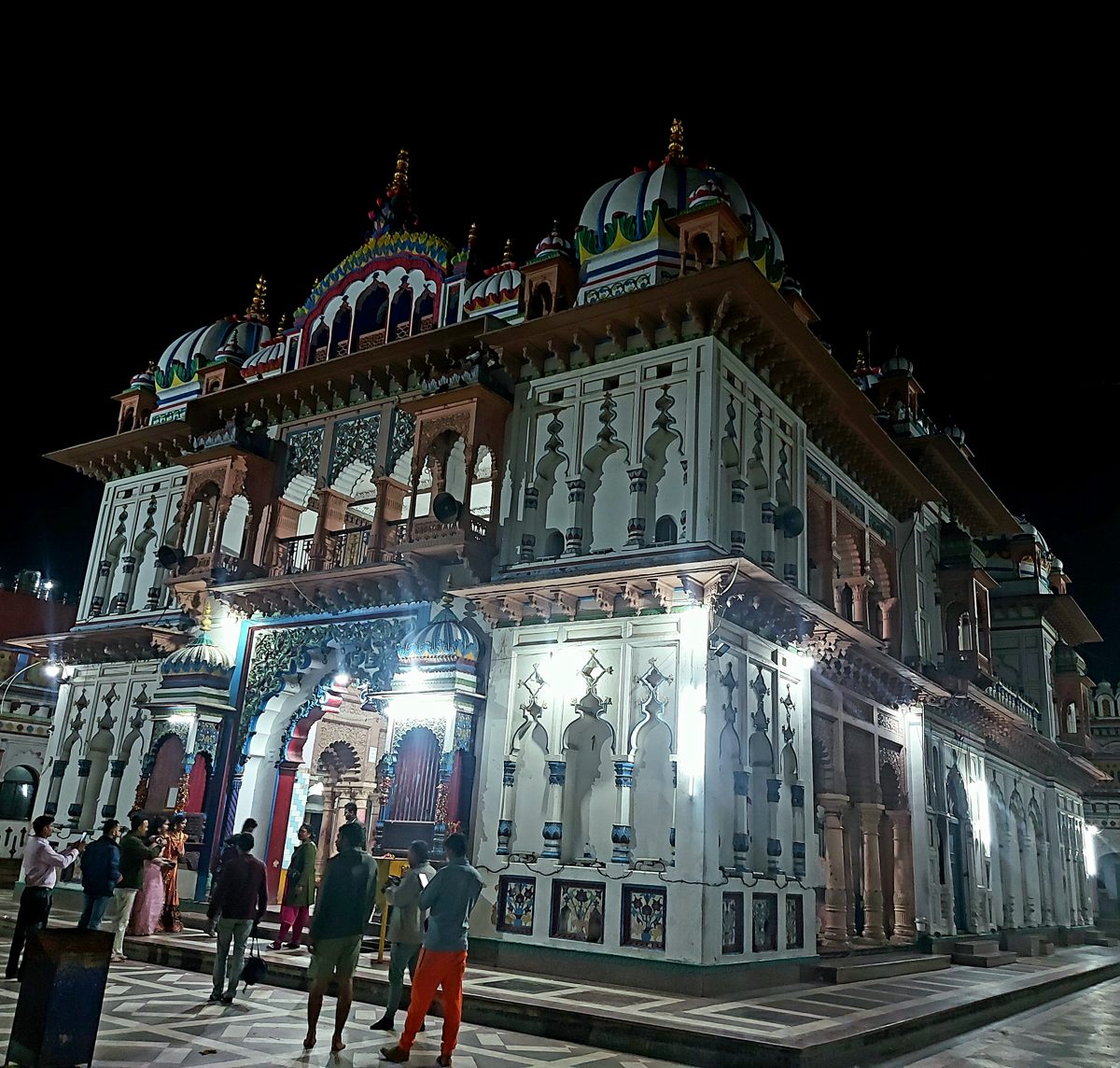
Janakpur, in Nepal's Terai, is the centre of this festival in a way no other city is the centre of any other festival in this series. Tradition holds it is Sita's birthplace and the place of the wedding itself. At its heart stands the Janaki Mandir — the Nau Lakha Mandir, completed in 1910 by Queen Vrisha Bhanu of Tikamgarh, a three-storey white marble palace of a temple in a Mughal-Rajput style, on UNESCO's tentative list since 2008. Beside it is the Vivah Mandap, the pavilion local tradition regards as the wedding site. The photograph at the top of this page is the Janaki Mandir at night, lit for the festival.
Vivah Panchami in Janakpur is not one day. It is a full week, the Shri Ram–Janaki Vivah Mahotsav, and each day replays a chapter of the epic. The baraat is welcomed in a Nagar Darshan procession through the city's lanes. There is the Phoolvari Leela, recalling the first meeting of Rama and Sita in the flower garden. There is the Dhanush Yagya, the breaking of the bow, staged in the open. The Tilakotsav honours the groom's side with turmeric, vermillion and gifts. The Matkor is led by the women of the community, collecting holy soil from a sacred pond. And on the main day the swayamvara is staged in the afternoon at the Rangabhoomi ground — the two processions, Rama's from the Ram Mandir and Sita's from the Janaki Mandir, meeting there — and the wedding itself is performed at night, under a mandap in the Janaki Mandir courtyard, with priests chanting in Maithili and the saat phere going on deep into the night.
Devotees also bathe in the holy ponds of Mithilanchal — Dhanushsagar, Gangasagar and the Argaza Pond — and the temple distributes Ram Kalewa, blessed food of sweets, vegetables, grains, curd and ghee. Hundreds of thousands of pilgrims come, from Nepal and India and from Mauritius and Fiji too, and the whole city is scrubbed clean, flower-chained and lit with a river of lamps that would not look out of place on Dev Diwali, until it looks, as one Janakpur writer put it, like a bride herself.
Ayodhya, Rama's birthplace, keeps the day too, and so do Rama temples across North India — but Janakpur is where the festival lives. If you ever mean to go, book weeks ahead; the hotels fill, and the cross-border trains from Jaynagar run packed.
How the day is actually kept
At home, the shape of it is simple, and it follows the story.
First, the morning. Bathe at dawn, clean the house, and dress it the way you would for a wedding in the family — flowers, rangoli at the door, the puja corner done properly. Set the idols or pictures of Rama and Sita side by side, dressed as bride and groom if your family does that, with garlands ready.
Second, the puja. Offer fruits, sweets, flowers and incense, and chant the names of Rama and Sita. Many families read the wedding episode aloud — from the Ramcharitmanas if that is your family's book, or from the Ramayana — and the reading is the heart of the day's observance, not an extra. Temples stage a symbolic wedding in the evening: the idols are adorned as bride and groom, garlands are exchanged between them — the varmala, the way Sita garlanded Rama at the swayamvara — and the congregation sings bhajans and watches Ramleela.
Third, the prayer. Couples pray for a steady, happy married life. The unmarried pray for a good match and for obstacles in marriage to clear. That is the day's specific ask, and it is why the festival matters to people who have no connection to Mithila at all: it is the one day of the year dedicated to marriage itself, kept by people who are married, people who want to be, and people who are simply fond of a love story that has lasted three thousand years.
What it is not: a day for starting your own wedding. See the note above. Pray for the marriage; don't schedule it.
Vivah Panchami 2026 in India
The observance is Monday, 14 December. The Panchami tithi in Delhi runs 4:47 PM on Sunday the 13th to 7:15 PM on Monday the 14th, so the whole of Monday — the morning puja, the reading, the evening temple ceremony — sits inside it. Delhi's sunrise on Monday is 7:05 AM and sunset is 5:25 PM.
Where India goes on this day
Mithila is the centre — Janakpur across the border in Nepal, and the towns of Bihar on the Indian side, where the week-long mahotsav spills over and Rama temples stage the wedding in the evening. Ayodhya keeps it too, as the groom's hometown, with processions and the wedding reenacted in its temples. Everywhere else, it is a temple and home festival: the morning puja, the reading, and the evening ceremony where the idols are married again in front of a congregation that sings along.
If you are in India and near a Rama temple, go in the evening. The crowds are nothing like Diwali's — this is a smaller, more local gathering, mostly families, mostly in the evening. The wedding is staged after sunset, the lamps are lit, and the varmala — the garland exchange — is the moment the whole room is watching for. It is the closest thing Hinduism has to a wedding you can attend every year without being invited.
Vivah Panchami 2026 in USA
The observance is Sunday, 13 December — a day earlier than India. The tithi in New York runs 6:17 AM on Sunday to 8:45 AM on Monday, so Sunday is the day, and the tithi ends on Monday morning, before most people are properly awake.
A Sunday wedding, which is almost convenient
This is the one festival in the series where the day shift actually helps. Sunday is not a working day, and the wedding is an evening ceremony, so American families can keep the whole day properly: the morning puja without rushing, the reading in the afternoon, and the temple in the evening. New York's sunrise on Sunday is 7:11 AM and sunset is 4:28 PM, so the evening ceremony happens in full dark by five, with the temple lit up — which, for a wedding reenactment, is exactly right.
One small mercy of the split: a video call home on Sunday evening in New York reaches India on Monday morning, right in the middle of their Vivah Panchami. Both ends of the call are celebrating the same wedding, just on different days, and neither side is wrong.
Vivah Panchami 2026 in UK
The observance is Monday, 14 December. London's tithi runs 11:17 AM on Sunday the 13th to 1:45 PM on Monday the 14th — it begins on Sunday morning, so Monday is fully inside it, and the tithi doesn't end until after lunch on Monday.
A 3:51 PM sunset, and a wedding in the dark
London's sunrise on Monday is 7:59 AM and sunset is 3:51 PM, which gives you just under eight hours of daylight. The practical consequence is that the evening wedding ceremony happens in full dark, in the middle of the afternoon, which honestly suits it — the temple lit, the idols garlanded, the bhajans carrying in a way they don't in daylight.
The morning puja is the same as everywhere: flowers, rangoli, the two idols side by side, the garlands ready. In a London flat the puja corner is usually the same shelf it always is, and that is fine. The wedding was originally staged in a palace courtyard in Mithila; it survives a living room perfectly well, and the reading of the wedding episode is the same text either way.
Vivah Panchami 2026 in Germany
The observance is Monday, 14 December. Berlin's tithi runs 12:17 PM on Sunday the 13th to 2:45 PM on Monday the 14th. Monday is the day, and it is entirely inside the tithi from the moment you wake up.
The shortest day of the series
Berlin's sunrise on Monday is 8:10 AM and sunset is 3:51 PM — seven hours and forty-one minutes of daylight, the shortest day in this article's six cities. The morning puja happens in darkness, the reading in the first grey light, and the evening ceremony in the middle of the afternoon. December in Berlin does not give you much sun to work with, and this festival, which is mostly about an evening wedding under lamps, is the one that minds least.
One practical note, the same one from the Dev Uthani article: Germany has Ruhezeiten, and a 3:51 PM dusk is still working hours for the neighbours. The home puja is quiet by nature — flowers, incense, a reading, a garland — which is one more reason this festival travels better than the noisy ones. If your temple stages the procession, it will be a temple affair, indoors, and the neighbours will never know. The wedding goes on either way.
Vivah Panchami 2026 in Mexico
The observance is Sunday, 13 December — a day earlier than India, like New York. Mexico City's tithi runs 5:17 AM on Sunday to 7:45 AM on Monday — it begins before dawn on Sunday, so the whole of Sunday is inside it.
The longest light of the six cities
Mexico City gets the most generous December day of the six: sunrise 7:01 AM, sunset 5:59 PM, nearly eleven hours of light. The morning puja can be unhurried, the reading done in actual morning sun, and the evening ceremony lit at a dusk that still feels like evening rather than the middle of the night. It is the only city in this article where the wedding reenactment happens after most people are home from work.
The Indian community in Mexico is small, and this is mostly a home observance there — which is fine, because a home observance is what Vivah Panchami mostly is, even in Janakpur, once you step outside the temple courtyard. The puja needs two garlands, flowers, fruits and sweets, and the wedding episode of the Ramayana. Everything else is commentary.
Vivah Panchami 2026 in Russia
The observance is Monday, 14 December. Moscow's tithi runs 2:17 PM on Sunday the 13th to 4:45 PM on Monday the 14th — it begins on Sunday afternoon, so Monday is fully inside it.
A wedding staged in the dark
Moscow's sunrise on Monday is 8:52 AM and sunset is 3:55 PM — seven hours and three minutes of daylight, and the morning is genuinely dark. The morning puja happens before the sun is up, which is the traditional form anyway: the bath at dawn, in darkness, is how the old guides describe the start of a festival day. A Moscow December simply makes the description literal.
The evening ceremony is the same as everywhere else, and the time zones offer their usual small mercy: a video call home after the evening puja reaches India at around 8:30 PM IST, when Delhi families are sitting down to their own evening after a day that began four hours earlier. Both ends of the call are celebrating the same wedding on the same Monday — Moscow and Delhi agree on this one.
East of Moscow the tithis shift with the time zones, as always. Your local temple or your own city's panchang is the authority there; Moscow's hours belong to Moscow.
What you'll need, roughly
Two small garlands — one for Rama, one for Sita — flowers, rangoli materials, fruits and sweets for offering, incense, a diya, and the wedding episode of the Ramayana or Ramcharitmanas to read aloud. Idols or pictures of Rama and Sita, set side by side, dressed as bride and groom if your family does that.
That is the entire list. Vivah Panchami is not a festival of shopping. It is a festival of a wedding, and a wedding, at home, needs flowers and a story and two garlands — and someone to tell the story to.
The Kartik–Margashirsha 2026 series: Diwali 2026 · Govardhan Puja 2026 · Bhai Dooj 2026 · Chhath Puja 2026 · Dev Uthani Ekadashi 2026 · Tulsi Vivah 2026 · Dev Diwali 2026 · Kalabhairav Jayanti 2026 · Utpanna Ekadashi 2026 · Margashirsha Amavasya 2026 · Vivah Panchami 2026
Check your own city before you rely on any date here: the Hindu Panchang Calculator shows today’s tithi and festival dates for your location, the Hindu Date Converter converts between Gregorian and Hindu calendar dates, and this article on the astronomy behind the panchang explains how these calculations are actually made.
Photos: Janaki Mandir at night, Janakpur — Tulsi Bhagat, CC BY-SA 4.0; Janaki Mandir by day — Tulsi Bhagat, CC BY-SA 4.0; Vivah Mandap entrance, Janakpur — Bijay Chaurasia, CC BY-SA 4.0; Sita–Rama varmala, Madhubani style — Janakpur Art, CC BY-SA 4.0; Ram–Sita Vivah, Madhubani painting — Suyash Dwivedi, CC BY-SA 4.0; The Wedding Procession of Rama, Mewar Ramayana — public domain; all via Wikimedia Commons.
Timings follow Drik Panchang's city pages for New Delhi, New York, London, Berlin, Mexico City and Moscow, checked 9 November 2026. Sunrise and sunset times are for Monday, 14 December 2026 (Sunday, 13 December for New York and Mexico City). Where other sites disagree — one blog's Monday 23 November, one travel site's Tuesday 16 December — this page says so and says which source it follows and why. Your local temple's announcement overrides any website, including this one.