Utpanna Ekadashi 2026 is on Friday, 4 December — the first Ekadashi, in every sense
Utpanna Ekadashi is on Friday, 4 December 2026 in India, USA, UK, Germany, Mexico and Russia. Parana times city by city, the Ekadashi Devi–Mura katha, vrat rules and how to begin the Ekadashi vow from this day.
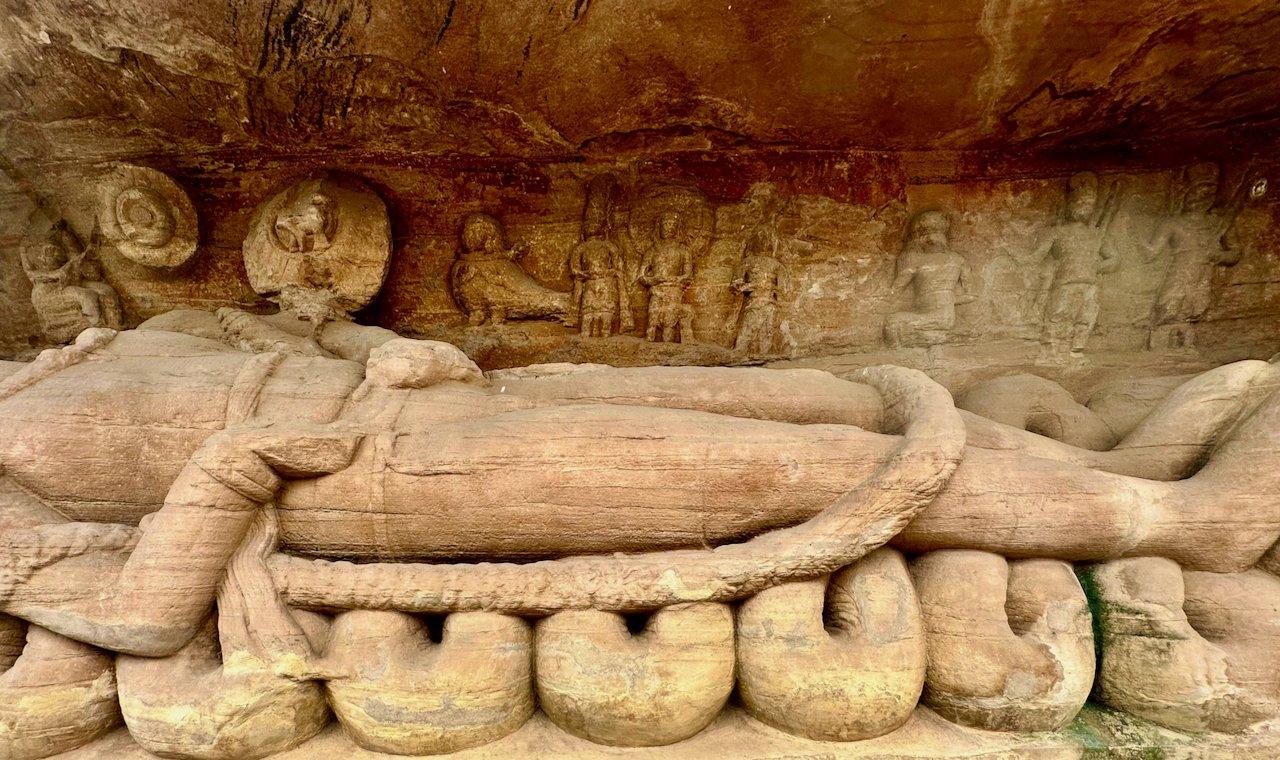
Utpanna Ekadashi is on Friday, 4 December 2026. In India, in the USA, in the UK, in Germany, in Mexico, in Russia — Friday the 4th, everywhere, with no Smarta–Vaishnava split and no second-day entry on any city's list. If you only came for the date, you have it.
Why this one, of the twenty-four Ekadashis, gets its own article: because it is the first. Not first in the calendar year — first in the story. This is the Ekadashi on which Ekadashi herself was born, out of Vishnu's own body, in the middle of a war he was losing. Drik Panchang's Mahatmya list numbers it No. 1 of the twenty-four, and its katha opens with Krishna instructing Arjuna: first of all, fast on the Ekadashi of the Krishna Paksha of Margashirsha. Which is a long way of saying: if you have been thinking of starting the Ekadashi vrat — people say this every year, usually in a temple queue in Kartik — this Friday is the door the tradition itself points at.
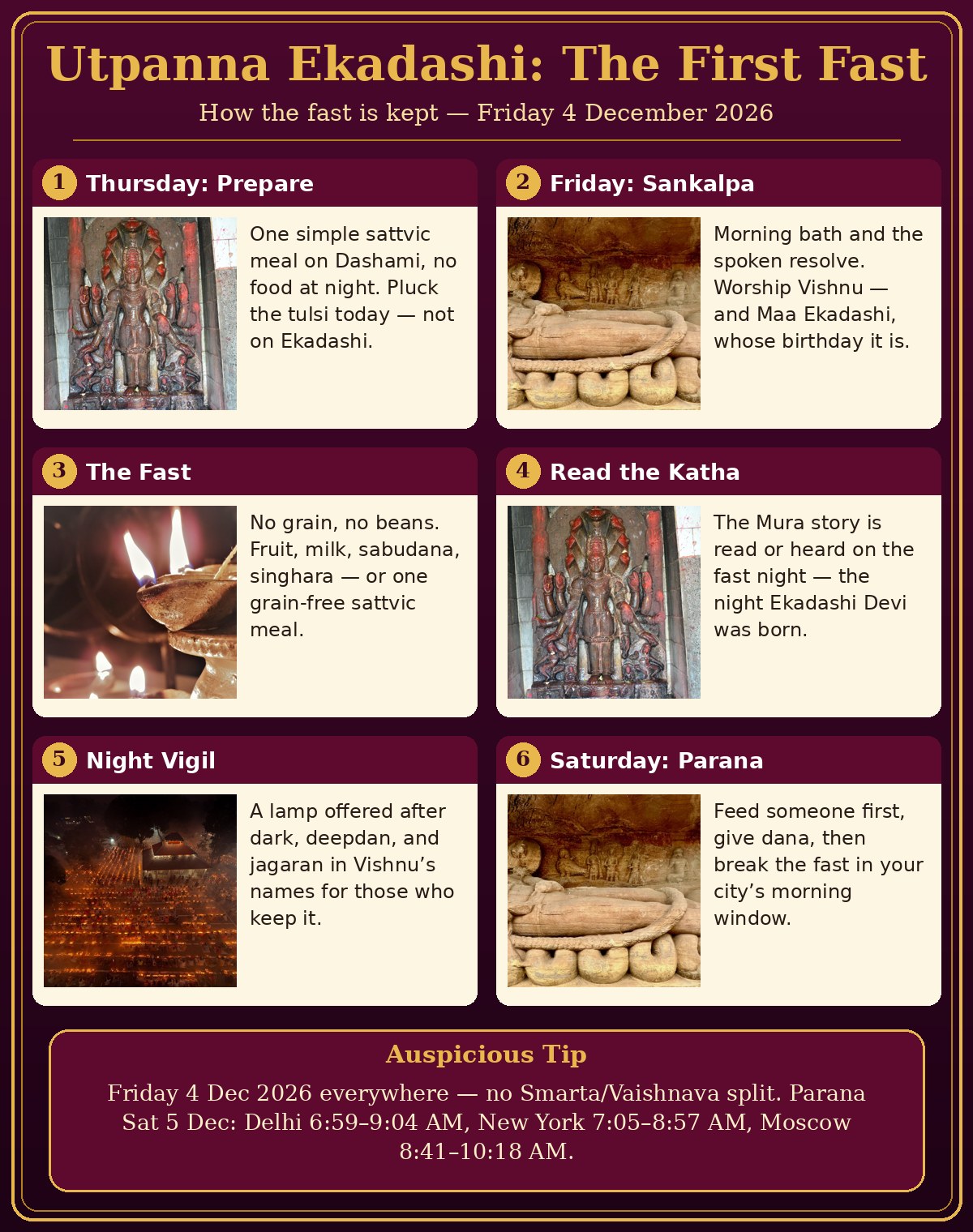
The practical headline, before anything else: it is a weekday fast, it breaks on Saturday morning, 5 December, and every city's Parana window is a civilised morning one this time. No afternoon traps, no fifteen-minute scrambles. Delhi 6:59–9:04 AM, New York 7:05–8:57 AM, London 7:49–9:26 AM, Berlin 8:00–9:37 AM, Mexico City 6:57–8:49 AM, Moscow 8:41–10:18 AM. Whoever scheduled this one scheduled it kindly.
Utpanna Ekadashi 2026 at a glance
| Fast | Friday, 4 December 2026 — India, USA, UK, Germany, Mexico, Russia |
| Tithi | Margashirsha Krishna Ekadashi (North); Kartika Krishna Ekadashi (South, amanta) |
| Ekadashi tithi, Delhi | 11:03 PM, 3 Dec to 11:44 PM, 4 Dec |
| Parana — New Delhi | Saturday, 5 Dec, 6:59 – 9:04 AM |
| Parana — New York | Saturday, 5 Dec, 7:05 – 8:57 AM EST |
| Parana — London | Saturday, 5 Dec, 7:49 – 9:26 AM GMT |
| Parana — Berlin | Saturday, 5 Dec, 8:00 – 9:37 AM CET |
| Parana — Mexico City | Saturday, 5 Dec, 6:57 – 8:49 AM CST |
| Parana — Moscow | Saturday, 5 Dec, 8:41 – 10:18 AM MSK |
| Smarta / Vaishnava | One date for both — Drik lists no Gauna entry in any of the six cities |
| Also called | Utpatti Ekadashi; the first Ekadashi; the birthday of Ekadashi Devi |
The story — the goddess who stepped out of a losing war
In the Satya Yuga, the katha says, there was a demon named Mura — son of Nadijangha, ruling from the city of Chandravati — and Mura did what ambitious demons in these stories do, only more thoroughly. He defeated Indra and the gods, threw them out of heaven, and installed his own people in their posts: a demon as Indra, a demon as Agni, as Yama, as Varuna, as the Moon, as the Sun.
The evicted gods went to Shiva first. Shiva sent them onward, to Vishnu, resting in the Kshira Sagara, the ocean of milk. Vishnu heard them out, marched with the gods on Chandravati, and fought.
And here the story does something unusual: Vishnu loses. Not dramatically — grindingly. His weapons fell on Mura, the katha says, like flowers. They wrestled. The fight went on and on — Drik's telling says a thousand years — and Mura would not fall. So Vishnu, exhausted, did the thing gods in this mythology are never too proud to do: he withdrew, went to Badrikashram, found a cave — Hemavati, in Drik's text, a cave with a single door — lay down, and slept.
Mura followed him. Found him sleeping. And raised his weapon over the sleeping god.
What happened next is why this Ekadashi exists. From Vishnu's own body there stepped out a radiant maiden, divine in form and dress, armed. She challenged Mura. She fought him — destroyed his weapons, smashed his chariot, knocked him senseless with a single blow, and cut off his head. The surviving demons fled to Patala, and the war was over, won by someone who had not existed that morning.
Vishnu woke to find Mura dead and asked who had killed him. "I, born from your body," she said, "have killed this demon." And when the pleased god offered her a boon, she asked for a boon that was entirely for other people: that whoever fasts on her day should have their sins destroyed and reach Vaikuntha — and, in the katha's own graded way, that even partial observance should earn a partial share. Vishnu granted it, and named her: You have appeared — utpanna, arisen — on Ekadashi; therefore your name is Ekadashi, and you will be known in the world as Utpanna Ekadashi; and you are dearer to me than the Tritiya, the Ashtami, the Navami or the Chaturdashi.
Some tellings have her burn Mura to ash with a single roar instead of fighting him; some give the story through Arjuna and Krishna, some through Yudhishthira; the sources name the Padma Purana and the Bhavishya-uttara Purana in different places, so this page won't pretend the attribution is tidier than it is. The shape doesn't change: the fast has a birthday, and this is it.
Why this is the Ekadashi to start on
Plenty of Ekadashis are bigger in the world's eyes — Nirjala for austerity, Devshayani and Dev Uthani for the story of the sleeping god, Mokshada later this same month for the Gita and the Vaikuntha gate (that one is a fortnight away, on 20 December, and no, before you ask, the gate-opening belongs to that Ekadashi, not this one). Utpanna's claim is different: it is the origin. The vrat was born on this tithi, and the Mahatmya's instruction is to begin the discipline here.
So the honest advice of every guide on this fast, repeated here because it is good advice: if you're starting, start gently. A phalahar fast — fruit, milk, nuts, sabudana, singhara or kuttu — is a complete and respectable first Ekadashi. The katha itself grades observance; the goddess's own boon assumes people will keep it in degrees. Nobody's first marathon is run at full speed, and nobody's first fast needs to be nirjala.
There's a setting detail worth enjoying, too. This Ekadashi falls in Margashirsha, the month Krishna singles out in the Gita above all others — māsānāṁ mārgaśīrṣo'ham, "of months, I am Margashirsha" (Gita 10.35). In parts of the tradition Margashirsha was once counted the first month of the year. The first month, by one old reckoning; the first Ekadashi, by the Mahatmya's. December starts well.
Utpanna Ekadashi 2026 in India
Fast: Friday, 4 December. Parana: Saturday, 5 December, 6:59–9:04 AM in Delhi. The Ekadashi tithi runs 11:03 PM Thursday to 11:44 PM Friday IST — the fast day is unambiguous, sunrise to sunrise, no split between Smarta and Vaishnava listings this year. Drik's Ekadashi lists show a single date for Delhi, and the day panchang for Saturday lists only the Parana. Clean.
If your home is in the South, your calendar calls this same Friday by a different month: Kartika Krishna (Bahula) Ekadashi, in the amanta reckoning — Telugu and Kannada homes often say Utpatti Ekadashi. And there, honestly, is the whole of the South's distinct angle on this day: it falls in the last days of Karthika Masam, a month of dusk lamps and Vishnu worship, and it is kept inside that devotion. There is no special temple festival for Utpanna in the South, no procession, no gate ceremony — it's the month's Krishna Ekadashi, kept the same way. Any page selling you a grand southern Utpanna tradition is decorating.
The North–South name difference matters practically for one reason: families abroad arguing over a calendar screenshot. Margashirsha Krishna and Kartika Krishna are the same tithi wearing two month-names. Both calendars are right. Nobody needs to win.
Utpanna Ekadashi 2026 in USA
Fast: Friday, 4 December. Parana: Saturday, 5 December, 7:05–8:57 AM in New York. The tithi runs 12:33 PM Thursday to 1:14 PM Friday EST — Ekadashi is fully in force at Friday's sunrise, and Drik lists no Gauna date for New York. One fast, one morning to break it.
It's a working Friday, and the version of this fast that American life actually supports is the one worth describing honestly: a light sattvic supper Thursday evening (that's Dashami — one simple meal, eaten before the evening is old), phalahar through the workday Friday, home for the lamp and the katha in the evening, and Parana Saturday morning before the day starts. Nothing in that is a diluted observance; the katha's method is a home method.
If this is your first Ekadashi — the beginner's-door point of this particular fast — a temple or community katha reading on the Thursday or Friday evening is worth finding. The Mura story lands differently when someone tells it than when you skim it, which is roughly the story's own point about hearing the katha on the night.
Utpanna Ekadashi 2026 in UK
Fast: Friday, 4 December. Parana: Saturday, 5 December, 7:49–9:26 AM in London. Tithi 5:33 PM Thursday to 6:14 PM Friday GMT. Single date, no Gauna listing.
Early December in Britain means the fast day is mostly darkness — sunrise after half seven, sunset before four. There's an accidental fitness in that: this is the Ekadashi of a night vigil, of lamps lit against the dark, and a British December supplies the dark generously. Jagaran, for those who keep any part of it, is an indoor, lamp-lit, tea-adjacent affair here, and there's nothing lesser about it.
Parana at 7:49 on a Saturday morning in December will be dark and cold in most of the UK. It's also a full hour and three quarters of window. Take the time; make something warm.
Utpanna Ekadashi 2026 in Germany
Fast: Friday, 4 December. Parana: Saturday, 5 December, 8:00–9:37 AM in Berlin. Tithi 6:33 PM Thursday to 7:14 PM Friday CET. One date; Drik lists no second day for Berlin.
The same northern-winter shape as London, an hour further on. What a German December takes away in daylight it gives back in structure: this is a fast with exactly one question — Friday, break it Saturday morning — and no regional sub-variants to reconcile. For Indian families here whose grandparents' calendars disagree about other Ekadashis (the Gauna entries that dogged Dev Uthani simply do not exist for Utpanna), a clean single date is its own small mercy.
Utpanna Ekadashi 2026 in Mexico
Fast: Friday, 4 December. Parana: Saturday, 5 December, 6:57–8:49 AM in Mexico City. Tithi 11:33 AM Thursday to 12:14 PM Friday CST.
Mexico City keeps the steadiest rhythm of the six cities in this series: a Friday fast in mild weather, broken early on a Saturday morning with the whole weekend ahead. The community is small and the observance is a home observance, which — as with most of the Ekadashis — is the original format anyway. If you're the only person in your building fasting on Friday, know that the tithi times say several million people are doing it on the same day; you're in a large, quiet company.
Utpanna Ekadashi 2026 in Russia
Fast: Friday, 4 December. Parana: Saturday, 5 December, 8:41–10:18 AM in Moscow. Tithi 8:33 PM Thursday to 9:14 PM Friday MSK. Drik lists no Gauna entry for Moscow either — Friday, everywhere, confirmed six ways.
A small kindness in Moscow's numbers, after last month's cruelty (Dev Uthani's Parana there was fifteen minutes): this window is an hour and thirty-seven minutes, the most generous of the six cities. An 8:41 start on a December Saturday in Moscow is still full night outside, but time is time. And the time-zone consolation from the Tulsi Vivah article applies again: Delhi's Parana (6:59 AM IST) is 4:29 AM in Moscow — too early to share — but the katha on Friday evening can be a family call at a civilised hour on both ends.
How the fast is kept — the vidhi
The katha does something helpful here: it doesn't only tell the story, it gives the method, in Krishna's own instructions. Combined with what homes actually do, it runs like this.
Thursday (Dashami). One simple sattvic meal, and in the katha's prescription, no food at night. Clean teeth before bed, the text says — datuna, the old twig toothbrush; a tiny, specific, very human detail to find in a Purana. Pluck the tulsi you'll offer on Friday today, because tulsi isn't plucked on Ekadashi.
Friday morning. Bathe, take the sankalpa — the spoken resolve to keep the fast — and set up the worship: Vishnu with tulsi leaves, yellow flowers, incense, fruit and a ghee lamp. On this Ekadashi, uniquely, there are two to worship: after Vishnu, Maa Ekadashi herself — it is, after all, her birthday. The katha prescribes an afternoon bath in which mud paste is applied first, with the old earth mantra ("O Earth, crossed by horses and chariots and by Vishnu, lifted up by Varaha — take away my sins"), and sandalwood tilak after bathing. Afternoon mud baths are beyond most modern Fridays, and said plainly: the morning bath and the sankalpa are where the day actually turns. Do what's real.
Friday's food. The standard Ekadashi discipline, stated once for the series: nothing made of grain — no rice, wheat, rava — and no beans or pulses; no onion, garlic, meat, eggs or alcohol; rock salt (sendha namak) if you salt. Kept as phalahar by most people — fruit, milk, curd, nuts, sabudana, singhara and kuttu preparations, one sattvic grain-free meal if that's your level — and as a full or waterless fast only by the healthy and practised. The katha grades it; your body gets a vote; the standard exclusions apply (children, the elderly, pregnancy, medication) and no guide worth reading, this one included, will tell you otherwise.
Friday night. A lamp offered after dark — deepdan — and jagaran for those who keep it: the night spent in Vishnu's names, singing, reading. The one text made for this night is the Utpanna katha itself, the Mura story above; homes read or hear it on the fast night. Vishnu Sahasranama and the mantra of the day, Om Namo Bhagavate Vasudevaya, fill the rest.
Saturday (Dwadashi) — Parana. Bathe, worship Vishnu, offer food to the Lord first. Then — a step the katha insists on and modern life keeps dropping — feed someone: a Brahmin in the text's world; a guest, a neighbour, the needy, a cow in everyone's actual world; give dana, and the katha adds, ask forgiveness for your faults while you do it. Then break your own fast inside your city's window, tulsi water or a tulsi leaf first, then a light sattvic meal. Parana inside the window is not a formality; in Ekadashi discipline it is half the vrat.
Samagri, briefly: Vishnu's image or picture (and a small place of honour for Ekadashi Devi — a kalash or a framed name does it), yellow cloth, tulsi leaves picked Thursday, yellow flowers, ghee lamp and camphor, incense, chandan, kumkum, panchamrit, fruit and sweets for naivedya, and whatever your phalahar kitchen needs.
The Kartik–Margashirsha 2026 series: Diwali 2026 · Govardhan Puja 2026 · Bhai Dooj 2026 · Chhath Puja 2026 · Dev Uthani Ekadashi 2026 · Tulsi Vivah 2026 · Dev Diwali 2026 · Kalabhairav Jayanti 2026 · Utpanna Ekadashi 2026
Check your own city before you rely on any date here: the Hindu Panchang Calculator shows today’s tithi and festival dates for your location, the Hindu Date Converter converts between Gregorian and Hindu calendar dates, and this article on the astronomy behind the panchang explains how these calculations are actually made.
Photos: Vishnu asleep on Shesha, Udayagiri Caves — Ms Sarah Welch, CC0; twelve-armed Vishnu, Ekteshwar Temple, Bankura — Bodhisattwa, CC BY-SA 4.0; a Kartik night vigil at Rakher Upobash, Dhaka — Sohelchy07, CC BY 4.0; all via Wikimedia Commons.
Dates, tithis and Parana windows follow Drik Panchang's Utpanna Ekadashi pages for New Delhi, New York, London, Berlin, Mexico City and Moscow, checked 9 November 2026 against each city's day panchang. Hari Vasara ends before sunrise in all six cities, so no Parana window is affected by it. Your local temple's announcement overrides any website, including this one.