
Tulsi Vivah 2026 is on Saturday, 21 November — at dusk, wherever you live
Tulsi Vivah is on Saturday, 21 November 2026 in India, USA, UK, Germany, Mexico and Russia, at dusk (Godhuli Vela) — there is no clock-time muhurat. Full wedding vidhi, Vrinda–Shaligram katha, samagri and a flat-friendly version.
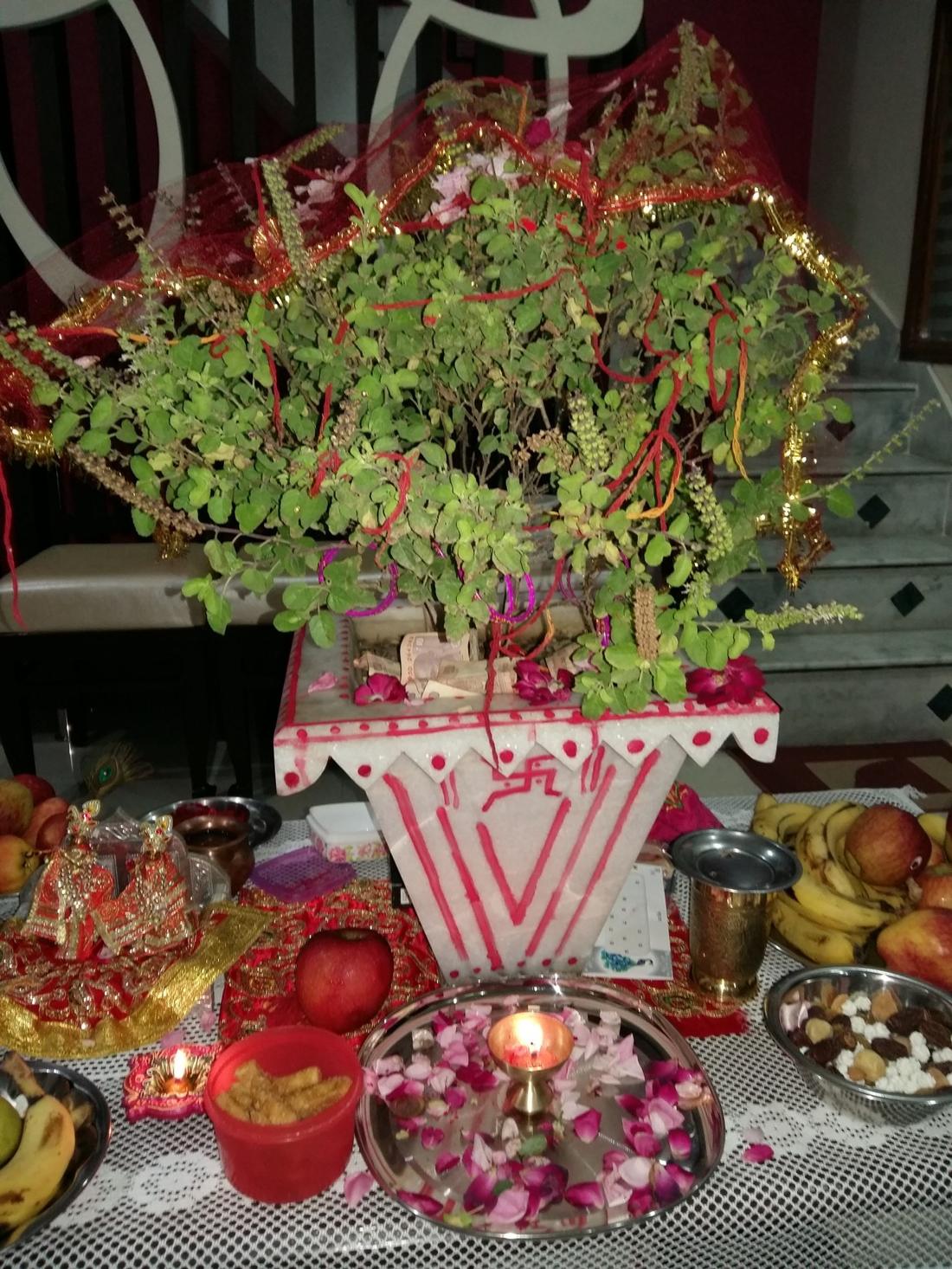
Tulsi Vivah is on Saturday, 21 November 2026 — in India, and on Saturday in the USA, the UK, Germany, Mexico and Russia too. If you only came for the date, you have it.
What you will not find on this page is a clock-time muhurat, because there isn't one. Drik Panchang's Tulsi Vivah pages, for every city we checked, give a date and a tithi and then go quiet on timings — the ceremony is done at Godhuli Vela, the dusk hour, when the cows come home and the light goes. Your sunset is the muhurat. Any website quoting you "Tulsi Vivah muhurat 6:42 PM" for your city has manufactured it, and you can stop reading that website.
So the practical version is this: Saturday, at dusk, dress the tulsi plant as a bride, seat Vishnu beside her as the groom — in most homes that means a Shaligram, the black river stone — and marry them, properly, with a sugarcane mandap and garlands and aarti, in your courtyard or on your balcony or next to the one south-facing window where the plant has been surviving the autumn. It is the first wedding of the season. Vishnu woke up yesterday — that's Dev Uthani Ekadashi — and this, traditionally, is his first auspicious act.
And if Saturday doesn't work, the tradition itself gives you room: Tulsi Vivah can be performed on any day from Dev Uthani up to Kartik Purnima, which is Tuesday, 24 November. The wedding keeps. Weddings, as anyone organising one learns, are flexible about everything except the couple.
Tulsi Vivah 2026 at a glance
| Date | Saturday, 21 November 2026 — India, USA, UK, Germany, Mexico, Russia |
| Ceremony time | Godhuli Vela — dusk, at your local sunset. No clock-time muhurat exists |
| Tithi | Kartik Shukla Dwadashi — Delhi: 6:31 AM, 21 Nov to 4:56 AM, 22 Nov |
| Dwadashi in New York | 8:01 PM, 20 Nov to 6:26 PM, 21 Nov |
| Dwadashi in London | 1:01 AM to 11:26 PM, 21 Nov |
| Dwadashi in Berlin | 2:01 AM, 21 Nov to 12:26 AM, 22 Nov |
| Dwadashi in Mexico City | 7:01 PM, 20 Nov to 5:26 PM, 21 Nov |
| Dwadashi in Moscow | 4:01 AM, 21 Nov to 2:26 AM, 22 Nov |
| Also on | Sunday, 22 November in Australia, New Zealand, Singapore and Malaysia (per HinduTone's calendar — not part of our Drik city check) |
| Window | Any day from Dev Uthani (Fri 20 Nov) to Kartik Purnima (Tue 24 Nov) |
| Also called | Tulsi Shaligram Vivah, Tulshiche Lagna (Marathi), Tulasi Kalyanam (Telugu/Tamil), Tulasi Maduve / Tulasi Habba (Kannada) |
The story — Vrinda, and the stone
This is not a sweet story, whatever the wedding decorations suggest. It is a story about a curse, and the wedding is the reconciliation at the end of it.
Vrinda was the daughter of the demon king Kalanemi, a devotee of Vishnu, and married to Jalandhar — a demon king born, the Shiva Purana says, from the fire of Shiva's third eye. Vrinda's unbroken devotion and fidelity were Jalandhar's armour: while she kept her vow, he could not be defeated, not even by the gods. And Jalandhar, armoured and overreaching, demanded that Shiva hand over Parvati herself.
So the gods did to Vrinda what Jalandhar had tried to do to Parvati. Vishnu came to her in disguise — first as a sage bearing news of her husband's death, and then, when she begged for Jalandhar's life back, in Jalandhar's own form. She received him as her husband, and in that moment her vow was broken. Shiva killed Jalandhar in battle.
Vrinda understood what had been done to her, and she cursed the god who had done it: Vishnu would turn to stone, and he too would be separated from his wife — a separation tradition connects to Rama's long separation from Sita. Then she mounted her husband's funeral pyre.
From her ashes — or, in the longer telling, from seeds planted where Vishnu grieved — grew the tulsi plant. And Vishnu, who does not dodge consequences in these stories, blessed her: she would live on earth as Tulsi and be worshipped in homes; no offering to him would ever be accepted without her leaf; and he, in the stone form her curse had given him, would marry her every year in Kartik.
That stone is the Shaligram — a black ammonite fossil from the bed of the Kali Gandaki river in Nepal, its spiral markings read as Vishnu's discus, unusual among sacred objects in needing no consecration: it is Vishnu already, self-manifested. When a family seats a Shaligram beside the tulsi plant on Saturday evening, they are not using a symbol for the groom. In the terms of the story, the groom has arrived in exactly the form the story left him in.
Other Puranas tell the curse slightly differently — one tradition gives it to Tulasi as a form of Lakshmi, and many homes simply honour Tulsi as Lakshmi herself. The versions differ. The wedding, every year, is the same.
Why a plant's wedding opens the marriage season
For four months of Chaturmas there were no weddings at all — Vishnu was asleep, and auspicious beginnings waited. He woke on Friday. His own wedding, on Saturday, is the divine wedding that reopens the season, and human weddings resume behind it. There is a reason the matrimonial machinery of an entire civilisation restarts within days of this small ceremony in a courtyard, and it's not only sentiment: the panchang quite literally begins listing vivah muhurats again.
There is a second reason this wedding is performed by people who will tell you, in the same breath, that it's "for the punya." Kanyadaan — giving a daughter in marriage — is counted among the highest forms of giving, and tradition holds that performing Tulsi's kanyadaan carries the same merit as giving away one's own daughter. That is why, in Maharashtra, a couple with no daughter traditionally acts as Tulsi's parents and bears the wedding's expense, and why in Saurashtra, couples hoping for a child perform the kanyadaan from the bride's side. Whether you file that under theology or under a society finding a way to give everyone a daughter for a day, it is a genuinely kind piece of engineering.
And it's Kartik — Vishnu's month, the month of lamps, the month when a lamp by the tulsi plant and a leaf offered to Vishnu are held to matter more than at any other time of year. The wedding lands on the second day of the five-day run from Dev Uthani to Dev Diwali. Saturday is the middle of the best week of the Hindu autumn.
Tulsi Vivah 2026 in India
Saturday, 21 November. Dwadashi tithi in Delhi runs 6:31 AM Saturday to 4:56 AM Sunday, and the ceremony belongs to the evening — Godhuli Vela, around sunset. Delhi's sunset that day is about 5:25 PM; light the lamp then, and begin.
In many homes the wedding actually happens a day earlier, on Friday evening straight after the Dev Uthani waking — same sugarcane mandap, no pause between the god waking and the god marrying. In others, Saturday is kept. There's no quarrel in it; the window runs to Tuesday's Purnima.
Do you fast for Tulsi Vivah? Here the sources genuinely split, so here's the honest version: the fast in this story is Ekadashi's, on Friday. Some families also eat phalahar until the wedding on Saturday evening; many don't fast for the wedding at all, because a wedding is a celebration, not a vrat. Shubh Darshika's guide states the second position flatly. Follow your family's house rule and don't let the internet overrule your grandmother.
One thing every guide does agree on: pluck your tulsi leaves a day or two before. Tulsi is not plucked on Ekadashi or Dwadashi. The bride, reasonably, is not to be harvested for her own wedding decorations.
Tulsi Vivah 2026 in USA
Saturday, 21 November. Dwadashi in New York runs from 8:01 PM on Friday the 20th to 6:26 PM on Saturday the 21st — the tithi is in force for the whole of Saturday's daylight, and the ceremony is at your local dusk, whatever coast you're on.
Saturday is the gift here. No workday squeeze: the full wedding can happen at home at a human pace — mandap up in the afternoon, bride dressed by the kids, aarti at sunset, prasad after. US temples do the big public versions on the same evening, and in places like Edison, Fremont and Houston they are worth attending once even if you keep the home one too.
The American practical problem isn't time, it's supply: four sugarcane stalks for the mandap. Indian grocery stores stock sugarcane precisely for this weekend — go Thursday or Friday, not Saturday evening, because every family in your zip code has the same plan. Short pieces tied around a potted plant make a perfectly good mini-mandap; the mandap is a canopy, not a construction project.
Tulsi Vivah 2026 in UK
Saturday, 21 November. London's Dwadashi runs 1:01 AM to 11:26 PM on the Saturday — the entire day is inside the tithi, so the timing question reduces to the one the tradition actually asks: do it at dusk.
Which, in a British late November, means doing it in the middle of the afternoon by Indian instinct. Sunset comes early, the light goes fast, and a Tulsi Vivah that starts when the street lights come on is correctly timed however strange it feels. Leicester, Birmingham and London temples will all be working to the same early dusk.
The British problem is the plant. Tulsi is a tropical basil; it has no frost tolerance at all, its leaves blacken below about 10°C, and one cold night on a windowsill can finish it. By 21 November your tulsi should already be living indoors — brightest south-facing window you've got, away from cold draughts and radiators, watered only when the top inch of soil is dry. UK growers keep them through winter with a grow light on 12–14 hours a day; November daylight in Britain is not a light source, it's a rumour. Full cold-weather care, and the honest answer about what to do if the plant has already died, is in the practical section below — it's the part of this article most likely to be needed in the UK and Germany, so it's written properly.
Tulsi Vivah 2026 in Germany
Saturday, 21 November. Berlin's Dwadashi runs 2:01 AM Saturday to 12:26 AM Sunday, and the wedding is at Berlin dusk — which by late November is a mid-afternoon event. Germans reading over your shoulder will find a 4 PM wedding unremarkable; Indians who have just arrived find it the strangest thing about the calendar here. Both reactions are correct.
Everything said for the UK about the plant applies double in a German winter: indoors well before the first frost, brightest window, grow light if you can, no draughty sill, no radiator heat blasting it dry. A tulsi that survives a Berlin winter has been kept, deliberately, and there's something fitting about the bride arriving at her wedding as the household's most protected resident.
Ruhezeiten note, briefly: a home wedding is mostly singing, aarti and food, none of which troubles quiet hours at normal volume on a Saturday. The baraat, if your household is inclined towards one, stays indoors. Vishnu has had quieter weddings.
For the diaspora here, there's a practical fallback worth knowing about: temples in the bigger cities hold collective Tulsi Vivahs that any family can join. If your plant didn't survive October, joining the temple wedding this year and starting a new plant in spring is a completely respectable way to keep the day — more on that below.
Tulsi Vivah 2026 in Mexico
Saturday, 21 November. Mexico City's Dwadashi runs from 7:01 PM on Friday the 20th to 5:26 PM on Saturday the 21st — so Saturday's dusk ceremony sits near the very end of the tithi, which is fine; it sits inside it.
Mexico City has the kindest climate on this page for the bride: a tulsi that lives outdoors most of the year doesn't face the European survival problem, and a balcony wedding at a warm dusk is about as close to the courtyard original as this festival gets outside India.
The community is small, so this will mostly be a home wedding — which, again, is what it mostly is everywhere. Sugarcane is the one thing Mexico will not make you hunt for; it grows there. Four stalks, a dressed plant, the groom beside her, aarti as the light goes, and prasad shared with whoever is home. The essentials travelled well.
Tulsi Vivah 2026 in Russia
Saturday, 21 November. Moscow's Dwadashi runs 4:01 AM Saturday to 2:26 AM Sunday. The wedding is at Moscow dusk — deep into the afternoon by the clock, dark November dark — and a lit lamp against that darkness is, once again, the correct aesthetic for Kartik, whether or not it was designed for this latitude.
People sometimes ask whether a ceremony this dependent on a living green plant makes sense in a Russian winter. Indoors, it does: the tulsi lives inside, as it does in London and Berlin, and the wedding happens around the plant where it lives. Nobody is suggesting a courtyard.
And here's the small mercy of the time zones: Moscow's dusk on Saturday is Delhi's Saturday evening, near enough. A video call at the aarti is a live call, not a recording — your family in India can watch the varmala happen at almost exactly the moment they'd be lighting their own lamps. Of all the festivals in this Kartik series, this is the one where the diaspora version and the home version can genuinely share an evening.
How the wedding goes — the vidhi
Families and regions vary the sequence; this is the common spine, and it is recognisably a wedding, with a wedding's logic.
Clean the place first. Bathe, clean clothes, clean around the tulsi's pot or the Tulsi Vrindavan — the raised, painted planter many homes keep her in — and draw a rangoli around it. Many families begin with Ganesh puja and a kalash; many don't. Then raise the mandap: four sugarcane stalks stood at the corners of the pot and tied at the top into a small canopy, decorated with mango leaves and marigold.
Dress the bride. Sprinkle the plant with clean or Ganga water, drape the pot in a red or pink sari or chunri, and offer the bridal shringar — bindi, sindoor, haldi, little bangles, simple jewellery, a small mangalsutra. Some homes give her a paper face with a bindi and nose-ring. In Braj the festivities run to a full haldi and mehndi; a mehndi cone is offered in the bridal thali in many homes. She should look, by the end of this, unmistakably like a bride. Children understand this part instinctively and should be given charge of it.
Seat the groom. The Shaligram is bathed with water or panchamrit, given chandan tilak, dressed in yellow cloth, offered the sacred thread — and placed beside her, on her right. No Shaligram? The section below covers it; don't let that stop the wedding.
At dusk, light the ghee lamp and incense, and offer haldi, kumkum, akshat, flowers and fruit to both of them. Then the wedding itself. In Maharashtra, a white cloth — the antarpat — is held between the bride and groom while the Mangalashtak verses are sung, and at the word "Savadhan" the cloth drops, rice mixed with kumkum rains over the couple, and everyone claps: it is the single most theatrical moment in any home wedding, and it belongs to a plant. Elsewhere, garlands are exchanged — the varmala — the householder couple performs kanyadaan, giving Tulsi away as her parents, and the bride and groom are tied together with a cotton kalava thread, the gathbandhan. Then someone picks up the Shaligram and carries him around the tulsi seven times — the pheras — while wedding songs or Vishnu's names are sung. Sindoor is touched to the plant as the closing mark.
Then aarti, both of them together, and prasad.
What you'll need: the tulsi plant in a clean pot; a Shaligram or a Vishnu/Krishna idol or picture; four sugarcane stalks; mango leaves or a flower toran; rangoli colours; for the bride — red or pink chunri, bindi, sindoor, haldi, kumkum, small bangles, a small mangalsutra; for the groom — yellow cloth, janeu, chandan, yellow flowers; kalash and coconut if your family sets them; akshat; kalava thread; ghee lamp, incense, camphor; garlands; panchamrit (milk, curd, ghee, honey, sugar); and for bhog, the season's own list — amla, ber, singhara, sweet potato, sugarcane pieces, coconut, groundnuts in Maharashtra, sweets, and kheer or payasam depending on which India your kitchen is from.
If you want one verse, the Tulsi Pranama is the one to print on your memory rather than your phone:
वृन्दायै तुलसीदेव्यै प्रियायै केशवस्य च। विष्णुभक्तिप्रदे देवि सत्यवत्यै नमो नमः॥
Vrindayai Tulasi-devyai, priyayai Keshavasya cha; Vishnu-bhakti-prade devi, Satyavatyai namo namah. "I bow again and again to Vrinda, Goddess Tulsi, dear to Keshava — O goddess, you give devotion to Vishnu, and you are truth itself." The aarti families sing varies by tradition — "Jai Jai Tulsi Mata" in many homes, "Tulsi Maharani Namo Namo" in others, the latter with a line about Tulsi becoming dear to the Shaligram, which is exactly right for this night. Sing yours.
The wedding, region by region
In Braj — Mathura and Vrindavan — this is done at full scale and full seriousness: haldi, mehndi, jaimala, pheras, a baraat, temple tableaux of Krishna and Tulsi, and every old Krishna temple keeping its ring of tulsi plants, its Tulsi ghera. Nothing is offered to the deity there without tulsi on any day of the year; on this day, she is the occasion.
In Maharashtra the wedding is led by women, real wedding food is cooked, and daughter-less couples take the parents' place — the antarpat and the shout of "Savadhan" described above are Maharashtra's centrepiece.
In Saurashtra, Gujarat, two Rama temples stage it between themselves: the bride's temple sends a formal invitation card to the groom's temple — a printed card, for a plant, and quite right too — and Lalji travels in a palanquin in a singing baraat to the bride's temple, where the wedding is held and bhajans run all night.
In Andhra Pradesh and Telangana it is Tulasi Kalyanam, kept on Dwadashi itself and called Ksheerabdhi Dwadashi — and the groom is present as an amla branch, placed in the Tulsi Vrindavan beside the bride, with the full sixteen-step Shodashopachara worship and payasam and pongal for naivedyam. Karnataka does a version of the same, amla branch and all, with lamps in the evening. If you've ever wondered whether the groom must be a stone: two entire regions answer, no, a branch of amla will do. Remember that answer — it settles the question in the next section too.
And in one village in Bihar, Prabhu Dham at Saunja, the whole village celebrates for three days — Ramayana chanting, a procession, and a Chappan Bhog of 56 dishes for everyone. A village wedding, for the village's daughter. Scale is not the point anywhere in this festival; belonging is.
No Shaligram, a small flat, a dead plant — the honest answers
No Shaligram. Use a small idol of Vishnu or Krishna, or a picture, and follow the same vidhi — multiple guides state this as a plain FAQ answer, and the amla-branch tradition above says the same thing in older language. There's even a sensible rider in the guides: a Shaligram carries daily-worship expectations in many families, so if you can't keep those up, an idol or a picture isn't a compromise — it's the better groom.
A small flat. A balcony or the puja corner is enough. Potted tulsi, short sugarcane pieces for a mini-mandap, the groom on a small chowki beside her. The full wedding has been performed in spaces smaller than a London bedsit, because for many families it already has been.
Keeping her alive until the wedding — and after. For the UK, Germany and anywhere cold: tulsi comes indoors well before frost — by late September in Britain, or whenever nights start dropping towards 8–10°C. South-facing windowsill for light, but not pressed against cold glass and not over a radiator; roughly 18–27°C is her comfort. November's real enemy is darkness — a full-spectrum grow light for 12–14 hours a day is what actually carries a tulsi through a northern winter. Water only when the top inch of soil is dry, about weekly indoors; overwatering in cool rooms kills more tulsi than cold does. Mist her, or stand the pot on a tray of wet pebbles, against the dry heated air.
If the plant has already died. First, check: scratch the stem with a thumbnail. Green underneath means she's alive — prune the dead tips, give her warmth and light. Dry and brittle all the way through means she has died, and the respectful thing is what families have always done: retire the plant to flowing water or bury it in clean soil, clean the pot, plant again in spring.
And no — a dead tulsi is not an omen, whatever the vastu sites say. A temple-guide source puts it best: a plant drying is a botanical event — frost, overwatering, age — and there is no reason for fear or guilt in it. A tropical plant met a European winter. That is the whole explanation.
What we will not do here is invent a rite for marrying a dead plant, because we couldn't find one — every vidhi assumes a living tulsi. The honest options are these: join a temple's collective Tulsi Vivah this year, of which there will be several in every big city; do a simple Tulsi–Vishnu puja and aarti at dusk on Saturday with the leaves and manjari you have; and grow the bride for next Kartik. If your family wants a ruling beyond that, it's a question for your own priest — not for a website, including this one.
The Kartik 2026 series: Diwali 2026 · Govardhan Puja 2026 · Bhai Dooj 2026 · Chhath Puja 2026 · Dev Uthani Ekadashi 2026 · Tulsi Vivah 2026 · Dev Diwali 2026
Check your own city before you rely on any date here: the Hindu Panchang Calculator shows today’s tithi and festival dates for your location, the Hindu Date Converter converts between Gregorian and Hindu calendar dates, and this article on the astronomy behind the panchang explains how these calculations are actually made.
Photos: Tulsi Vivah at home — Antrabhardwaj2, CC BY-SA 4.0; tulsi (holy basil) — Diamante Phi, CC BY-SA 4.0; Lakshmi-Narasimha shaligram with a tulsi leaf — Arnab Dutta, CC BY-SA 4.0; all via Wikimedia Commons.
Dates and tithis follow Drik Panchang's city pages for New Delhi, New York, London, Berlin, Mexico City and Moscow, checked 9 November 2026. Drik lists no clock-time Tulsi Vivah muhurat for any city, and this page invents none; the Australia/NZ/Singapore/Malaysia date (Sunday 22 November) is from HinduTone's calendar, as marked. Your local temple's announcement overrides any website, including this one.