
Subrahmanya Shashthi 2026 is on Tuesday, 15 December — Murugan's day, a day early in New York, London, Berlin and Mexico City
Subrahmanya Shashthi 2026 is on Tuesday, 15 December in India and Moscow — and Monday, 14 December in New York, London, Berlin and Mexico City. Tithi times city by city, the Kartikeya katha, Kukke Subramanya and how to keep the vrat at home.
Subrahmanya Shashthi 2026 is on Tuesday, 15 December in India and Moscow — and on Monday, 14 December in New York, London, Berlin and Mexico City. It is the day of Kartikeya, the six-faced son of Shiva, the god with the vel and the peacock, and in Karnataka it is the biggest day of the year at Kukke Subramanya.
The tithi is the same instant everywhere — Shashthi begins at 13:45 UTC on Monday 14 December and ends at 15:49 UTC on Tuesday 15 December — but the clocks disagree, so the day itself splits. If you live in New York, London, Berlin or Mexico City, your Subrahmanya Shashthi is Monday. In Delhi and Moscow it is Tuesday. That is the whole confusion, and it is worth settling before anything else, because a fast kept on the wrong day is a fast kept for nothing.
Subrahmanya Shashthi 2026 at a glance
| Date | Tuesday, 15 December 2026 — India, Russia; Monday, 14 December 2026 — New York, London, Berlin, Mexico City |
| Shashthi tithi, Delhi | 07:15 PM Mon 14 Dec – 09:19 PM Tue 15 Dec IST |
| Shashthi tithi, New York | 08:45 AM Mon 14 Dec – 10:49 AM Tue 15 Dec EST |
| Shashthi tithi, London | 01:45 PM Mon 14 Dec – 03:49 PM Tue 15 Dec GMT |
| Shashthi tithi, Berlin | 02:45 PM Mon 14 Dec – 04:49 PM Tue 15 Dec CET |
| Shashthi tithi, Mexico City | 07:45 AM Mon 14 Dec – 09:49 AM Tue 15 Dec CST |
| Shashthi tithi, Moscow | 04:45 PM Mon 14 Dec – 06:49 PM Tue 15 Dec MSK |
| Also called | Skanda Shashthi; Kukke Subramanya Sashti; the Shashthi after Soorasamharam |
| The day's work | Dawn bath, Shashthi vrat, puja to Subrahmanya with flowers and milk, milk poured at the anthill, reading of the katha |
| No muhurat | Drik Panchang lists no festival-specific muhurat clock time beyond the tithi itself — the tithi window above is the timing |
One honest wrinkle before we go further. A few American calendars disagree with this page about New York. HinduTone's US table lists Subrahmanya Shashthi as Tuesday 15 December for the Eastern and Central time zones, Monday only on the West Coast. Drik Panchang's own New York page says Monday 14 December, and this page follows Drik — it is the house source for the whole series, and I checked its New York page directly. But the disagreement is real, and it comes from different rules about which sunrise the tithi has to cover. If your temple in the US says Tuesday, follow your temple. That sentence is doing real work here, not being polite.
There is a second wrinkle, smaller. Drik notes that for the Shashthi vratam, the day when Shashthi is combined with Panchami is preferred, and some families keep the vrat a day earlier on that reading. So a minority of households in India will fast on Monday 14 December. Neither side is wrong; they are following different rules from the same books. The festival date here is Tuesday, the vrat has its own argument, and your family's custom settles it.
The god this day belongs to
Kartikeya has more names than most gods get in a lifetime — Subrahmanya, Murugan, Skanda, Shanmukha, Kumara — and the story behind the names is the story of the day. Tarakasura had a boon from Brahma that only a son of Shiva could kill him, and he was counting on Shiva never marrying after Sati's death. Shiva's tejas, carried by Agni and then the Ganga, came to rest in a reed forest, where it became six babies on lotuses. Six Krittika maidens nursed them — hence Kartikeya, son of the Krittikas — and when Parvati embraced the six, they merged into one child with six faces and twelve arms. That is Shanmukha, the six-faced one, and he was made commander-in-chief of the devas.
The demon he was born to kill depends on which telling you grew up with, and both are worth knowing. In the pan-Indian telling of the Skanda Purana, he kills Tarakasura. In the Tamil telling, he fights the asura brothers led by Soorapadman for six days at Tiruchendur, and on the sixth day Soorapadman becomes a mango tree. Murugan splits it with his vel — one half becomes the peacock, his vahana, the other the rooster on his banner. The vel itself was his mother's gift, her shakti made into a spear. One tradition even says he was born on Margashirsha Shukla Panchami and killed Tarakasura the next day, on Shashthi — which would make this day the anniversary of the victory itself, not just the birthday.
Shashthi is the sixth tithi, and it is his. Every month has a Shukla Shashthi, and every one of them belongs to Skanda in some measure. This one, in Margashirsha, is the one that carries a festival with it.
Not the November Shashthi
This is the part people get wrong, and it matters, because the two Shashthis have different shapes. The famous one is the Aippasi Skanda Shashthi, the six-day fast in the Tamil month of Aippasi that ends with Soorasamharam — the enactment of the killing of Soorapadman on the Tiruchendur shore — and then Thirukalyanam the next day. In 2026 that ran from 10 to 15 November, with Soorasamharam on Sunday 15 November. That is the big Tamil fast, and it is over.
This December day is what Drik calls the next Skanda Sashti after Soorasamharam — also known as Kukke Subramanya Sashti, falling in the lunar month of Margashirsha. It is a monthly Shashthi observance plus a big regional festival, not a repeat of the six-day fast. If you kept the November vratam, you know what a six-day fast feels like; this day is a single day's observance, and it does not ask for the same thing.
One more name to keep straight. In Maharashtra, the same Shashthi tithi ends Champa Shashthi, a six-day festival of Khandoba, marking his victory over the demons Mani and Malla. Same date, different god, different story. Don't let a calendar that says "Champa Shashti" on 15 December convince you this article is about Khandoba. It isn't.
How the day is actually kept
At home, the shape of it is simple, and it follows the god.
First, the morning. Bathe before sunrise and keep the Shashthi vrat — many families fast until the puja is done, and some from the previous evening. Set Subrahmanya's picture or idol with flowers, turmeric and kumkum, and offer milk — milk abhishekam is the offering of this day in a way water is not, and the reason is the serpent.
Second, the nagas. Subrahmanya is worshipped in serpent form, a five-hooded snake, and the tradition says he protected the snakes and blessed that his puja be done in serpent form. So milk is poured at the anthill — the putta — or before a naga image, and the prayer is for children, and for relief from sarpa dosha and skin ailments. Families also offer small silver serpent hoods, and recite the Subrahmanya Ashtakam, the Subrahmanya Bhujangam, or the Kanda Sashti Kavasam. If you have an anthill near your home in India, you will see the milk being poured there on this day. Abroad, a picture of the naga and a small bowl of milk does the same work, and nobody in the tradition would call it less.
Third, the katha. The story of the birth and the victory is read aloud, and the fast is broken after the puja. That is the whole of it. What it is not: a Kavadi day. Kavadi belongs to Thaipusam, and no source ties it to this Shashthi, so don't go looking for it.
Kukke Subramanya, where the festival lives
If one temple owns this day, it is Kukke Subramanya, on the Kumaradhara river at the foot of Kumara Parvatha in Dakshina Kannada, near Mangalore. Drik names it outright as the famous shrine of Lord Murugan outside Tamil Nadu, and the temple's grandest annual festival is Champa Shashti — a season of about fifteen days from Karthika Bahula Dwadashi to Margashira Shuddha Purnima, crowned by the Brahmarathotsava, the great chariot procession, with thousands pulling the Brahma Ratha through the streets. It is one of the seven Mukti Kshetras of Parashurama, and on this day it is crowded in a way that makes an ordinary Tuesday look like a rumour.
One thing worth saying plainly, because it gets misreported: the famous Sarpa Samskara at Kukke — the two-day dosha-remedy rite — is a year-round rite, booked through the Karnataka portal, not something done only on Shashthi. The related daily rites are Ashlesha Bali and Naga Prathishte. The festival is the festival; the Samskara is always there.
Mopidevi, in Andhra Pradesh, keeps Subrahmanya Shashti as its most important festival, with special abhishekams, kalyanam and very large crowds. Ghati Subramanya in Karnataka is known for a single stone that holds two deities — Subrahmanya facing east, Lakshmi Narasimha facing west. And in Tamil Nadu, Palani and Thiruchendur keep the day with abhishekam and vel puja, as two of the six abodes of Murugan. Thiruchendur's signature event remains the November Soorasamharam; in December it is a monthly Shashthi, kept properly and without the six-day crowds.
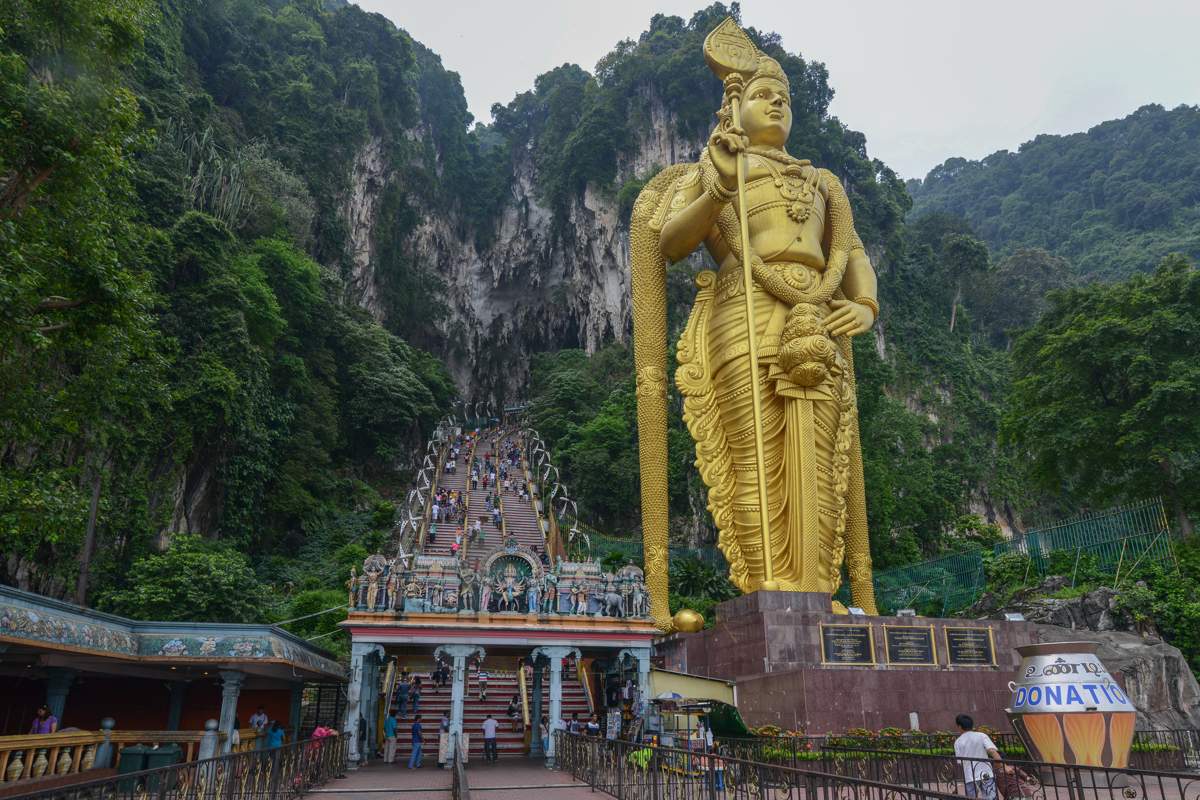
The photograph at the top of this page is the 42.7-metre golden Murugan at Batu Caves in Malaysia, vel in hand, beside the 272 steps. He is the same god, and the diaspora knows him there better than anywhere outside India.
Subrahmanya Shashthi 2026 in India
The observance is Tuesday, 15 December. The Shashthi tithi in Delhi runs 7:15 PM on Monday the 14th to 9:19 PM on Tuesday the 15th, so the whole of Tuesday — the dawn bath, the fast, the puja, the milk at the anthill — sits inside it. Delhi's sunrise on Tuesday is 7:06 AM and sunset is 5:26 PM.
Where India goes on this day
Kukke Subramanya is the centre, and it will be packed — the Brahmarathotsava season draws devotees from across Karnataka, Andhra Pradesh and Tamil Nadu, and the town's lodges fill. Mopidevi in Andhra Pradesh is the other great crowd, and Ghati Subramanya near Bengaluru keeps the day with its own following. In Tamil Nadu, Palani and Thiruchendur keep it as a monthly Shashthi, quieter than November, with abhishekam in the morning and the vel carried in procession.
It falls the day after Vivah Panchami, Rama and Sita's wedding day, and a week after Margashirsha Amavasya, the ancestors' day — three observances in eight days, which is the shape of Margashirsha. If you are in India and near a Subramanya temple, go in the morning. The milk abhishekam is the moment to see, and the crowds, while real, are nothing like Diwali's.
Subrahmanya Shashthi 2026 in USA
The observance is Monday, 14 December — a day earlier than India, on Drik's New York page. The tithi in New York runs 8:45 AM on Monday to 10:49 AM on Tuesday, so Monday is the day, and the tithi ends on Tuesday morning, before most people are properly awake.
A Monday fast, and the temple question
This is the awkward one of the series: a Monday, a working day, and a fast that runs through it. New York's sunrise on Monday is 7:12 AM and sunset is 4:28 PM, so the day is short and the puja has to be fitted around work. The practical shape most American families use: the dawn bath before work, a light fast through the day, and the puja and the milk offering in the evening, after sunset. The tithi is still running on Monday evening — it doesn't end until Tuesday morning — so an evening puja is inside it.
One small mercy of the split: a video call home on Monday evening in New York reaches India on Tuesday morning, right in the middle of their Subrahmanya Shashthi. Both ends of the call are keeping the same day, just on different dates, and neither side is wrong. But remember the wrinkle at the top of this page — a few American calendars say Tuesday for the Eastern time zone. If your temple says Tuesday, follow your temple, and don't let this page argue with it.
Subrahmanya Shashthi 2026 in UK
The observance is Monday, 14 December. London's tithi runs 1:45 PM on Monday the 14th to 3:49 PM on Tuesday the 15th — it begins on Monday afternoon, so Monday is the day, and the tithi is still running at Tuesday's lunch.
An afternoon tithi, and a dark evening
London's sunrise on Monday is 7:59 AM and sunset is 3:51 PM, which gives you just under eight hours of daylight. The practical consequence is that the tithi itself doesn't start until early afternoon, so the morning is outside it — the dawn bath and the fast can still be kept in the morning, as the vrat is a day's observance, but the puja itself belongs to the afternoon and evening. The evening ceremony happens in full dark, in the middle of the afternoon, which honestly suits a lamp-lit puja.
The morning puja is the same as everywhere: flowers, turmeric, kumkum, milk for the naga, the katha read aloud. In a London flat the puja corner is usually the same shelf it always is, and that is fine. The god was born in a reed forest and is worshipped at an anthill; he survives a living room perfectly well, and the milk in a small bowl is the same offering either way.
Subrahmanya Shashthi 2026 in Germany
The observance is Monday, 14 December. Berlin's tithi runs 2:45 PM on Monday the 14th to 4:49 PM on Tuesday the 15th. Monday is the day, and the tithi begins in the afternoon, like London's.
The shortest day of the series
Berlin's sunrise on Monday is 8:10 AM and sunset is 3:51 PM — seven hours and forty-one minutes of daylight, the shortest day in this article's six cities. The morning puja happens in darkness, the reading in the first grey light, and the evening puja in the middle of the afternoon. December in Berlin does not give you much sun to work with, and this festival, which is mostly about a dawn bath, a fast and an evening lamp, is the one that minds least.
One practical note, the same one from the Dev Uthani article: Germany has Ruhezeiten, and a 3:51 PM dusk is still working hours for the neighbours. The home puja is quiet by nature — flowers, milk, a reading, a lamp — which is one more reason this festival travels better than the noisy ones. If your temple stages a procession, it will be a temple affair, indoors, and the neighbours will never know. The fast goes on either way.
Subrahmanya Shashthi 2026 in Mexico
The observance is Monday, 14 December — a day earlier than India, like New York. Mexico City's tithi runs 7:45 AM on Monday to 9:49 AM on Tuesday — it begins just after dawn on Monday, so the whole of Monday is inside it.
The longest light of the six cities
Mexico City gets the most generous December day of the six: sunrise 7:02 AM, sunset 6:00 PM, nearly eleven hours of light. The dawn bath can be unhurried, the fast kept in actual morning sun, and the evening puja done at a dusk that still feels like evening rather than the middle of the night. It is the only city in this article where the whole observance fits comfortably into daylight.
The Indian community in Mexico is small, and this is mostly a home observance there — which is fine, because a home observance is what Subrahmanya Shashthi mostly is, even in Kukke, once you step outside the temple courtyard. The puja needs flowers, turmeric, kumkum, milk and the katha. Everything else is commentary.
Subrahmanya Shashthi 2026 in Russia
The observance is Tuesday, 15 December — the same day as India. Moscow's tithi runs 4:45 PM on Monday the 14th to 6:49 PM on Tuesday the 15th — it begins on Monday afternoon, so Tuesday is fully inside it.
A fast staged in the dark
Moscow's sunrise on Tuesday is 8:53 AM and sunset is 3:55 PM — seven hours and two minutes of daylight, and the morning is genuinely dark. The dawn bath happens before the sun is up, which is the traditional form anyway: the bath at dawn, in darkness, is how the old guides describe the start of a festival day. A Moscow December simply makes the description literal.
The evening puja is the same as everywhere else, and the time zones offer their usual small mercy: a video call home after the evening puja reaches India at around 8:30 PM IST, when Delhi families are sitting down to their own evening after a day that began four hours earlier. Both ends of the call are keeping Subrahmanya Shashthi on the same Tuesday — Moscow and Delhi agree on this one.
East of Moscow the tithis shift with the time zones, as always. Your local temple or your own city's panchang is the authority there; Moscow's hours belong to Moscow.
What you'll need, roughly
Flowers, turmeric and kumkum, a diya, incense, milk for the abhishekam and for the anthill or naga image, fruits and sweets for offering, and the Subrahmanya Ashtakam, the Bhujangam or the Kanda Sashti Kavasam to recite. A picture or idol of Subrahmanya — with Valli and Devasena if your family keeps them together — and the katha to read aloud.
That is the entire list. Subrahmanya Shashthi is not a festival of shopping. It is a festival of a god who was born to fight, and a fast kept for him needs flowers and milk and a story — and someone to tell the story to.
The Kartik–Margashirsha 2026 series: Diwali 2026 · Govardhan Puja 2026 · Bhai Dooj 2026 · Chhath Puja 2026 · Dev Uthani Ekadashi 2026 · Tulsi Vivah 2026 · Dev Diwali 2026 · Kalabhairav Jayanti 2026 · Utpanna Ekadashi 2026 · Margashirsha Amavasya 2026 · Vivah Panchami 2026 · Subrahmanya Shashthi 2026
Check your own city before you rely on any date here: the Hindu Panchang Calculator shows today’s tithi and festival dates for your location, the Hindu Date Converter converts between Gregorian and Hindu calendar dates, and this article on the astronomy behind the panchang explains how these calculations are actually made.
Photos: Murugan statue at Batu Caves, Malaysia — Jorge Láscar, CC BY 2.0; Diya flame — Ventrovert, CC BY 4.0; Murugan with Valli and Devasena — Raja Ravi Varma, public domain; Murugan statue, Batu Caves — Maxim Shesterikov, CC BY-SA 4.0; Adi Subramanya, Kukke — Gpkp, CC BY-SA 4.0; Kukke Subramanya Temple — A. Murali, CC0; Palani Murugan Hill Temple — Spsarvana, CC BY-SA 4.0; all via Wikimedia Commons.
Timings follow Drik Panchang's city pages for New Delhi, New York, London, Berlin, Mexico City and Moscow, checked 12 November 2026. Sunrise and sunset times are for Tuesday, 15 December 2026 (Monday, 14 December for New York, London, Berlin and Mexico City). Where other sites disagree — HinduTone's US table lists Tuesday 15 December for the Eastern time zone — this page says so and says which source it follows and why. Your local temple's announcement overrides any website, including this one.