
Margashirsha Amavasya 2026 is on Tuesday, 8 December — the ancestors' day, not a festival
Margashirsha Amavasya is on Tuesday, 8 December 2026 in India, USA, UK, Germany, Mexico and Russia. Tithi times city by city, pitru tarpan, snan-daan and deep daan — and why some sites list different timings.
Margashirsha Amavasya 2026 is on Tuesday, 8 December. In Delhi, in New York, in London, in Berlin, in Mexico City, in Moscow — Tuesday the 8th, all of them. The new-moon tithi runs from 4:12 AM on Tuesday to 6:21 AM on Wednesday in Delhi, and the whole of Tuesday sits inside it in every city we checked.
It is not a festival in the way Diwali is a festival. There are no fireworks, no new clothes, no feast. It is the quietest big day of the Hindu year: a day for the people who aren't here anymore. You bathe at dawn, you offer water and black sesame to your ancestors, you give something away, and in the evening you float a lamp on water and watch it go. That's the whole day, and it has been the whole day for a very long time.
Margashirsha Amavasya 2026 at a glance
| Date | Tuesday, 8 December 2026 — in all six countries |
| Amavasya tithi, Delhi | 04:12 AM Tue 8 Dec – 06:21 AM Wed 9 Dec IST |
| Amavasya tithi, New York | 05:42 PM Mon 7 Dec – 07:51 PM Tue 8 Dec EST |
| Amavasya tithi, London | 10:42 PM Mon 7 Dec – 12:51 AM Wed 9 Dec GMT |
| Amavasya tithi, Berlin | 11:42 PM Mon 7 Dec – 01:51 AM Wed 9 Dec CET |
| Amavasya tithi, Mexico City | 04:42 PM Mon 7 Dec – 06:51 PM Tue 8 Dec CST |
| Amavasya tithi, Moscow | 01:42 AM Tue 8 Dec – 03:51 AM Wed 9 Dec MSK |
| Also called | Darsha Amavasya; Bhaumavati Amavasya (it falls on a Tuesday); Karthika Amavasya in the Telugu/Kannada amanta calendar |
| The day's work | Snan at sunrise, pitru tarpan, daan, deep daan at dusk |
| No muhurat | Drik Panchang lists no festival-specific muhurat for Amavasya itself — the tithi window above is the timing |
One honest wrinkle before we go further. If you have another tab open, it may disagree with this page by about an hour. SmartPuja lists the Delhi tithi as 3:22 AM on Tuesday to 2:40 AM on Wednesday — earlier at both ends than Drik Panchang's 4:12 AM to 6:21 AM. This page follows Drik, which is the house source for this whole series, and the difference is a panchang-calculation difference, not a mistake either side would admit to. It does not change the day — Tuesday the 8th either way — and it does not change what you do. If your temple prints its own timings, follow your temple. That sentence is doing real work here, not being polite.
Why this Amavasya, and why this month
Every month has an Amavasya, and every one of them belongs to the ancestors. Margashirsha's has two things the others don't.
The first is the month itself. Margashirsha is the month Krishna names as his own in the Bhagavad Gita — māsānāṁ mārgaśīrṣo 'ham, "among months, I am Margashirsha" (Gita 10.35). So this Amavasya sits inside the month he claimed, and reading the Gita on it is one of the standard observances: not a long reading, necessarily. A chapter, or the verses you already know. The point is the pairing — the ancestors' day inside Krishna's month.
The second is the weekday. An Amavasya that falls on a Tuesday is a Bhaumavati Amavasya, and the guides treat Tuesday Amavasyas as carrying extra weight for pitru rites. It also means the day has a second name — Darsha Amavasya, the name Drik Panchang prints — which is the one your grandmother's calendar probably used.
And then there is the calendar split, which is worth a paragraph because it will confuse someone in your family WhatsApp group. In the North Indian purnimanta calendar this is Margashirsha Amavasya. In the Telugu and Kannada amanta calendar the same tithi is Karthika Amavasya — the last day of Karthika Masam, the month that began the day after Diwali. Same moon, same Tuesday, two names. And on Wednesday morning, 9 December, Telugu families keep Poli Swargam at dawn: small lit lamps set afloat on rivers or tanks, marking the first day of Margasira. If your family follows the amanta calendar, the lamps on Wednesday morning are part of this same observance, not a different festival.
What this day is not: a day for beginnings. Amavasya is traditionally avoided for weddings, housewarmings and new ventures. It is a day for looking backwards with gratitude and for giving things away. That is the whole theology, really. The moon is absent, so you supply the light yourself.
How the day is actually kept
The shape of it is four things, in order, and none of them needs a priest.
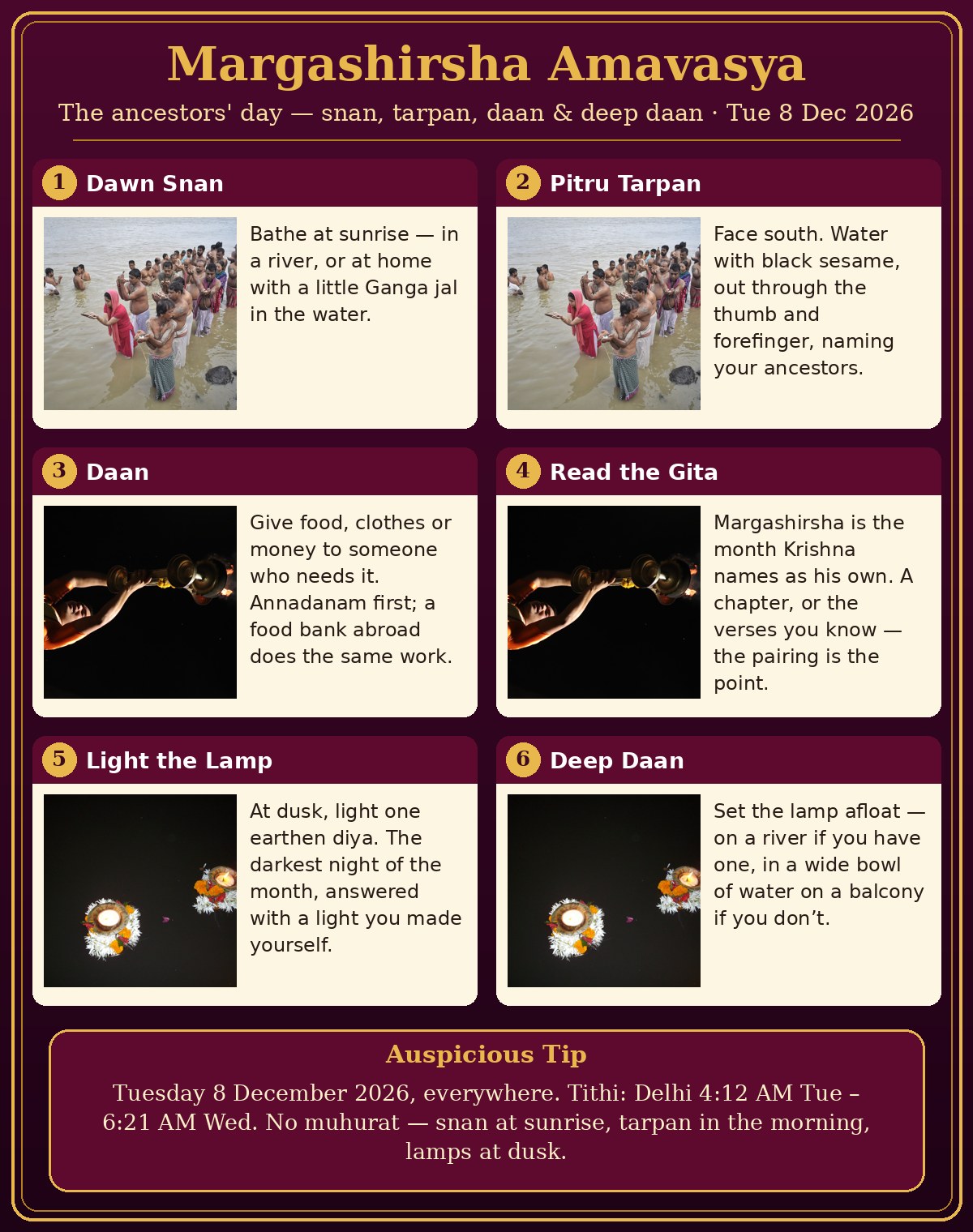
First, the bath. Snan at sunrise — in a river if you have one, in the Ganga if you're lucky enough to be near one, and at home with a little Ganga jal in the bath water if you're not. Delhi's sunrise on Tuesday is 7:01 AM, and the tithi has already been running for nearly three hours by then. The bath is the start of the day, not a race against the tithi.
Second, the tarpan. This is the heart of it. You face south — the direction of the ancestors — take water with black sesame seeds in your right palm, and let it flow out through the gap between your thumb and index finger, the Pitru Tirtha, into a plate or a vessel. You name your ancestors as you do it: father, grandfather, great-grandfather, and the ones whose names you never learned. Three offerings is the usual count. The sesame is not decoration; in the ritual logic, til is what carries the offering to them.
Third, the giving. Daan on Amavasya is food, clothes, sesame, money — given to someone who needs it, or to a Brahmin, or to a temple kitchen. Annadanam, feeding people, is the form most guides put first. Feeding a cow, a crow or a dog is the other half of it: the old idea that food offered to animals reaches the subtle realms. Abroad, where there is no cow at the end of the street, a donation to a food bank does the same work and nobody's ancestors have ever complained about the format.
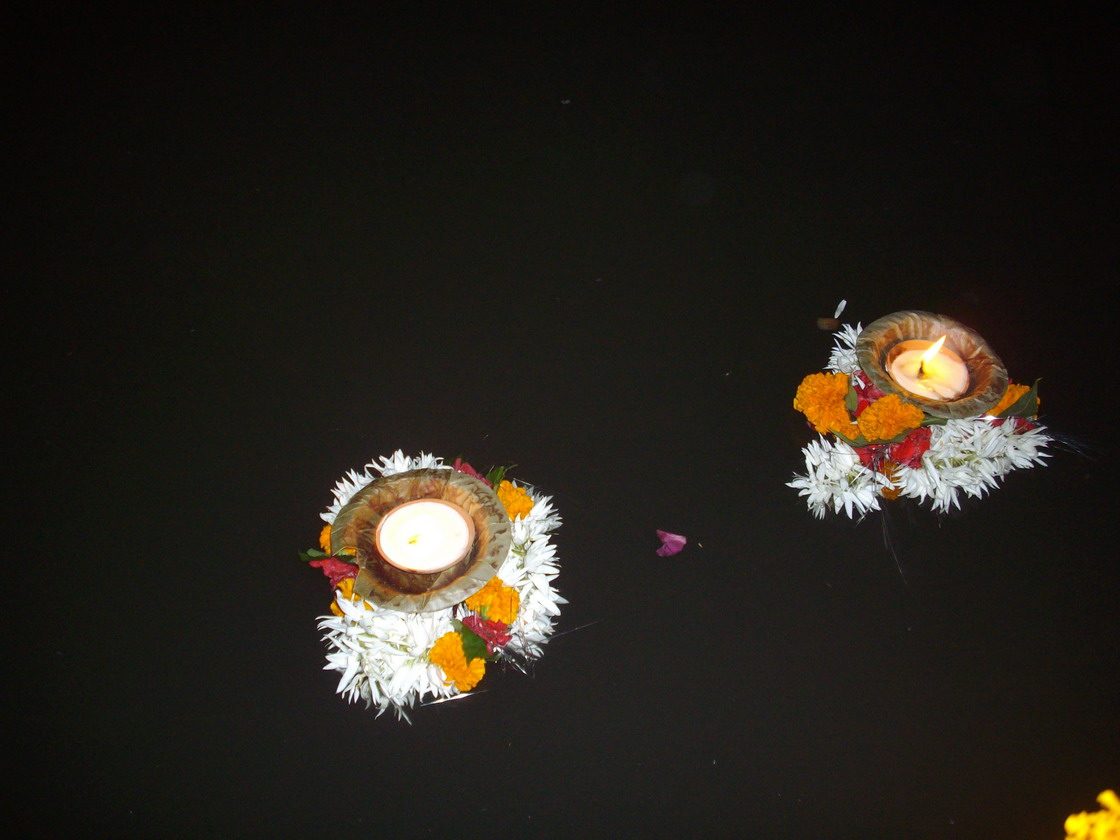
Fourth, the lamp. Deep daan at dusk: a small earthen diya, lit, set afloat on water — a river if you have one, a wide bowl of water on a balcony if you don't. This is the image on this page's header, and it's the one to hold onto: the darkest night of the month, and the house answering it with a small light it made itself. It is also why this Amavasya rhymes with Dev Diwali, a fortnight earlier — Kartik Purnima's lamps were for the gods; these are for the dead.
Some families also keep a fast on the day — simple food, no onion or garlic, no meat or alcohol — and many read the Gita in the evening. None of that is compulsory. The tarpan and the lamp are the day.
Margashirsha Amavasya 2026 in India
The observance is Tuesday, 8 December. Amavasya tithi in Delhi runs 4:12 AM Tuesday to 6:21 AM Wednesday, so the entire day — sunrise bath at 7:01 AM, tarpan in the morning, lamps at the 5:24 PM sunset — sits comfortably inside the tithi. There is no muhurat to miss. Drik Panchang lists no festival-specific window for Amavasya, and this page will not invent one.
Where India goes on this day
The ghats are the centre of it, as they are for every Amavasya: Varanasi, Haridwar, Prayagraj, Nashik, Ujjain. The crowds are nothing like Diwali's — this is a quieter gathering, mostly older people, mostly before noon, standing in the water with cupped hands. If you are in India and near a river, go in the morning. The tarpan is a river rite in its original form, and the photograph in the infographic below is exactly that scene: people standing waist-deep in the Ganges at Murshidabad, offering water to their ancestors.
In the south, the same Tuesday is Karthika Amavasya, and the month of Karthika ends with it. Temples that have been lit every evening through Karthika Masam go dark after Tuesday night, and Wednesday dawn brings Poli Swargam — lamps floated on tanks and rivers at first light. If you are in Hyderabad or Bengaluru, your calendar may call the day by the other name. It is the same day.
Margashirsha Amavasya 2026 in USA
The observance is Tuesday, 8 December. The tithi in New York runs 5:42 PM on Monday the 7th to 7:51 PM on Tuesday the 8th — it begins on Monday evening local time, which means by the time Delhi is waking up to the fast, New York has already been in Amavasya since dinner. The day itself is Tuesday, and the whole of Tuesday is inside the tithi.
Doing it on a workday
Tuesday is a working day, and this is the most practical problem the diaspora has with this festival, because its centre of gravity is the morning: bath at sunrise (7:07 AM in New York), tarpan before work. That is doable, and it is how most American families actually keep it — a short tarpan at the kitchen sink or in the bath, facing south, sesame and water in a steel plate, names said quietly, and then the office. The lamps wait for the evening, after sunset at 4:28 PM, which is early enough to do properly before dinner.
If your temple does a group tarpan, it will almost certainly be on Tuesday morning or on the preceding Sunday, and the Sunday version is fine — group observances are scheduled for when people can come, and the ancestors, by every account, are not checking the calendar against you. Check your temple's announcement rather than assuming Tuesday.
Margashirsha Amavasya 2026 in UK
The observance is Tuesday, 8 December. London's tithi runs 10:42 PM on Monday the 7th to 12:51 AM on Wednesday the 9th — it begins late on Monday night, so Tuesday is fully inside it, and the tithi doesn't end until after midnight on Tuesday.
A 3:51 PM sunset changes the shape of the evening
London's sunset on Tuesday is 3:51 PM, and sunrise is 7:53 AM, which gives you a seven-hour-and-fifty-eight-minute day — the shortest kind of December day. The practical consequence is that deep daan happens in full dark, in the middle of the afternoon, which honestly suits it. Light the diya when you get home, float it in a wide bowl of water by the window, and let it burn while the street outside is already black.
The morning tarpan is the same as everywhere: facing south, water and sesame, names spoken aloud. In a London flat the south-facing window is usually the one you already know, and the plate can be the same steel thali you use for everything else. The rite was designed for a riverbank; it survives a kitchen perfectly well.
Margashirsha Amavasya 2026 in Germany
The observance is Tuesday, 8 December. Berlin's tithi runs 11:42 PM on Monday the 7th to 1:51 AM on Wednesday the 9th. Tuesday is the day, and it is entirely inside the tithi from the moment you wake up.
The shortest day of the series
Berlin's sunrise on Tuesday is 8:03 AM and sunset is 3:52 PM — seven hours and forty-eight minutes of daylight, the shortest day in this article's six cities. The snan happens in darkness, the tarpan in the first grey light, and the lamps go out in the middle of the afternoon. December in Berlin does not give you much sun to work with, and this festival, which is mostly about darkness anyway, is the one that minds least.
One practical note, the same one from the Dev Uthani article: Germany has Ruhezeiten, and a 3:52 PM dusk is still working hours for the neighbours. The lamps are quiet by nature — a diya makes no noise at all — which is one more reason this Amavasya travels better than the noisy festivals. If your building has a shared courtyard, a single lamp in a bowl of water on your own balcony is the courteous version, and it is also the complete version.
Margashirsha Amavasya 2026 in Mexico
The observance is Tuesday, 8 December. Mexico City's tithi runs 4:42 PM on Monday the 7th to 6:51 PM on Tuesday the 8th — it begins on Monday afternoon, so by Tuesday morning the city has been in Amavasya for most of a day already.
The longest light of the six cities
Mexico City gets the most generous December day of the six: sunrise 6:58 AM, sunset 5:58 PM, nearly eleven hours of light. The snan can be unhurried, the tarpan done in actual morning sun, and the lamps lit at a dusk that still feels like evening rather than the middle of the night. It is the only city in this article where deep daan happens after most people are home from work.
The Indian community in Mexico is small, and this is mostly a home observance there — which is fine, because a home observance is what Amavasya mostly is, even in Varanasi. The tarpan needs water, sesame, a plate, and the names. The lamps need a diya and a bowl of water. The daan needs someone to give to, and Mexico City is not short of people to give to. Everything else is commentary.
Margashirsha Amavasya 2026 in Russia
The observance is Tuesday, 8 December. Moscow's tithi runs 1:42 AM on Tuesday to 3:51 AM on Wednesday — it begins in the small hours of Tuesday itself, so the whole day is Amavasya from the moment it starts.
Tarpan before a 8:45 AM sunrise
Moscow's sunrise on Tuesday is 8:45 AM and sunset is 3:56 PM — seven hours and eleven minutes of daylight, and the morning is genuinely dark. The snan happens before the sun is up, which is the traditional form anyway: the bath at dawn, in darkness, is how the rite is described in the old guides. A Moscow December simply makes the description literal.
The lamps at dusk are the same as everywhere else, and the time zones offer their usual small mercy: a video call home after the evening lamps reaches India at around 8:30 PM IST, when Delhi families are sitting down to their own evening after a day that began four hours earlier. The ancestors, it turns out, are honoured on the same Tuesday on both ends of the call.
East of Moscow the tithis shift with the time zones, as always. Your local temple or your own city's panchang is the authority there; Moscow's hours belong to Moscow.
What you'll need, roughly
Water, black sesame seeds, a copper or steel plate, a small vessel, and the names of your ancestors — spoken aloud, three generations back at least, and the ones you never met included by intention rather than by name. For the bath: Ganga jal if you have it, plain water if you don't. For the evening: one earthen diya, oil and a wick, flowers if you like, and a wide bowl of water to float it in. For the giving: food, clothes, or money, and somewhere to give it — a person, a temple kitchen, a food bank.
That is the entire list. Amavasya is not a festival of shopping. It is a festival of remembering, and remembering is, mercifully, free.
The Kartik–Margashirsha 2026 series: Diwali 2026 · Govardhan Puja 2026 · Bhai Dooj 2026 · Chhath Puja 2026 · Dev Uthani Ekadashi 2026 · Tulsi Vivah 2026 · Dev Diwali 2026 · Kalabhairav Jayanti 2026 · Utpanna Ekadashi 2026 · Margashirsha Amavasya 2026
Check your own city before you rely on any date here: the Hindu Panchang Calculator shows today’s tithi and festival dates for your location, the Hindu Date Converter converts between Gregorian and Hindu calendar dates, and this article on the astronomy behind the panchang explains how these calculations are actually made.
Photos: Floating diyas on the Ganges — Rudolph.A.furtado, CC0; tarpan on the Ganges at Murshidabad — Kiran Guha, CC BY-SA 4.0; Ganga Aarti at Dashashwamedh Ghat, Varanasi — Chetanbtc, CC BY-SA 4.0; all via Wikimedia Commons.
Timings follow Drik Panchang's city pages for New Delhi, New York, London, Berlin, Mexico City and Moscow, checked 9 November 2026. Sunrise and sunset times are for Tuesday, 8 December 2026. Where calculators disagree — SmartPuja's Delhi tithi is the live one — this page says so and says which it follows and why. Your local temple's announcement overrides any website, including this one.