
Kalabhairav Jayanti 2026 is on Tuesday, 1 December in India — Monday, 30 November in New York, London and Mexico City
Kalabhairav Jayanti is on Tuesday, 1 December 2026 in India, Berlin and Moscow — and Monday, 30 November in New York, London and Mexico City. Ashtami timings, midnight puja vidhi, the Brahma katha, dog feeding and the Kalabhairav Ashtakam.
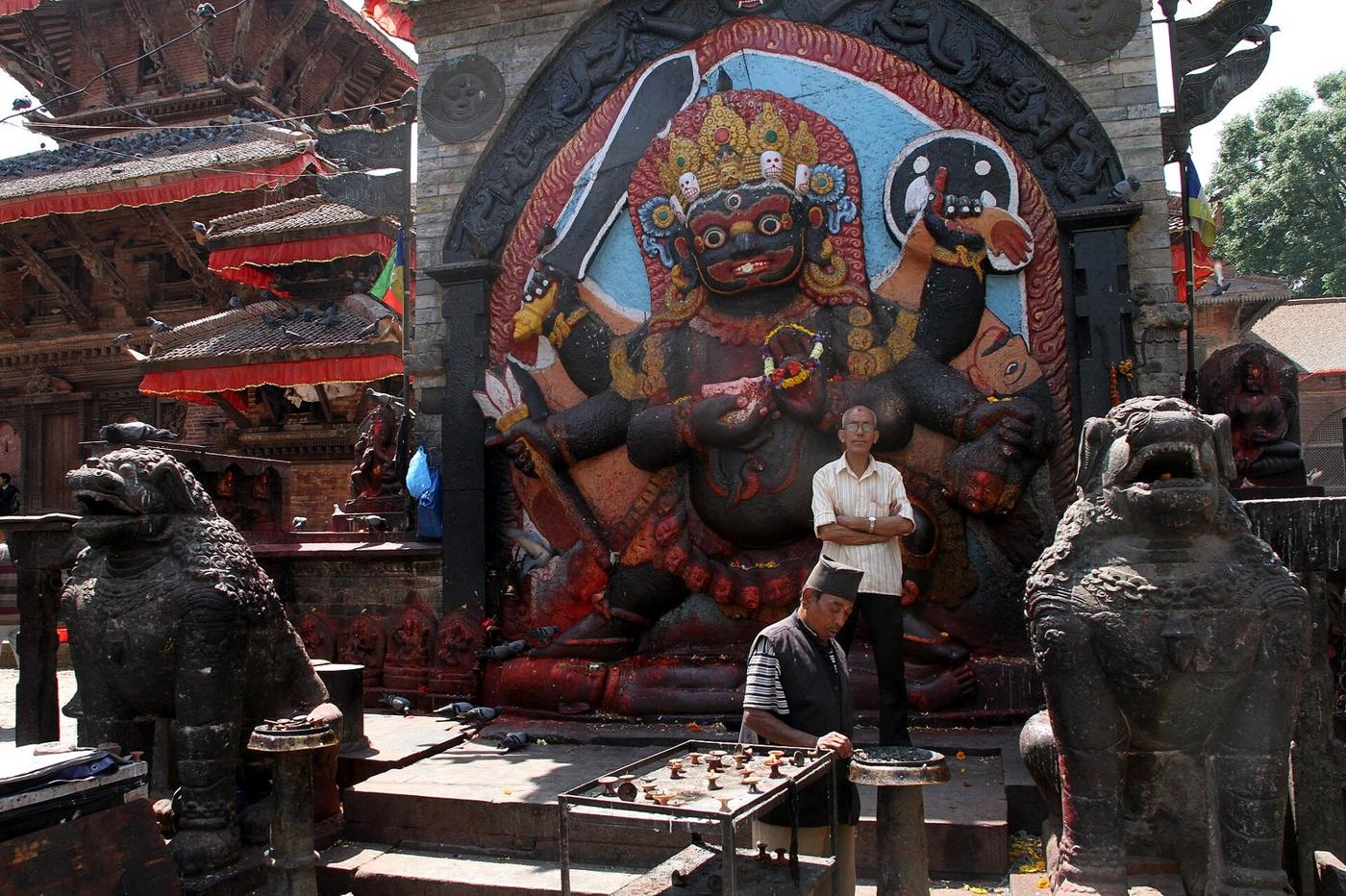
Kalabhairav Jayanti falls on Tuesday, 1 December 2026 in India — and on Monday, 30 November in New York, London and Mexico City. Berlin and Moscow stay with India on the Tuesday. If you only came for the date, check which side of that line your city is on, because this is a night festival and the night is the whole point.
Why the split? Kalabhairav Jayanti is a night observance — the year's principal Kalashtami, kept on the Krishna Paksha Ashtami with the fast running through the evening puja to a midnight aarti. A tithi that has to be caught at night, not at sunrise, moves differently across the world than a morning festival does. In New York the Ashtami begins at 1:41 PM on Monday and the moon — for this vrat, what matters is the moon — rises at 11:33 PM that same night. Monday night is the Ashtami night there. In Delhi the Ashtami doesn't begin until 12:11 AM on Tuesday, so Tuesday night is the night. Same tithi, same festival, two evenings, decided by where the dark hours fall.
Everything below is the full picture: the story of how Shiva's fiercest form came to be, and why he carries a skull he couldn't put down; the Kotwal of Kashi and his black thread; the vidhi, including the four-wick mustard-oil lamp and the deity's favourite sweets; an honest paragraph about the liquor offered at Ujjain and what it is and is not; and why, on this one night of the year, feeding a dog is not charity on the side. It is the puja.
Kalabhairav Jayanti 2026 at a glance
| Date — India, Germany, Russia | Tuesday, 1 December 2026 |
| Date — USA, UK, Mexico | Monday, 30 November 2026 |
| Tithi | Kartik Krishna Ashtami (amanta) = Margashirsha Krishna Ashtami (purnimanta) — same tithi |
| Ashtami in Delhi | 12:11 AM, 1 Dec to 11:13 PM, 1 Dec |
| Ashtami in New York | 1:41 PM, 30 Nov to 12:43 PM, 1 Dec |
| Ashtami in London | 6:41 PM, 30 Nov to 5:43 PM, 1 Dec |
| Ashtami in Berlin | 7:41 PM, 30 Nov to 6:43 PM, 1 Dec |
| Ashtami in Mexico City | 12:41 PM, 30 Nov to 11:43 AM, 1 Dec |
| Ashtami in Moscow | 9:41 PM, 30 Nov to 8:43 PM, 1 Dec |
| Moonrise, observance night | Delhi 12:42 AM (night of 1–2 Dec) · New York 11:33 PM · London 11:09 PM · Berlin 12:32 AM · Mexico City 12:32 AM · Moscow 12:48 AM |
| Also called | Bhairav Ashtami, Kalabhairav Ashtami, Kaal Bhairav Jayanti — the year's main Kalashtami |
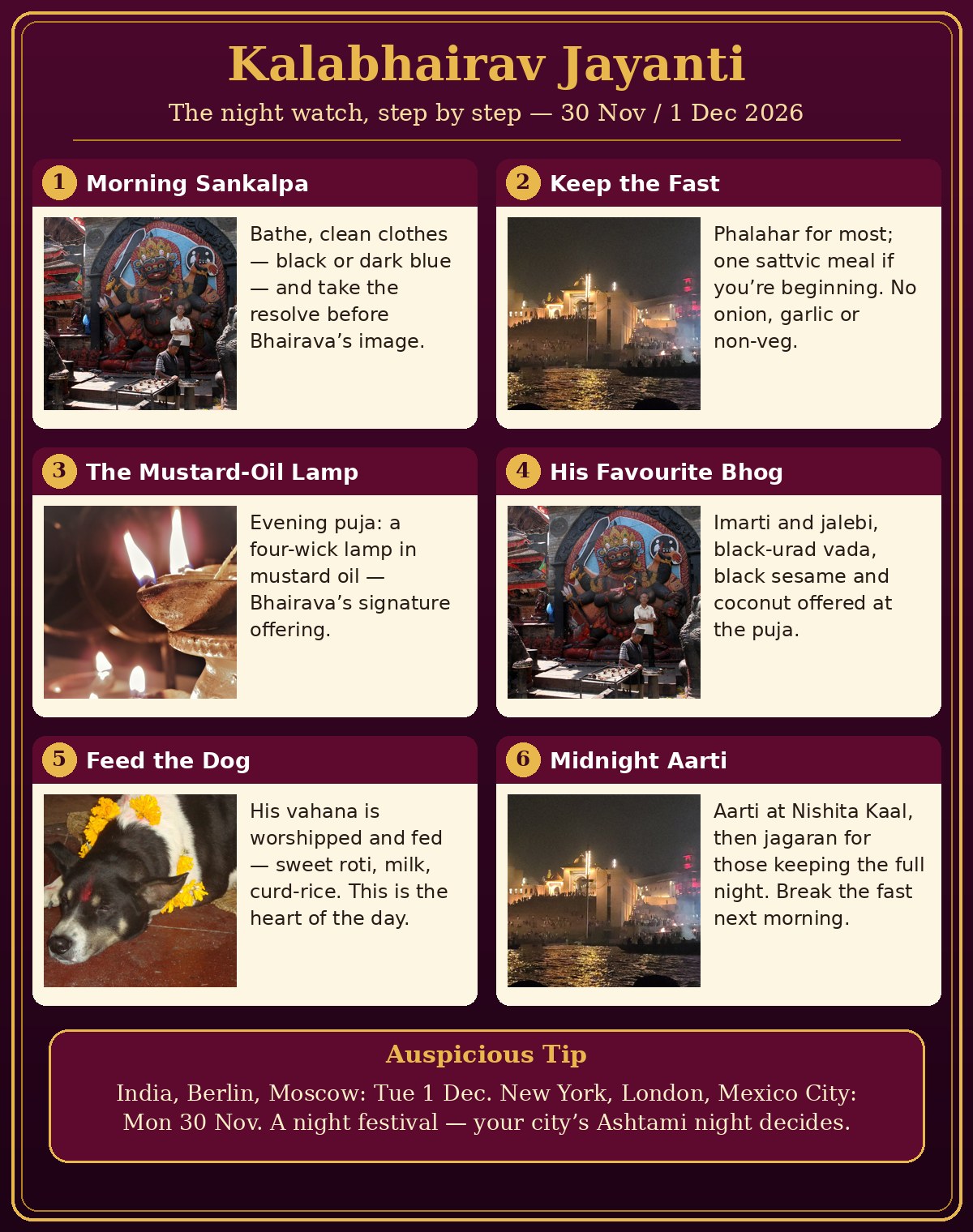
One honesty note on timings: Drik Panchang lists no festival-specific puja muhurat for Kalabhairav Jayanti in any city — only the date and the Ashtami. The midnight (Nishita) windows quoted in the country sections are the ordinary midnight windows from each city's day panchang, which is where the midnight aarti naturally sits. Any site quoting you a precise "Kalabhairav puja muhurat" has dressed up a general window as a specific one.
The story — the head, the skull, and the city that set him free
The story begins with an argument about rank, which in this mythology is how a great many things begin.
Brahma and Vishnu were disputing which of them was supreme when Shiva appeared between them as a pillar of fire with no top and no bottom — the Lingodbhava. Find an end, each was told. Vishnu became a boar and dug down for an age and found nothing, and came back and said so. Brahma became a swan and flew up for an age and found nothing either — and said he had found the top. In the fuller tellings he produced the ketaki flower as his false witness. The fifth head of Brahma, the head that spoke the lie, was the arrogance itself.
Shiva produced Bhairava. And Bhairava — with the fingernail of his left thumb, in the better-attested telling, not a sword — cut that fifth head off. Brahma has been four-faced ever since.
Then the story turns on its own hero. Cutting off Brahma's head, even at Shiva's command, was brahmahatya — the gravest sin there is, the killing of the most learned of Brahmins. The severed skull stuck fast to Bhairava's left palm and would not come away, and in the Kashi Khanda's telling, Brahmahatya herself, personified and terrible, pursued him. To work the sin off he undertook the kapala-vrata: wandering the worlds naked as a mendicant, begging his food in the skull of the god he had beheaded. The Kapalika ascetics shaped their whole way of life on that wandering.
He went from holy place to holy place and the skull did not fall. Until he entered Kashi.
The moment Bhairava stepped into Varanasi, the skull dropped from his hand — at the spot still called Kapalamochana, "release from the skull," a real tirtha in the north of the old city — and Brahmahatya, who could not enter Kashi, sank away behind him. Freed, he did not leave. Shiva appointed him the city's guardian for eternity: its Kotwal, in the word Varanasi still uses, and its sin-eater, the one who takes on what the city's dead cannot carry.
That is why this fierce form, of all Shiva's forms, is worshipped as a protector and not a terror. The fierceness was never the point. The point is what the fierceness is for: he is the one who stands at the boundary so that you don't have to. Kala, in his name, means time, and death, and black — Kalabhairava is the lord of time itself, the one even Time is said to fear, and in Kashi's understanding that makes him the safest address in the universe. Even Yama, tradition holds, cannot take a soul out of Kashi without Bhairav's permission.
The manifestation is placed by the Kashi tradition on the Krishna Ashtami of this month — Kartik in the South's calendar, Margashirsha in the North's — and that is why, of the twelve or thirteen Kalashtamis in a year, this one is the Jayanti.
The Kotwal's city, and what people still do there
In Varanasi, the guardian role is not a metaphor; it runs like a municipal fact. The neighbourhood of his temple is called Kotwalpuri. The temple's own photo, locals will tell you, sits at the Kotwali police station nearby, and officers, administrators and elected representatives traditionally call on the Kotwal before taking charge — the city's real police report to its mythical one first. Residents visit him before leaving Kashi on a journey and again when they return, taking his permission to come and go, the way you inform the head of a household. No pilgrimage to Kashi is considered complete without his darshan, and several temples will quietly tell you he is to be visited before Vishwanath, not after: you check in with the Kotwal before you meet the King.
At the temple, devotees are tied a black thread — the Bhairav Raksha Sutra — after darshan, worn as his protection against fear and the evil eye. The official Kashi portal describes it, so file it under documented custom, not souvenir invention. His standard offerings there are oil, black sesame and flowers.
And the temple keeps one Jayanti custom worth knowing about from anywhere in the world: through the year, a cloth covers the central icon so that only the silver face shows. On Bhairav Ashtami the cloth is removed, the full figure is revealed and garlanded with silver skulls, and the festival is preceded by an eight-day pilgrimage around the city's eight Ashta Bhairava temples, ending on this night. The fierce god spends the year veiled. Once a year, Kashi looks at all of him.
The guardian pattern repeats far beyond Kashi. In Shiva temples across India, the day's last act is to place the temple keys before Bhairava for the night and take them back with his leave in the morning — Sringeri Math states the custom plainly for its own Kalabhairava. He is the lock on the door of every sacred place, and in Ujjain, Mahakal's city, he holds the military version of the same job: not Kotwal but Senapati, the commander of the city's guard.
Kalabhairav Jayanti 2026 in India
Tuesday, 1 December. Ashtami tithi in Delhi runs 12:11 AM to 11:13 PM on the Tuesday — the whole day is Ashtami, which makes the Indian observance the straightforward one in this series: fast through Tuesday, the puja Tuesday evening, the midnight aarti in the Nishita window of 11:43 PM to 12:38 AM, moonrise at 12:42 AM in the small hours, and the fast broken on Wednesday morning. (Delhi's day panchang lists Kalashtami and Masik Krishna Janmashtami on the same Tuesday — three Ashtami observances sharing one tithi, as Ashtamis do.)
It's a working Tuesday, and the observance is built for that, as you'll see in the vidhi: the weight of this festival sits after sunset. What India adds that nowhere else quite can is the temples — Varanasi above all, Ujjain, and Delhi's own pair of Bhairav temples at Purana Qila (of which more below).
Kalabhairav Jayanti 2026 in USA
Monday, 30 November — a day earlier than India, and the difference is the moon. Ashtami in New York runs 1:41 PM Monday to 12:43 PM Tuesday EST; the moonrise that anchors this night observance falls at 11:33 PM on Monday night, inside the Ashtami. Wait until Tuesday night and the Ashtami is gone. So American temples will hold the Jayanti on Monday — check yours, because a temple working from an Indian calendar printout may say Tuesday, and this is one of the years where the local reckoning genuinely matters more than the imported one.
The Nishita window on Monday night is 11:16 PM to 12:14 AM. A Monday-night midnight aarti before a working Tuesday is a serious ask, and the tradition itself grades this observance (see the vidhi) — the evening puja, the lamp, the dogs fed, and an aarti at the latest hour you can honestly keep is a kept Jayanti. The all-night form belongs to temples and to those whose Tuesday allows it.
Kalabhairav Jayanti 2026 in UK
Monday, 30 November, like the USA. London's Ashtami runs 6:41 PM Monday to 5:43 PM Tuesday GMT — it begins, neatly, right at Monday's dusk, so the entire festival night from sunset to the 11:09 PM moonrise and the Nishita window of 11:18 PM to 12:21 AM sits inside the tithi, and Tuesday evening is already Navami. If you keep one night festival from this whole autumn series in Britain, the calendar has conspired to make this one tidy: dark by half past four, everything done by half past midnight.
Kalabhairav Jayanti 2026 in Germany
Tuesday, 1 December, with India. Berlin's Ashtami runs 7:41 PM Monday to 6:43 PM Tuesday CET — it opens on Monday evening but the observance night, by Drik's listing, is Tuesday's, with moonrise at 12:32 AM in the small hours of Tuesday–Wednesday and Nishita 11:24 PM to 12:28 AM.
A German December Tuesday night is about as dark as nights get, which suits a festival whose entire aesthetic is a mustard-oil flame against the dark. Ruhezeiten applies to jagaran singing the way it applied at Dev Uthani: indoors, normal volume, nobody's rules broken. The one piece of this vidhi that needs a thought in Germany is the dogs — feeding strays is neither customary nor straightforward here, and the honest modern adaptation (framed as exactly that, an adaptation, not a rule from any text) is in the vidhi section below.
Kalabhairav Jayanti 2026 in Mexico
Monday, 30 November. Mexico City's Ashtami runs 12:41 PM Monday to 11:43 AM Tuesday CST, moonrise 12:32 AM at the end of Monday night. One technical caveat, stated because this page doesn't clean numbers up silently: Drik's own day panchang for Mexico City prints the Nishita window beginning at "12:00 PM," which is plainly a typo on their page for 12:00 AM — a midnight window does not begin at noon. The observance is the midnight hour of the Monday–Tuesday night; if you need the minute, your temple's word beats a misprint.
For Mexico's small community this is a home festival in any case, and the home version travels intact: evening puja, four-wick lamp, the sweets, a dog fed. It has travelled further than Mexico before now.
Kalabhairav Jayanti 2026 in Russia
Tuesday, 1 December, with India and Berlin. Moscow's Ashtami runs 9:41 PM Monday to 8:43 PM Tuesday MSK; moonrise on the observance night 12:48 AM, Nishita 11:46 PM to 12:52 AM.
Moscow's numbers make for the deepest-night version of this festival in the series — midnight in a Moscow December is night in a way London only gestures at. And the time zones offer their usual small mercy: Moscow's Tuesday night runs three and a half hours behind Delhi's, so a family call during the evening puja lands while Delhi is still in its own Ashtami evening. The fierce guardian, it turns out, keeps office hours across the whole diaspora on the same night — just not, this year, on the same date everywhere. Check yours again at the top of this page before you plan.
How the night is kept — the vidhi
Regional and family sequences vary; this is the common spine, and it is honest about what scales.
Morning. Rise early, bathe, clean clothes — black, dark blue or red are the colours the lists favour — and take the sankalpa before Bhairava's image or picture. The fast runs from the morning.
The fast. Kept in grades, like every vrat in this series: nirjala for the practised; phalahar — fruit, milk, sabudana — for most; one simple sattvic meal for beginners, the elderly and anyone whose health says so. What the day excludes across every list: non-vegetarian food, onion and garlic, tobacco — and alcohol for the person fasting, a distinction that matters and gets its own paragraph below.
Evening puja. Seat the image on a red or black cloth. The centrepiece is the four-wick lamp filled with mustard oil — mustard oil is Bhairava's the way ghee is Vishnu's; it is the single most distinctive item in this puja. Light guggul or loban incense. Offer black sesame, coconut, flowers (white or dark red; kaner where it's found), sindoor, betel leaf and nut, and then the food he is famous for liking: imarti and jalebi, the syrup sweets, and vada of black urad dal; some homes add halwa-puri or kheer. Nobody starves this god.
Recitation. The Kalabhairav Ashtakam, traditionally attributed to Adi Shankaracharya — eight verses, every one ending with the same refrain: Kāśikā-purādhinātha-kālabhairavaṁ bhaje, "I worship Kalabhairava, lord of the city of Kashi." Its first verse:
देवराजसेव्यमानपावनाङ्घ्रिपङ्कजं व्यालयज्ञसूत्रमिन्दुशेखरं कृपाकरम् । नारदादियोगिवृन्दवन्दितं दिगम्बरं काशिकापुराधिनाथकालभैरवं भजे ॥
Devarāja-sevyamāna-pāvanāṅghri-paṅkajaṁ, vyāla-yajña-sūtram-indu-śekharaṁ kṛpākaram; Nāradādi-yogi-vṛnda-vanditaṁ digambaraṁ, Kāśikā-purādhinātha-kālabhairavaṁ bhaje. — "I worship Kalabhairava, lord of Kashi, whose purifying lotus feet are served by Indra; who wears a serpent for his sacred thread and the moon on his crest; who is compassion itself; praised by Narada and the hosts of yogis; clothed in the directions alone." The simple mantra for japa is Om Kalabhairavaya Namah.
Midnight. The aarti at Nishita Kaal, with conch and bells — and for those keeping the full Jayanti, jagaran after it, the night spent in his stories and Shiva's. The fast is broken next morning after a bath and a short puja, on sattvic food. (A note for honesty: on monthly Kalashtami, some families break the fast after moonrise and arghya to the moon. The Jayanti tradition is the night-long form. Both exist; this article leads with the Jayanti's own.)
The dogs. After Bhairava, Shiva and Parvati are worshipped, the standard observance summary says a thing no other festival in this series says: the dog is worshipped — with flowers and sweets — and dogs are fed. This is not garnish. The dog is Bhairava's vahana, the lists call feeding dogs direct service to the deity, and the food is simple and fresh: sweet roti, milk, curd or curd-rice, a portion of the bhog set aside on its own plate. Many lists prefer a black dog (his own dog is black); treat that as the lists' preference, not a condition — a fed dog is a fed dog. Abroad, where there are no street dogs to feed, devotees feed a neighbour's or a friend's dog with permission — and many now give to an animal shelter instead. That last one is a modern adaptation in the same spirit, not a rule from any text, and it's labelled that way here because this page labels things.
Samagri, in one breath: image or picture; red or black cloth; four-wick earthen lamp and mustard oil; guggul/loban incense; camphor; black sesame; black urad (for the vada); coconut; chandan; sindoor; flowers; betel leaf and nut; Ganga jal if kept; imarti/jalebi and sweets; milk and roti for the dogs; a black thread if your family keeps the raksha custom at home.
The liquor question, answered plainly
Some readers will have come here for this, so it gets facts, not euphemism.
At Ujjain's Kal Bhairav temple, liquor is the famous offering. Devotees buy a bottle at the government-licensed counters outside; the priest pours from it into a saucer held at the image's mouth; the liquid is seen to diminish; roughly a third of the bottle comes back to the devotee as prasad. The temple tradition explains it as the one literal survivor of the tantric Panchamakara offerings. It is entirely optional even there — coconut, flowers and sweets are fully accepted, and most devotees on most days offer those. The same offering exists at Delhi's Kilkari Bhairav temple — which, in a piece of built pastoral care, has a second wing next door, Doodhiya Bhairav, where families offer milk instead. Delhi built the alternative into the same courtyard.
Three things to hold onto. It is a custom of specific temples, rooted in Tantric practice — it is not part of the household vidhi, and no home guide prescribes it. The devotee who is fasting abstains from alcohol; offering and drinking are kept strictly apart in the tradition itself. And the famous detail — that the poured liquor vanishes and no drain has ever been found — is what devotees and the temple report seeing. This page passes it on as exactly that: living temple tradition, not an investigated fact.
And if Kathmandu is closer to your imagination than Ujjain: Nepal's great Sweta Bhairav, a huge gilded mask hidden behind a lattice all year for the ferocity of its face, is unveiled at Indra Jatra, when a pipe in the mask's mouth gives out rice beer and liquor as prasad to the crowd. Same god, same offering, two countries — and in both, it's the temple's custom, not the home's rule.
One more Bhairava — the child
Not all of Bhairava is the night god with the skull garland. Batuk Bhairav is Bhairava as a five-year-old child — gentle, approachable, the form parents worship for their children's protection, called Apaduddharaka, rescuer from calamity, for the child who slew the demon Apad, killable only by a five-year-old. His worship is mild where Kala Bhairava's is fierce: milk, sweets, fruit. Delhi's other famous Bhairav temple, at Chanakyapuri, is his, and the Doodhiya wing at Purana Qila is his logic too. If the fierce form puts you off, the tradition itself points you to the child. Both are Bhairava; the Jayanti in this article is the elder one's.
The Kartik–Margashirsha 2026 series: Diwali 2026 · Govardhan Puja 2026 · Bhai Dooj 2026 · Chhath Puja 2026 · Dev Uthani Ekadashi 2026 · Tulsi Vivah 2026 · Dev Diwali 2026 · Kalabhairav Jayanti 2026 · Utpanna Ekadashi 2026
Check your own city before you rely on any date here: the Hindu Panchang Calculator shows today’s tithi and festival dates for your location, the Hindu Date Converter converts between Gregorian and Hindu calendar dates, and this article on the astronomy behind the panchang explains how these calculations are actually made.
Photos: Kal Bhairav, Kathmandu Durbar Square — Gerd Eichmann, CC BY-SA 4.0; a dog garlanded and honoured with tika, Bhairava's vahana — Manju, CC BY-SA 4.0; Varanasi ghats at night — Goutam1962, CC BY-SA 4.0; all via Wikimedia Commons.
Dates, Ashtami timings and moonrises follow Drik Panchang's Kalabhairav Jayanti pages for New Delhi, New York, London, Berlin, Mexico City and Moscow, checked 9 November 2026 against each city's day panchang. Drik lists no festival-specific puja muhurat for this festival; the Nishita windows quoted are the general midnight windows from the day panchangs, and the Mexico City page prints its Nishita start as "12:00 PM", which reads as a typo on their page. Your local temple's announcement overrides any website, including this one.