
Guru Nanak Jayanti 2026: Gurpurab Date, Akhand Path, Nagar Kirtan and the Langar That Feeds Everyone
Guru Nanak Jayanti 2026 — Gurpurab — is on Tuesday, 24 November, the 557th Prakash Purab of Guru Nanak Dev Ji. Akhand Path from 22 November, Nagar Kirtan on the 23rd, and langar for everyone on the day. Dates and gurdwara programmes for India, the USA, UK, Canada, UAE and Australia.
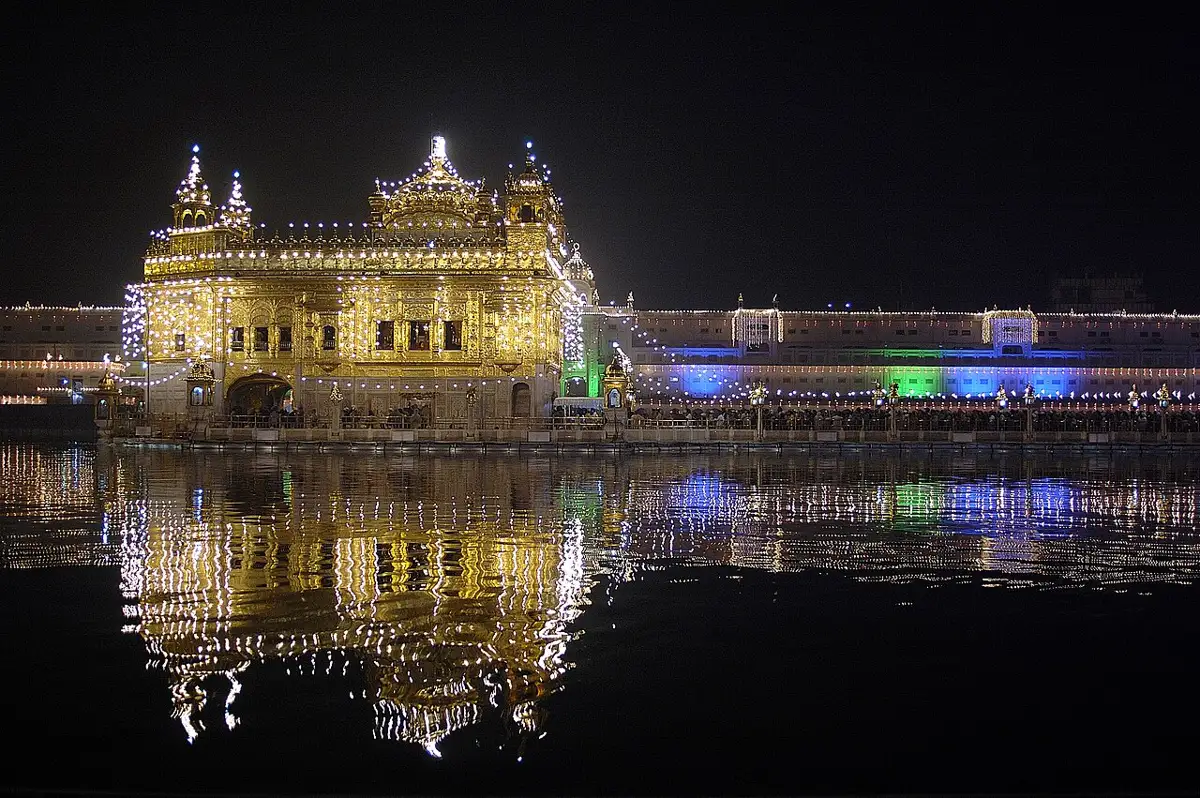
Guru Nanak Jayanti 2026 — Gurpurab, the 557th Prakash Purab of Guru Nanak Dev Ji — falls on Tuesday, 24 November 2026, the full moon of Kartik Purnima. But nobody who has ever been near a gurdwara in November would call it a one-day festival. The Akhand Path begins two days earlier, on Sunday 22 November. The Nagar Kirtan fills the streets on the 23rd. And on the day itself, the doors open before dawn and the langar hall simply does not stop. Wherever you are reading this — Amritsar or Southall, Toronto or Dubai — the pattern is the same, because it has been the pattern for five and a half centuries.
A quick word on what Gurpurab means, since the word does a lot of work. A gurpurab is a day connected with the life of one of the ten Sikh Gurus — a birth, a martyrdom, a succession. This one marks the birth of the first Guru and the founder of the Sikh faith, and Sikhs also call it Prakash Purab or Prakash Parv: the festival of light, of the day the light came into the world. It shares its full moon with Kartik Purnima, which Hindu families mark on the same Tuesday — two festivals, one moon, and in Punjab a single enormous week.
Guru Nanak Jayanti 2026: date and the shape of the three days
In India, Gurpurab is Tuesday, 24 November 2026, and it is a gazetted public holiday. The Kartik Purnima tithi behind the date runs from 11:42 pm on Monday 23 November to 8:23 pm on Tuesday 24 November (IST, New Delhi, per Drik Panchang). One honest difference from most festivals on this site: Gurpurab does not run on a puja muhurat. There is no single auspicious hour to hit. The day runs on the gurdwara's programme — the reading, the singing, the prayer, the meal — so the timings that matter are the ones your local gurdwara announces.
- Sunday 22 November — the Akhand Path begins. In gurdwaras across India, readers take their seats in the morning and begin the Guru Granth Sahib from the first page. They will not stop for 48 hours.
- Monday 23 November — Nagar Kirtan. In most Indian cities the great procession moves a day before Gurpurab, led by the Panj Pyare. Some cities shift it to the Sunday or the day itself — Mumbai's Four Bungalows gurdwara, for instance, took its Nagar Kirtan out on the evening of 22 November this year.
- Tuesday 24 November — Gurpurab. The Akhand Path reaches its Bhog (conclusion) in the morning, and the day unfolds in kirtan, katha and langar until late at night, when the gurdwaras are lit up like wedding houses.
For the tithi behind any of these dates in your own city, check our Hindu Panchang Calculator — and if you are forever converting between the lunar calendar and the one on your phone, the Hindu Date Converter does exactly that.
How the days unfold
The Akhand Path. This is the still centre of Gurpurab. The Guru Granth Sahib — the Sikh scripture, treated by Sikhs not as a book but as the living Guru — runs to 1,430 pages, and an Akhand Path is its complete, uninterrupted reading, cover to cover, by a relay of readers working in shifts through the day and night. It takes about 48 hours. Sit in a gurdwara at 3 in the morning during those two days and you will find a reader, a small knot of listeners, and a reading that has not paused since it began. The conclusion on Gurpurab morning is called the Bhog, and it flows straight into the day's celebrations.
Prabhat Pheris. In the days and weeks before Gurpurab, many neighbourhoods wake to singing. Prabhat Pheris are early-morning processions — devotees walking the local streets at dawn, singing shabads (hymns), going house to house in the cold November dark. In Mumbai this year, one gurdwara ran them daily from 11 to 21 November, 5 to 7 each morning. If you hear hymns outside your window at an hour when nobody should be awake, that is a Prabhat Pheri, and you are welcome to join the end of it.
Nagar Kirtan. The Nagar Kirtan is the festival walking out of the gurdwara and into the city. At its head march the Panj Pyare — the Five Beloved Ones, five Sikhs in saffron and deep blue, carrying swords, representing the first five Sikhs initiated into the Khalsa in 1699. Behind them comes the Guru Granth Sahib, carried in a decorated palanquin (a palki) on a float, treated with the honours of a sovereign. Around it: kirtan parties singing from moving trucks, gatka teams performing the Sikh martial art with whirling staffs and swords, schoolchildren, brass bands, and — this is the part first-timers remember — volunteers pressing tea, snacks and sweets on the spectators. A Nagar Kirtan does not ask whether you are Sikh. It feeds you anyway.
The day itself. Gurpurab begins in the Amrit Vela, the ambrosial hours before dawn, with Asa di Var — Guru Nanak's own morning hymns, sung as the sky lightens. Then the Bhog of the Akhand Path, kirtan through the day, and katha: talks that retell the janamsakhis, the traditional stories of the Guru's life, and unpack what he actually taught. Ardas, the congregational prayer, gathers it all up. And underneath everything, from morning to midnight, the langar.
The langar. Langar is the free community kitchen attached to every gurdwara on earth, and on Gurpurab it runs at full stretch. Everyone sits together on the floor in rows — pangat — and everyone eats the same vegetarian food: dal, sabzi, roti, kheer, served by volunteers. Prince and cleaner, Sikh and tourist, same row, same plate. This is not charity and it is not a food stall; it is the teaching, served hot. Guru Nanak started it, insisting that nobody who came to listen would leave hungry and nobody would be seated above anybody else. The Golden Temple's langar in Amritsar is the largest free kitchen in the world, feeding tens of thousands on an ordinary day; on Gurpurab, with the complex lit up and fireworks over the sarovar after dark, it goes far beyond that.
The man: Guru Nanak in brief
He was born in 1469 in Rai Bhoi Ki Talwandi, a village in Punjab that is now called Nankana Sahib, in present-day Pakistan. The janamsakhi tradition remembers a boy who questioned things early — who, sent to buy goods with twenty rupees, spent the money feeding hungry holy men instead and came home calling it the only true bargain. Employed as a young man in a grain store at Sultanpur Lodhi, he is said to have weighed out the thirteenth measure and kept going — tera tera, "I am yours, I am yours" — giving customers more than they had paid for. Sikhs tell that story the way you tell a story about someone you love: as the whole philosophy in one gesture.
Then came the udasis, the great journeys — years of walking, tradition says, across India and beyond: to Hindu pilgrimage towns and Muslim holy cities, to the Himalayas and to Mecca, arguing, listening, singing. His companions included Mardana, a Muslim musician whose rabab accompanied the hymns. What he taught, he taught everywhere, to anyone: there is one God, Ik Onkar, formless and without fear or enmity; caste is nothing; ritual without honesty is theatre; and a householder who works and shares is worth more than a hermit who only renounces. He asked why a woman should be called low, when kings are born of women. Five and a half centuries later, it has not dated.
At the end of his journeys he founded Kartarpur, a town on the banks of the Ravi, and did the most radical thing of all: he farmed. For his last eighteen years or so, the Guru worked the fields, sang morning and evening with a growing community, and ran the langar that made his teaching edible. He died at Kartarpur in 1539. The Gurdwara Darbar Sahib there is now reachable from India through the Kartarpur Corridor, opened in 2019, which lets Indian pilgrims walk the few kilometres across the border visa-free for the day — a door cut through one of the hardest borders in the world, for a teacher who spent his life walking through walls.
His three teachings fit in three short phrases, and Sikhs organise whole lives around them:
- Naam Japna — remember God; keep the divine name in your mind through the day, not only in the prayer hall.
- Kirat Karni — earn your living honestly, by real work, without exploiting anyone.
- Vand Chhakna — share what you have; eat only after others have eaten. Langar is this sentence, cooked.
Gurpurab 2026 in the United States
American gurdwaras keep the SGPC date: Tuesday, 24 November 2026. One wrinkle worth knowing about, because it confuses families every year: on the West Coast, the Kartik Purnima tithi ends before sunrise on the Tuesday, so a Hindu panchang for San Francisco or Seattle puts Kartik Purnima on Monday 23 November. Both dates are honestly arrived at — they answer different questions. For Gurpurab, follow your gurdwara, and your gurdwara will be celebrating on the 24th.
California
The biggest sangats are here: the Bay Area (San Jose, Fremont, Hayward), Sacramento and Stockton, and the Central Valley towns where Sikh farmers have been putting down roots for over a century. Expect the Akhand Path to end on Tuesday morning, a full day of kirtan, and langar on a scale that empties the neighbourhood's grocery shelves. Nagar Kirtans in the US are usually moved to the nearest weekend so working families can walk — check your gurdwara's notice for which Saturday or Sunday.
East Coast and the rest
New York and New Jersey (Richmond Hill in Queens is practically a small Punjab), Chicago, Houston, Dallas and Atlanta all have gurdwaras running the full three-day pattern. Because the 24th is a working Tuesday, the pattern abroad is a weekday Gurpurab at the gurdwara and the biggest community events — processions, special kirtan darbars with visiting ragi jathas — spread across the weekends either side of it.
Gurpurab 2026 in the United Kingdom
The UK date is Tuesday, 24 November — in London, the Purnima tithi runs from the evening of Monday 23 November to mid-afternoon on the 24th, so there is no date confusion this year. What the UK does have is scale. Britain's Sikh communities are old, organised and numerous, and Gurpurab here is a civic event, not just a religious one.
London
Southall, in west London, holds some of the largest Sikh gatherings in Europe; its Nagar Kirtan draws tens of thousands into the street. The big Singh Sabha gurdwaras — Park Avenue in Southall, and Havelock Road — run Akhand Paths into the Tuesday, and East London's gurdwaras stretch the celebration across the weekends around it: one Namdhari gurdwara in Forest Gate, for example, holds its Gurpurab mela on Sunday 29 November. If you are planning around work, that weekend pattern is the rule in Britain, not the exception.
Birmingham and the Midlands
Birmingham's gurdwaras begin early — Guru Nanak Gurdwara on Stratford Road in South Birmingham held a Kirtan Darbar for Gurpurab on Friday 20 November, with sessions through the afternoon and evening — and the Smethwick and Wolverhampton gurdwaras run their own full programmes. The Midlands nagar kirtans, when they roll, close main roads and bring out crowds that have nothing to do with being Sikh: the whole street comes to watch the Panj Pyare pass.
Gurpurab 2026 in Canada
Canada's gurdwaras also keep Tuesday, 24 November. The panchang split shows up here too: in Toronto and Brampton, Purnima runs from Monday afternoon to Tuesday morning, and the 24th holds; in Vancouver, Surrey and Calgary it ends before Tuesday's sunrise, so local Hindu calendars print Kartik Purnima on Monday 23 November. For Gurpurab, again, the gurdwara's date — the 24th — is the one that organises the Akhand Path and the langar.
Toronto and Brampton
The Greater Toronto Area has one of the largest Sikh populations outside Punjab. Ontario Khalsa Darbar in Mississauga — Dixie Gurdwara to everyone who goes there — and the gurdwaras of Brampton run the full programme, and community celebrations spill into the following weekend: a Brampton programme is announced for Sunday 29 November, opening with Asa di Var in the early morning, which tells you something about how seriously Brampton takes this.
Surrey and Vancouver
Surrey, in British Columbia, is the other great centre — the Khalsa Diwan Society's Ross Street Gurdwara in Vancouver is among the oldest in the country. Sri Guru Singh Sabha in Surrey has announced Gurpurab programmes across the weekend of 28–29 November, including Raensabaayee Kirtan — an all-night session of singing that runs from evening into the small hours. If you have never heard kirtan at 3 am in a hall full of people who have no intention of sleeping, Gurpurab weekend in Surrey is your chance. Smaller communities keep the flame too: Halifax's Maritime Sikh Society has announced its Gurpurab gathering for Sunday 29 November.
Gurpurab 2026 in the UAE
The UAE observes Gurpurab on Tuesday, 24 November 2026 (in Dubai, the Purnima tithi runs from about 10:12 pm on Monday 23 November to 6:53 pm on the Tuesday). The centre of it all is Guru Nanak Darbar in Jebel Ali, Dubai — a full-scale gurdwara opened in 2012, among the largest in the Middle East, in a country where the Sikh community is made up largely of people who came to work and stayed for decades.
The Darbar runs the classic pattern — Akhand Path, kirtan through the day, and a langar that famously draws visitors of every faith and none, because in Dubai the gurdwara has become a place even non-Sikhs bring their guests to show them something about how the city actually works. Programmes are announced by the gurdwara itself, and details can change, so check Guru Nanak Darbar's own announcements before you set out; Abu Dhabi's Sikh community marks the day as well. One practical note: the UAE weekend is Saturday–Sunday, so the largest community gatherings may sit on the weekend before or after the Tuesday.
Gurpurab 2026 in Australia
Australia keeps the same date: Tuesday, 24 November 2026, in every state — in Sydney the Purnima tithi runs from early Tuesday morning to the small hours of Wednesday, so the full moon sits squarely inside the Australian Tuesday. And because it is a working Tuesday, Australian gurdwaras do what diaspora gurdwaras everywhere do: the day itself is kept properly, and the biggest programmes lean on the weekends around it.
Sydney
Gurdwara Sahib Glenwood, in Sydney's north-west, is one of the country's great gathering points, and its announced Gurpurab programme runs the full day — 5 am to 10 pm on Tuesday 24 November, with the timetable starting at 2:45 in the morning: Sukhmani Sahib, Prabhat Pheri, Asa di Var, ardas, and kirtan and katha through the day. That is not a typo. The sangat will be there before three in the morning, and the langar will still be serving at night.
Melbourne and the other cities
Melbourne's Sikh heartland is its growth suburbs — Sri Guru Singh Sabha in Craigieburn, the gurdwara at Keysborough — with big programmes and langar on a serious scale. Brisbane (Eight Mile Plains), Perth (Bennett Springs), Adelaide and Canberra each keep the day at their own gurdwaras, and on the New South Wales north coast the old Sikh temple at Woolgoolga, built by Punjabi banana farmers generations ago, reminds you how deep these roots run. Wherever you are, the advice is the same as everywhere else in this article: the date is the 24th, the details are your gurdwara's, so check its notice.
Visiting a gurdwara on Gurpurab: a short, honest guide
You do not need to be Sikh. You do not need an invitation. Gurdwaras are open to everyone — that is rather the point of the building — and Gurpurab, when the whole place is decorated and the kitchen is running at full capacity, is the best day of the year for a first visit. A few customs, observed, will carry you through:
- Cover your head before you enter — a scarf, a handkerchief, anything clean. Most gurdwaras keep a basket of spare rumals (head coverings) at the entrance for visitors. Men and women both cover.
- Shoes off, in the shoe room by the door, and wash your hands. Some gurdwaras have a small water channel or taps at the entrance; follow the crowd.
- In the Darbar Sahib (the prayer hall), the Guru Granth Sahib sits on a raised throne under a canopy. Devotees bow before it as they enter. If you are not comfortable bowing, a quiet nod and sitting down is fine — nobody is scoring you. Sit on the floor with everyone else; traditionally men and women sit on opposite sides, so follow the room.
- Sit through some kirtan. You will not understand every word, and it does not matter much. Stay for the Ardas if you can — when the whole hall stands together for the closing prayer, something about the day clicks into place.
- Eat the langar. Refusing is the only real mistake available to you. Sit in the pangat, accept what is served, eat what you take. When kada prasad — the warm, sweet semolina offered after prayers — is given, receive it with both hands, or the right hand supported by the left.
- Offer seva, if you like. Seva is voluntary service: washing dishes in the langar hall, serving water, peeling vegetables alongside aunties who will out-peel you without looking up. On Gurpurab, a visitor who picks up a tray is not helping out. They are doing the festival.
- Basics: no alcohol or tobacco anywhere near the premises, dress modestly, keep your phone silent, and ask before photographing people — rules on photography inside the hall vary, and asking takes five seconds.
Words you will hear all day
- Gurpurab / Prakash Purab — the anniversary day of a Guru; here, Guru Nanak's birth anniversary, the festival of his light entering the world.
- Gurdwara — the Sikh place of worship; literally, the Guru's door. Open to all, always.
- Guru Granth Sahib — the Sikh scripture, revered as the eternal Guru. The Akhand Path reads it entire.
- Akhand Path / Bhog — the unbroken 48-hour complete reading; the Bhog is its conclusion.
- Nagar Kirtan — the street procession that takes the singing through the city.
- Panj Pyare — the Five Beloved Ones who lead it, representing the first five initiated Sikhs of 1699.
- Gatka — the Sikh martial art you will see performed in the procession.
- Prabhat Pheri — the dawn singing processions of the days before.
- Amrit Vela — the ambrosial pre-dawn hours, when the day's worship begins.
- Kirtan / Katha / Ardas — the singing of hymns; talks on the Guru's life and teaching; the closing congregational prayer.
- Langar / Kada Prasad — the free kitchen that feeds everyone; and the sweet semolina offering, received with both hands.
- Seva / Sangat — selfless service; and the congregation itself, the community gathered.
Guru Nanak's whole teaching can be carried in one line of his own: work honestly, remember God, share your food. On 24 November, in Amritsar and Surrey and Southall and Jebel Ali, several million people will spend the day doing exactly those three things, in that order, and feeding anyone who walks in. Go and be fed.
Photo: Giridhar Appaji Nag Y, CC BY 2.0, via Wikimedia Commons.