
Dhanurmasam 2026 begins Wednesday, 16 December — a month of dawn pujas, and a day earlier in Mexico City
Dhanurmasam 2026 begins Wednesday, 16 December in India — and Tuesday, 15 December in Mexico City. Dhanu Sankranti Punya Kala city by city, the Thiruppavai, Margazhi in Tamil Nadu, and Kharmas dates to 14 January 2027.
Dhanurmasam 2026 begins on Wednesday, 16 December in India, New York, London, Berlin and Moscow — and on Tuesday, 15 December in Mexico City. It is not a one-day festival. It is a whole solar month, the Sun's thirty days in Dhanu, running to Thursday, 14 January 2027, and it is kept the same way every morning of it: up before dawn, a bath, a kolam at the door, one verse of the Thiruppavai, and pongal for Krishna before the sun is properly up.
The moment itself is one instant worldwide — the Sun enters Dhanu at 04:59 UTC on Wednesday 16 December, which is 10:29 AM in Delhi and 10:59 PM on Tuesday night in Mexico City. That is the whole split. Mexico City's Dhanu Sankranti falls on Tuesday because the moment lands on Tuesday night there; everywhere else the first dawn of the month is Wednesday morning. New York is the near-miss worth naming: the moment falls at 11:59 PM on Tuesday 15 December, one minute before midnight, and Drik still observes Wednesday 16 December, because the month is counted from the first dawn after the transit, and that dawn is Wednesday's.
Dhanurmasam 2026 at a glance
| Period | Wednesday, 16 December 2026 – Thursday, 14 January 2027 (Bhogi, the last day) |
| Dhanu Sankranti, Delhi | Wednesday, 16 December 2026; moment 10:29 AM IST |
| Dhanu Sankranti, Mexico City | Tuesday, 15 December 2026; moment 10:59 PM CST |
| Punya Kala, Delhi | 10:29 AM – 04:00 PM; Maha Punya Kala 10:29 AM – 12:13 PM |
| Punya Kala, New York | 07:14 AM – 11:52 AM; Maha Punya Kala 07:14 AM – 08:46 AM |
| Punya Kala, London | 08:00 AM – 11:56 AM; Maha Punya Kala 08:00 AM – 09:19 AM |
| Punya Kala, Berlin | 08:12 AM – 12:02 PM; Maha Punya Kala 08:12 AM – 09:28 AM |
| Punya Kala, Mexico City | 12:32 – 06:01 as Drik lists it; Maha Punya Kala 04:11 PM – 06:01 PM |
| Punya Kala, Moscow | 08:54 AM – 12:25 PM; Maha Punya Kala 08:54 AM – 10:04 AM |
| Also called | Margazhi (Tamil), Dhanur Masa, Chaapa Masa; the same stretch is Kharmas in the north |
| The month's work | Dawn bath, kolam, one Thiruppavai pasuram a day, pongal for Krishna, temples open early |
| Ends | Sun enters Makara 9:14 PM IST, Thu 14 Jan; Makar Sankranti observed Fri 15 Jan 2027 in India |
| Inside the month | Vaikuntha Ekadashi Sun 20 Dec; Mandala Pooja at Sabarimala Sun 27 Dec; Koodaravalli Mon 11 Jan |
One wrinkle about Mexico City, because it matters and I won't smooth it over. Drik prints the Mexico City Punya Kala as "12:32 to 06:01" with no AM or PM, while the Maha Punya Kala on the same page is printed "04:11 to 06:01 PM". The Punya Kala is almost certainly 12:32 PM to 06:01 PM on the same clock — but Drik itself doesn't say so on that line, and this page won't guess a muhurat window. Take the Maha Punya Kala, 4:11 to 6:01 PM on Tuesday 15 December, as the safe window, and check your local panchang for the rest.
A second wrinkle, smaller, about the wedding calendar. Some popular calendars show the Kharmas break starting on 13 December, not the 16th. Drik's sankranti moment is 10:29 AM on 16 December, and this page follows Drik — the Sun is not in Dhanu until then. The 13 December variant comes from calendars that close the season a few days early as a precaution. If your family's pandit says the 13th, follow him; the last wedding dates in the published lists run to 12 December, some to the 14th, and either way the calendar goes quiet well before Christmas.
What the month actually is
Dhanurmasam is a solar month, not a lunar one. It begins when the Sun crosses into Dhanu, Sagittarius, and it ends the day before the Sun crosses into Makara, Capricorn. That is why the dates barely move from year to year — mid-December to mid-January, every year — and why no tithi table is needed to find it. The Tamil calendar calls the same stretch Margazhi, and the Telugu calendar places it across Margasira and Pushya.
The reason the whole month is kept before dawn is an old piece of arithmetic that the tradition takes seriously. One human year is one day of the gods, and Dhanurmasam is the hour just before their dawn. So the month is the gods' Brahma Muhurta, and the worship is done in ours — up in the dark, bathed, at the temple or the home altar while the stars are still out. Krishna says it himself in the Gita, in the line every Tamil grandmother quotes in December: among months, I am Margashirsha.
That is also why the month feels different from the festivals around it. Margashirsha Amavasya was a day for the ancestors, Vivah Panchami a wedding day, Subrahmanya Shashthi a single day's fast. Dhanurmasam is thirty mornings in a row. It asks for less drama and more stamina. Nobody keeps it perfectly. Most families keep the first few days properly, then settle into whatever their mornings allow, and the month is built to absorb that.
Andal and the Thiruppavai
The month belongs to Andal. She is the only woman among the twelve Alvars, the Tamil poet-saints of Vishnu, and her Thiruppavai is the reason Margazhi sounds the way it does. Thirty Tamil verses, one for each dawn of the month. In them she pictures herself as a cowherd girl of Gokul, waking her friends in the Margazhi dark and walking together to Krishna's door to ask for his grace.
The verses have a shape worth knowing, because it is the shape of the month. The first five set out the vow — rise early, bathe, keep the rules of the month, speak no harsh word, give generously. The next ten wake the sleeping girls, one by one, each verse a knock on a different door. Then the party wakes Nandagopa's household and Nappinnai, and the last verses stand at Krishna's door and ask. It is a poem about getting up, and it is sung by people getting up.
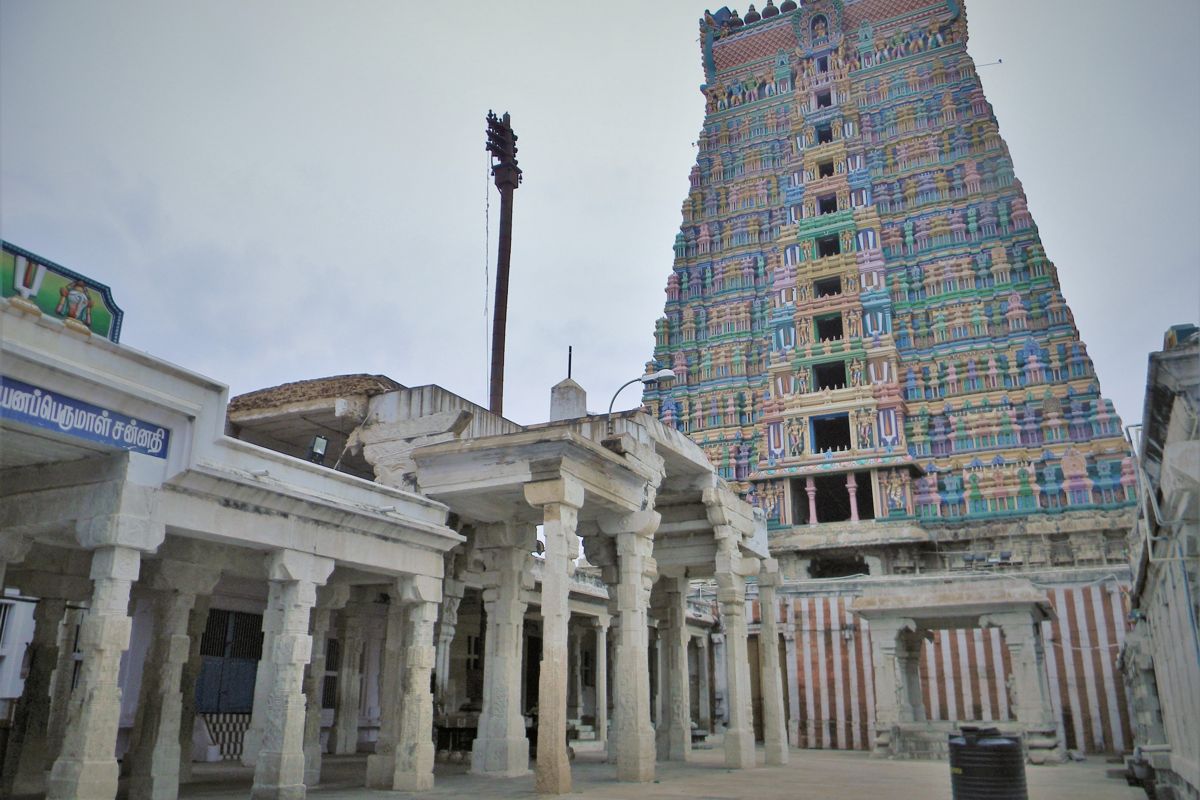
Andal was found as a child under a tulasi plant in the garden of the Srivilliputhur temple by Periyalvar, who raised her. She wore the garland meant for the deity before offering it, and Vishnu, appearing in Periyalvar's dream, asked that the garland she had worn be offered to him daily — a practice that continues now. The temple's rajagopuram rises 192 feet over the town, eleven tiers of it, and the photograph at the top of this page is that tower. Tradition says she attained union with Ranganatha of Srirangam at the end of these thirty days, which is why the month ends the way it does, at Bhogi, and not a day later.
If you keep one thing from this month, keep the count. Sixteen December is day one, pasuram one, "Margazhi thingal". Bhogi, 14 January, is day thirty. Koodaravalli, the twenty-seventh pasuram, falls on Monday 11 January by that count — confirm it with your temple, as the count is the article's, not a panchang's.
Kharmas: what pauses, and what doesn't
North India calls this same stretch Kharmas, and it is the part of the month that confuses people, because it sounds like a ban on living. It isn't. Kharmas is about when to begin certain ceremonies, not about whether the month is good or bad.
The rule comes from the muhurta books. The Muhurta Chintamani, the handbook written around 1600, lists the solar months in which weddings are held: the Sun in Mesha, Vrisha, Mithuna, Vrischika, Makara or Kumbha. Dhanu and Meena are not on the list. The same book keeps the start of building and the entering of a new house out of these months too. So in Kharmas, weddings and engagements wait, griha pravesh waits, mundan waits, and by custom a shop opening or a new partnership deed waits as well. Daily life, worship and work go on exactly as usual, and the month is considered a strong one for path, japa, daan and tirtha yatra — the tradition redirects the month from ceremony to sadhana.
The practical consequence is a calendar, not a superstition. The winter wedding season's last dates fall in the first half of December, and the next ones open after Makar Sankranti on 15 January. If you have a wedding booked for late December, you already know this — your pandit told you months ago. If you are the one being asked to move a date, this is the reason, and it is a respectable one: the books close the month to beginnings, and they have done so for centuries.
How the month is kept
In Tamil Nadu, Margazhi is the loudest month of the year, and it starts before sunrise. Women are up around four, the doorstep is swept and sprinkled, and the kolam goes down in rice flour — and in Margazhi the kolams grow until they fill the whole road in front of the house, neighbours quietly trying to outdo each other each morning. The classic Margazhi kolam has a small ball of cow dung in the middle with a pumpkin flower in it. Temples open early, the Thiruppavai is sung, and in the great Vishnu temples the Pagal Pathu and Ra Pathu utsavams — the ten days and ten nights of Thiruvaimozhi recitation — run through the month. At Srirangam, where Andal is believed to have merged with Ranganatha, the Paramapada Vasal, the gateway to Vaikuntha, opens for Vaikuntha Ekadashi on Sunday 20 December.
In Andhra Pradesh and Telangana the same month is kept with muggu at the door — kolam by its Telugu name — and at Tirumala the change is visible in the daily routine itself. For the thirty days of Dhanurmasam, the Suprabhatam that usually wakes the Lord is replaced by Andal's Thiruppavai, and Srinivasa is worshipped as Krishna. The Thomala Seva at the start of the month is done without the usual recitation of Divya Prabandham verses, and during the Sahasranama Archana the Lord is offered archana with bilva leaves. It is a small set of changes, and regulars notice every one of them.
Kerala keeps the month differently again, because in Kerala December is the Sabarimala season. The Mandala season runs from Vrischikam 1, Tuesday 17 November, to Mandala Pooja on Sunday 27 December, and the whole of Dhanurmasam's first half sits inside it — the temple crowded with pilgrims in black, the forty-one-day vratam, the climb to the shrine. The month's dawn discipline and the pilgrims' discipline are the same habit wearing different clothes.
In the north, the month is quieter, and that is the point. There is no single great Dhanurmasam festival in Delhi or Lucknow to go to; there is Kharmas, and the daily puja, and the knowledge that the wedding season has paused. Families that keep the month in the north tend to keep it at home — an early bath, Vishnu Sahasranamam or a few names of Krishna, and the day begun before the sun. It travels well precisely because it asks for so little: a lamp, a verse, and an alarm clock set an hour earlier than usual.
Dhanurmasam 2026 in India
The observance begins Wednesday, 16 December. The sankranti moment is 10:29 AM IST, with Punya Kala 10:29 AM to 4:00 PM and Maha Punya Kala 10:29 AM to 12:13 PM. Delhi's sunrise that day is 7:07 AM and sunset 5:27 PM, and the Brahma Muhurta — the window the month is built around — runs 5:17 to 6:12 AM.
Where India goes in this month
Srivilliputhur is the centre, and it is worth the trip if you can make it: Andal's temple, the 192-foot tower, the garden where Periyalvar found her, the garland that is still offered after she wore it. Tirumala keeps the month with the Thiruppavai in place of the Suprabhatam, and Srirangam keeps it with the Paramapada Vasal opening on 20 December. Sabarimala is in full Mandala season until the 27th. And in Tamil Nadu generally, the month is the kolam month — the streets in the morning are the sight, and they cost nothing to see.
It falls the day after Subrahmanya Shashthi, two days after Vivah Panchami, and a week after Margashirsha Amavasya — four observances in nine days, which is the shape of Margashirsha. If you are in India and near a Vishnu temple, go in the morning, not the evening. The evening will be there every day of the year. The morning, in this month, is the point.
Dhanurmasam 2026 in USA
The observance begins Wednesday, 16 December — the same day as India, on Drik's New York page, even though the moment itself falls at 11:59 PM on Tuesday 15 December, one minute before midnight. The month is counted from the first dawn after the transit, and that dawn is Wednesday's. Punya Kala on Wednesday runs 7:14 to 11:52 AM, Maha Punya Kala 7:14 to 8:46 AM. New York's sunrise is 7:14 AM and sunset 4:30 PM, and the Brahma Muhurta is 5:16 to 6:15 AM.
A month of alarms, and a phone full of pasurams
This is the honest part. A month of 5:16 AM alarms in December, in a working household, is a serious undertaking, and most American families don't keep all thirty days — they keep the first week properly, then the weekends, then Vaikuntha Ekadashi on the 20th, and that is a respectable month. The practical shape that works: the Thiruppavai on the phone, one pasuram with the morning coffee, the kolam skipped or drawn small on the kitchen floor with rice flour on a plate, and the pongal on Sundays.
One small mercy of the split: a video call home on Wednesday morning in New York reaches India on Wednesday evening, after their Punya Kala, when Delhi families are sitting down to their own evening. Both ends of the call are in the same month, on the same day, and neither side is wrong. The month, unlike a one-day festival, forgives a late start — it is thirty mornings, and missing one is not missing the month.
Dhanurmasam 2026 in UK
The observance begins Wednesday, 16 December. The moment is 4:59 AM GMT, Punya Kala 8:00 to 11:56 AM, Maha Punya Kala 8:00 to 9:19 AM. London's sunrise is 8:00 AM and sunset 3:52 PM — seven hours and fifty-one minutes of daylight — and the Brahma Muhurta runs 5:51 to 6:56 AM.
The dark morning, and the wet doorstep
London gives you the hardest version of the month's central demand: the Brahma Muhurta ends at 6:56 AM, more than an hour before the sun comes up, so the bath and the lamp happen in full dark, in the middle of the night by any honest description. The kolam is the other casualty — rice flour on a wet London doorstep in December does not behave like rice flour on a Chennai one, and most families draw it indoors, on a plate or a board, or skip it and keep the lamp and the verse instead. Nobody in the tradition would call that less.
The evening ceremony happens in full dark, in the middle of the afternoon, which honestly suits a lamp-lit puja. And the month's own logic helps: the Thiruppavai is a poem about waking in the dark and walking to Krishna's door, and a London December is the closest most of us will ever come to the Margazhi dark it describes.
Dhanurmasam 2026 in Germany
The observance begins Wednesday, 16 December. The moment is 5:59 AM CET, Punya Kala 8:12 AM to 12:02 PM, Maha Punya Kala 8:12 to 9:28 AM. Berlin's sunrise is 8:12 AM and sunset 3:52 PM — seven hours and forty minutes of daylight, the shortest day in this article's six cities after Moscow — and the Brahma Muhurta runs 6:01 to 7:06 AM.
The shortest day of the series
Berlin's morning puja happens in darkness, the reading in the first grey light, and the evening puja in the middle of the afternoon. December in Berlin does not give you much sun to work with, and this month, which is mostly about a dawn bath, a verse and a lamp, is the one that minds least.
One practical note, the same one from the Dev Uthani article: Germany has Ruhezeiten, and a 6 AM alarm and a running tap are still working hours for the neighbours. The home puja is quiet by nature — a lamp, a verse, a small bowl of pongal — which is one more reason this month travels better than the noisy ones. If your temple stages a Margazhi programme, it will be a temple affair, indoors, and the neighbours will never know. The month goes on either way.
Dhanurmasam 2026 in Mexico
The observance begins Tuesday, 15 December — a day earlier than India, the only one of the six cities where it does. The moment is 10:59 PM CST on Tuesday, Punya Kala is listed as 12:32 to 06:01 with no AM or PM printed, and Maha Punya Kala is 4:11 to 6:01 PM. Mexico City's sunrise on Tuesday is 7:03 AM and sunset 6:01 PM, and the Brahma Muhurta runs 5:18 to 6:10 AM.
The longest light of the six cities
Mexico City gets the most generous December day of the six: sunrise 7:03 AM, sunset 6:01 PM, ten hours and fifty-eight minutes of light. The dawn bath can be unhurried, the kolam drawn in actual morning sun, and the evening puja done at a dusk that still feels like evening rather than the middle of the night. It is the only city in this article where the whole observance fits comfortably into daylight.
The Indian community in Mexico is small, and this is mostly a home observance there — which is fine, because a home observance is what Dhanurmasam mostly is, even in Srivilliputhur, once you step outside the temple courtyard. The month needs a lamp, a verse and an alarm clock. Everything else is commentary. And remember the wrinkle at the top of this page: take the Maha Punya Kala, 4:11 to 6:01 PM on Tuesday, as the safe window for the sankranti itself.
Dhanurmasam 2026 in Russia
The observance begins Wednesday, 16 December — the same day as India. The moment is 7:59 AM MSK, Punya Kala 8:54 AM to 12:25 PM, Maha Punya Kala 8:54 to 10:04 AM. Moscow's sunrise is 8:54 AM and sunset 3:56 PM — seven hours and two minutes of daylight, the shortest day in this article — and the Brahma Muhurta runs 6:38 to 7:46 AM.
A month staged in the dark
Moscow's Brahma Muhurta ends more than an hour before the sun is up, and the sun, when it comes, is up for seven hours. The dawn bath happens before the sun is up, which is the traditional form anyway: the bath at dawn, in darkness, is how the old guides describe the start of a festival day. A Moscow December simply makes the description literal.
The evening puja is the same as everywhere else, and the time zones offer their usual small mercy: a video call home after the evening puja reaches India at around 8:30 PM IST, when Delhi families are sitting down to their own evening after a day that began four hours earlier. Both ends of the call are keeping Dhanurmasam on the same Wednesday — Moscow and Delhi agree on this one.
East of Moscow the timings shift with the time zones, as always. Your local temple or your own city's panchang is the authority there; Moscow's hours belong to Moscow.
What you'll need, roughly
An alarm clock, and the willingness to use it. A lamp and oil, a picture or idol of Vishnu or Krishna — with Andal if your family keeps her beside him — flowers, and rice and jaggery for the pongal. The Thiruppavai, in print or on the phone, one pasuram a day. Rice flour for the kolam, if your doorstep allows it.
That is the entire list. Dhanurmasam is not a festival of shopping. It is a festival of getting up, and a month kept for Vishnu needs a lamp and a verse and someone willing to be awake before the sun — and someone to sing the verse to.
The Kartik–Margashirsha 2026 series: Diwali 2026 · Govardhan Puja 2026 · Bhai Dooj 2026 · Chhath Puja 2026 · Dev Uthani Ekadashi 2026 · Tulsi Vivah 2026 · Dev Diwali 2026 · Kalabhairav Jayanti 2026 · Utpanna Ekadashi 2026 · Margashirsha Amavasya 2026 · Vivah Panchami 2026 · Subrahmanya Shashthi 2026 · Dhanurmasam 2026
Check your own city before you rely on any date here: the Hindu Panchang Calculator shows today’s tithi and festival dates for your location, the Hindu Date Converter converts between Gregorian and Hindu calendar dates, and this article on the astronomy behind the panchang explains how these calculations are actually made.
Photos: Srivilliputhur Andal Temple gopuram — Shanze1, CC BY-SA 4.0; Margazhi flower kolam — Durgha B, CC BY-SA 4.0; Srirangam Ranganathaswamy Temple gopurams — Writer hit, CC BY-SA 4.0; all via Wikimedia Commons.
Timings follow Drik Panchang's city pages for New Delhi, New York, London, Berlin, Mexico City and Moscow, checked 13 November 2026. Sunrise, sunset and Brahma Muhurta times are from Drik's day panchang for 16 December 2026 (15 December for Mexico City). The period end — Sun enters Makara 9:14 PM IST on 14 January 2027, Makar Sankranti observed 15 January — follows Drik's Makara Sankranti listing; the Makar Sankranti article in this series re-verifies it directly. Vaikuntha Ekadashi on Sunday 20 December and the Koodaravalli count (day 27, Monday 11 January) are given as listed by HinduTone and by the one-pasuram-a-day count — confirm both with your temple. Where other calendars disagree — some show the Kharmas break from 13 December — this page says so and says which source it follows and why. Your local temple's announcement overrides any website, including this one.