
Dev Uthani Ekadashi 2026 is on Friday, 20 November — in India and everywhere else, for once
Dev Uthani (Prabodhini) Ekadashi is on Friday, 20 November 2026 in India, USA, UK, Germany, Mexico and Russia. Paran times city by city, vrat rules, evening waking puja, mantra and katha.
Dev Uthani Ekadashi is on Friday, 20 November 2026. In India, in the USA, in the UK, in Germany, in Mexico, in Russia — Friday the 20th, all of them. If you only came for the date, you have it, and you also have something rarer this Kartik: a festival where the forwards will actually agree with each other.
After Govardhan and Bhai Dooj, which landed on different days on different continents, this one is almost suspiciously simple. The fast is Friday. You break it on Saturday morning — except in Delhi, where you break it on Saturday afternoon, and in Moscow, where you get exactly fifteen minutes to do it in. Those two oddities are real, they're further down, and the Delhi one will contradict half the websites you have open in other tabs. We'll get to why.
This is the day Vishnu wakes up. For four months, since Devshayani Ekadashi in Ashadha, he has been in Yoga Nidra — a yogic sleep, out on the ocean of milk — and the whole of Chaturmas has been a kind of held breath: no weddings, no housewarmings, no big auspicious beginnings. On Friday evening, in courtyards and puja corners and a fair number of apartment balconies, people will draw his footprints on the floor, cover the season's first sugarcane with a basket, and then make a deliberate, joyful racket to wake him.
Bells. Conch. Clapping. A steel plate beaten like a drum. God is asleep, and the house intends to do something about it.
Dev Uthani Ekadashi 2026 at a glance
| Fast (Smarta) | Friday, 20 November 2026 — in all six countries |
| Vaishnava / Gauna fast (Delhi listing) | Saturday, 21 November — Paran Sunday, 22 November |
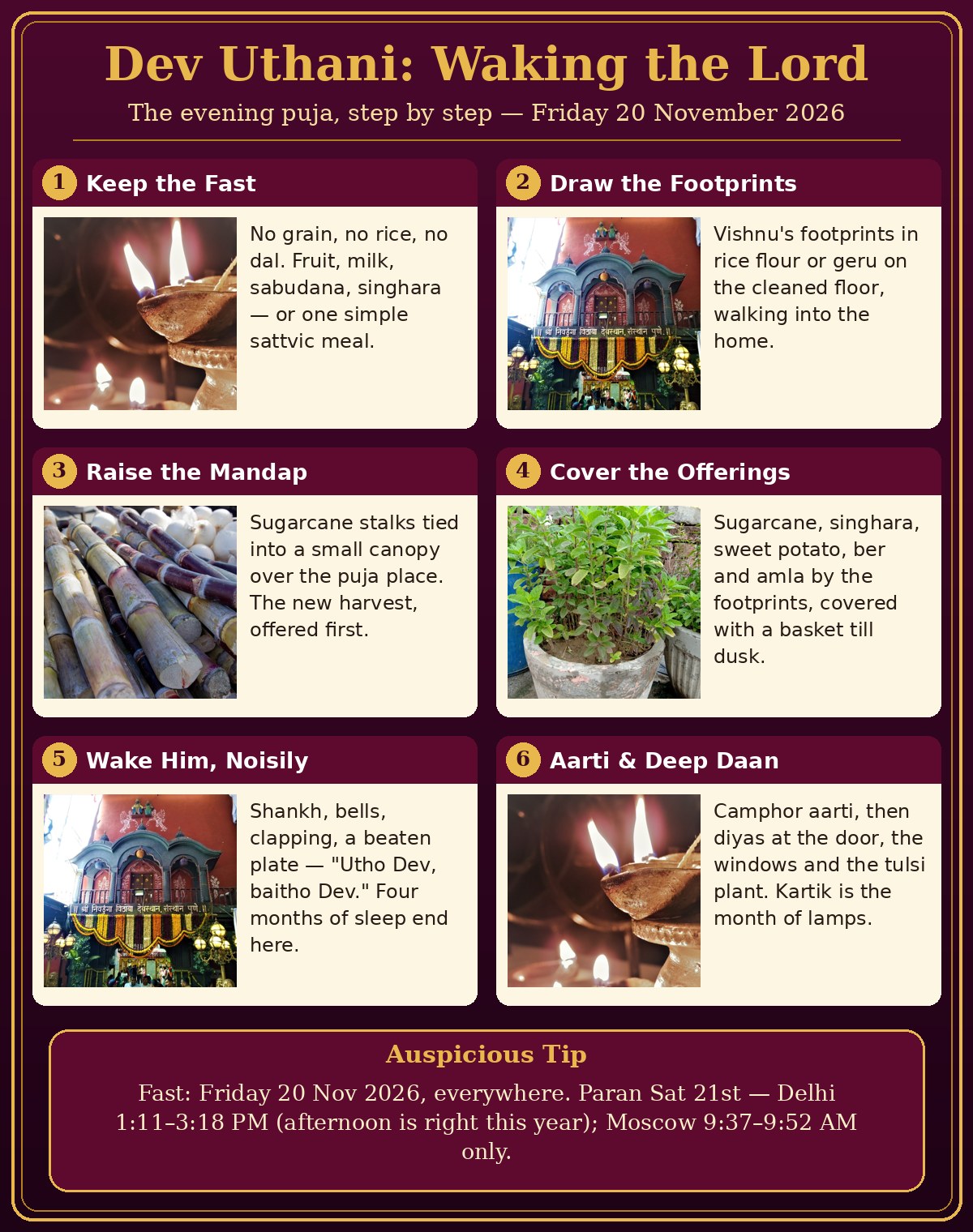
| Paran in Delhi | Saturday, 21 November, 1:11 – 3:18 PM — afternoon, and yes, that's correct |
| Paran in New York | Saturday, 21 November, 6:50 – 8:47 AM |
| Paran in London | Saturday, 21 November, 7:28 – 9:12 AM |
| Paran in Berlin | Saturday, 21 November, 7:38 – 9:20 AM |
| Paran in Mexico City | Saturday, 21 November, 6:48 – 9:02 AM |
| Paran in Moscow | Saturday, 21 November, 9:37 – 9:52 AM — fifteen minutes |
| Tithi | Kartik Shukla Ekadashi |
| Also called | Prabodhini Ekadashi, Devutthana Ekadashi, Dev Uthani Gyaras, Kartiki Ekadashi, Bada Ekadashi (Odisha), Thulo Ekadashi (Nepal) |
One honest wrinkle before we go further. "Friday the 20th" is the Smarta reckoning, and it is what the panchangs print for Delhi and for every city abroad that we checked. But inside India the map is not quite that tidy. In much of the east and south — Kolkata, Varanasi, Chennai, Bengaluru, Hyderabad — sunrise on Saturday the 21st still catches the Ekadashi tithi before it ends at 6:31 AM, so local panchangs there keep the fast on Saturday, 21 November. Pandharpur's Warkaris keep Saturday too, and Odia calendars list Bada Ekadashi on the 21st. Nobody is wrong. Ekadashi is decided at sunrise, and India has a lot of sunrises. Follow your family's and your temple's day, and don't argue about it at the dinner table — both tables are fasting, just on adjacent days.
Why does Vishnu sleep for four months?
The story most homes tell is disarmingly domestic. Lakshmi, the tradition says, pointed out to Vishnu that he had no schedule at all: he would stay awake for ages, then sleep for ages, and nobody — god or human — ever knew when he could be found. So he agreed to something more reasonable. Four months of rest every year, from Devshayani Ekadashi in Ashadha to Dev Uthani in Kartik. A bounded sleep. Office hours, of a sort.
That is why the waking is noisy. You don't let a god who has finally agreed to a timetable oversleep it.
In some regions the four months are explained differently — as the months Vishnu spent at King Bali's door in Patal after the Vamana avatar took his three steps, with Lakshmi negotiating his part-year return. If Bali's name sounds familiar, it's because you met him a fortnight ago: Govardhan Puja week also carries Bali Pratipada. The stories of this season are all holding hands.
The formal vrat katha is neither of these, by the way. As Drik Panchang recounts it, it is a dialogue — Narada asking Brahma what this fast is worth, and Brahma answering in the extravagant arithmetic of the Puranas: merit equal to a thousand Ashvamedha yajnas, they say, and a night vigil on this night praised above pilgrimage itself. Treat those numbers the way you'd treat a grandmother's "this will make you strong" — as a statement about how much the day matters, not as an audited figure.
And the folk katha read out in many North Indian homes is a small story about a king who banned grain on Ekadashi throughout his kingdom, animals included, and a servant who cooked rice by a river and called the Lord to come and share it — and the Lord came. Its own retellers cheerfully admit it's a household story, not a Purana. Its moral survives anyway: the fast was never really about the grain.
What reopens on Friday
Chaturmas ends. Whatever your family gave up for the four months — a vegetable, salt in one meal, sleeping on a bed, whatever the vow was — the katha's own instruction is that it is resumed from this day.
And the wedding season opens. Four months without a single auspicious date is a long drought in a country that runs on shaadis, and it ends here: Tulsi Vivah, the symbolic first wedding of the season, is performed on Friday evening in many homes and on Saturday in most. Real vivah muhurats follow within days, family calendars fill up at a speed that startles people every year, and the window is short — Kharmas will pause weddings again in mid-December. If you have a cousin who got engaged in August and has been in a holding pattern ever since, this Friday is why your phone is about to get busy.
The five days from Friday to Dev Diwali on Kartik Purnima also form Bhishma Panchak, the Vaishnava observance named for Bhishma teaching dharma from his bed of arrows. So read this week as one arc: Vishnu wakes on Friday, Tulsi is married on Saturday, and the gods celebrate their Diwali on Tuesday.
Dev Uthani Ekadashi 2026 in India
Fast: Friday, 20 November on the Smarta reckoning (Delhi, Mumbai, Jaipur, Ahmedabad, Pune, Bhopal and the North and West generally). Ekadashi tithi in Delhi runs 7:15 AM Friday to 6:31 AM Saturday — it begins after Friday's sunrise, which is exactly the sort of detail that splits states, as the east-and-south note above explains. Vaishnava (Gauna) observance in the Delhi listing: fast Saturday, 21 November, Paran Sunday, 22 November, 6:49 – 8:56 AM.
The Paran problem, explained before it confuses you
Paran — breaking the fast — happens on Dwadashi, Saturday. Every generic Ekadashi page on the internet will tell you to break your fast in the morning, shortly after sunrise. In Delhi this year, that advice is wrong, and Drik Panchang's window is in the afternoon: 1:11 – 3:18 PM.
Here's why. Paran must never fall inside Hari Vasara, the first quarter of Dwadashi, and this year Hari Vasara in Delhi doesn't end until 12:07 PM. The midday period has to pass as well. So the window slides into the afternoon, and 1:11 PM is simply the first clean moment. If a family member forwards you a morning Paran time for Delhi — and someone will — this is the disagreement, and the afternoon is the better-supported answer. Eat lightly through Saturday morning if you're keeping the fast strictly until Paran; phalahar exists for exactly this situation.
Pandharpur, Girnar and Puri — where India is walking this week
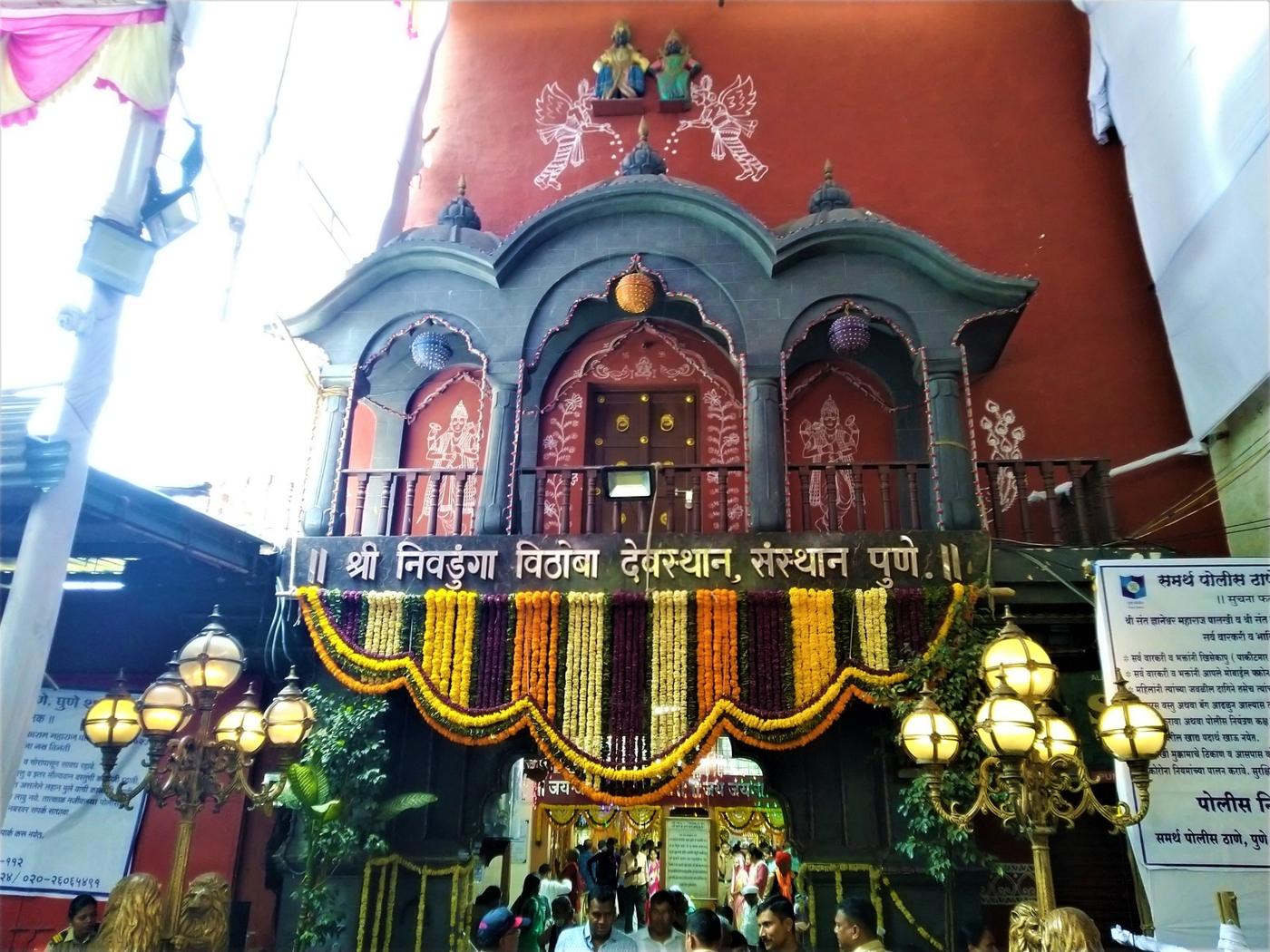
In Maharashtra this is Vitthal's day. The Kartiki Wari to Pandharpur is the second-greatest of the four annual waris — only Ashadhi is bigger — and the two bookend Vishnu's sleep: Ashadhi puts him to rest, Kartiki wakes him. Warkaris walk in their dindis, bathe in the Chandrabhaga, and sing abhangs more or less continuously, and the state government performs an official mahapuja on the day. Their observance this year falls on the Vaishnava day, Saturday the 21st.
In Gujarat, the Lili Parikrama — the green circumambulation of Mount Girnar, a forest circuit open only for these few days — runs from Ekadashi to Purnima, Friday to Tuesday. And for Swaminarayan families, a large diaspora constituency, Prabodhini is also diksha day, marking Swaminarayan's initiation — expect their temples abroad to be as busy as the ones in Gujarat.
In Odisha the day is Bada Ekadashi, the Great Ekadashi, and it opens Panchuka, the intense last five days of the Kartika month at Puri, each with its own divine costume — besha — for the deities. Odia calendars keep it on Saturday the 21st. Same fast, neighbouring day, no contradiction once you know about the sunrise rule.
Dev Uthani Ekadashi 2026 in USA
Fast: Friday, 20 November. Ekadashi tithi in New York runs from 8:45 PM on Thursday the 19th to 8:01 PM on Friday the 20th, local time — the whole of Friday is comfortably inside it.
Paran time in New York and across the country
Paran in New York: Saturday, 21 November, 6:50 – 8:47 AM EST, with Dwadashi running until 6:26 PM. A normal, civilised morning window — the Hari Vasara complication is Delhi's, not yours.
Friday is a working day, which shapes how this festival actually gets kept in the US: the fast is the private part, done at your desk with a fruit bowl, and the waking puja is the family part, done in the evening at your own dusk. That works, because the waking rite was always an evening rite. Draw the footprints when you're home, put the lamps out, wake him properly. No conversion of an Indian muhurat is needed for the home puja — your sunset is the right one by definition.
November also means the Indian grocery stores have sugarcane in for exactly this week. If yours has sold out by Friday — it happens — two or three stalks were never the point. The point is the new harvest offered to a god who has just woken up hungry after four months. Seasonal fruit says the same thing in a different language.
Dev Uthani Ekadashi 2026 in UK
Fast: Friday, 20 November. Ekadashi tithi in London runs 1:45 AM Friday to 1:01 AM Saturday, so Friday is the fast from the moment you wake up.
Paran time in London
Paran: Saturday, 21 November, 7:28 – 9:12 AM GMT, inside a Dwadashi that ends at 11:26 PM. A Saturday-morning window, at a Saturday-morning hour. Kartik has been kind to Britain this year.
Drik's London listing, like the other cities abroad, shows no separate Gauna or second-day fast — the split you may see discussed for India isn't printed for London. If your temple announces a Vaishnava observance on Saturday, follow your temple; if you're deciding at home, Friday is the day Drik gives you.
By late November the waking puja in Britain is done in full dark, lamps against a 4 PM-ish dusk, which honestly suits a festival of lamps better than it has any right to. Kartik in the UK is Diwali weather extended by a month.
Dev Uthani Ekadashi 2026 in Germany
Fast: Friday, 20 November. Ekadashi tithi in Berlin runs 2:45 AM Friday to 2:01 AM Saturday.
Paran time in Berlin
Paran: Saturday, 21 November, 7:38 – 9:20 AM CET, with Dwadashi ending just after midnight, at 12:26 AM on Sunday.
One practical grace note. Waking Vishnu is supposed to be noisy — bells, conch, clapping, a plate beaten in genuine enthusiasm. Germany has Ruhezeiten, quiet hours, and neighbours with opinions. The Berlin version of this festival, honed over years by families in flats, is a small bell, singing at indoor volume, and the plate left in the drawer. He has been woken by quieter things. Nobody's devotion is measured in decibels, whatever the folk song implies.
And since Tulsi Vivah follows on Saturday at dusk — in Berlin, a mid-afternoon dusk by late November — the Tulsi Vivah guide has the bit about keeping a tropical plant alive through a German winter, which is the real spiritual challenge of this weekend.
Dev Uthani Ekadashi 2026 in Mexico
Fast: Friday, 20 November. Mexico City's Ekadashi tithi runs from 7:45 PM on Thursday the 19th to 7:01 PM on Friday the 20th — it starts on Thursday evening local time, which means by the time Delhi is waking up to the fast, Mexico City has been in the tithi since dinner.
Paran time in Mexico City
Paran: Saturday, 21 November, 6:48 – 9:02 AM CST, Dwadashi ending 5:26 PM. Another straightforward morning window.
The Indian community in Mexico is small and mostly does this festival at home, before work, without much ceremony beyond the home puja — which is fine, because a home puja is what Dev Uthani mostly is, even in Varanasi. The evening waking needs a puja corner, sugarcane if the Indian store has it, lamps, and as much noise as your household can decently produce. Everything else is commentary.
Dev Uthani Ekadashi 2026 in Russia
Fast: Friday, 20 November. Ekadashi tithi in Moscow runs 4:45 AM Friday to 4:01 AM Saturday.
Paran time in Moscow — set an alarm for this one
Paran in Moscow: Saturday, 21 November, 9:37 – 9:52 AM MSK. Fifteen minutes.
That is not a typo, and it is the tightest window on this entire page. Hari Vasara in Moscow ends at 9:37 AM, and the usable Paran window after it is just those fifteen minutes. Everywhere else gets a couple of hours to wander downstairs and put the kettle on; Moscow gets a quarter of an hour. If you keep this fast in Moscow, have Saturday's first food ready on Friday night.
East of Moscow the tithis shift with the time zones, as always — a city several hours ahead can land differently. Your local temple or your own city's panchang is the authority there; Moscow's fifteen minutes belong to Moscow.
The consoling part: a video call home after Paran reaches India in its early afternoon, right when Delhi is sitting down to its own long-awaited Paran. For once, the time zones put the two meals almost on top of each other.
The evening waking — how Dev Uthani is actually done
The morning is ordinary Ekadashi: up early, bathe, take the sankalpa — the simple resolve to keep the fast — set Vishnu and Lakshmi (or your Shaligram) on a clean cloth, lamp lit, Tulsi offered. One detail the old hands insist on: pluck any Tulsi leaves you need on Thursday, on Dashami. Tulsi is not plucked on Ekadashi itself.
Keep the fast through the day, and then, in the evening, the festival happens.
First, the footprints. On the cleaned floor — courtyard if you have one, puja-room floor or balcony if you don't — draw Vishnu's footprints walking into the house, in rice flour paste or geru, the red ochre. In some homes, full figures of Vishnu and Lakshmi are drawn instead. The footprints are the invitation: the god is awake, and this is the way in.
Then the sugarcane mandap — stalks tied at the corners over the puja place, a small green canopy. Under and around it, the season's offerings: sugarcane itself, singhara (water chestnut), sweet potato, ber, amla, seasonal fruit and sweets. In the old farm form of this rite, the farmer does puja in the field first, gives five canes each to the priest, the blacksmith, the carpenter, the washer-man and the water-carrier, and brings five home. Prabodhini is when the sugarcane harvest begins. The sugarcane in your puja is not decoration; it is the new crop, offered first, before anyone eats it.
Then — the part children wait all year for — cover the offerings with a basket or a big paraat, and wake him. Shankh, bells, clapping, the covered basket beaten like a drum, everyone making as much affectionate noise as the building allows, and the waking verse:
उत्तिष्ठोत्तिष्ठ गोविन्द उत्तिष्ठ गरुडध्वज। उत्तिष्ठ कमलाकान्त त्रैलोक्यं मङ्गलं कुरु॥
Uttishthottishtha Govinda, uttishtha Garudadhvaja; uttishtha Kamalakanta, trailokyam mangalam kuru. Rise, rise, Govinda; rise, you whose banner is Garuda; rise, beloved of Kamala — bring auspiciousness to the three worlds. It's the second verse of the Suprabhatam sung every morning at Tirupati, which is why half your family will find they know it already.
In North Indian homes the women also sing the folk waking song while the plate is beaten — Utho Dev, baitho Dev... Ashadh mein soye Dev, Kartik mein jaage Dev — get up, Lord, sit up, Lord; you slept in Ashadh, you wake in Kartik; stretch your hands and feet, crack your fingers. One of its verses asks him, now that he's up, to kindly get the unmarried daughter of the house married. The wedding season is inside the song. Parents have been singing that line with intent for centuries.
Uncover the offerings, set a lit lamp where the basket was, do the aarti, and then light diyas around the house — door, windows, and by the Tulsi plant. For one evening the house looks like Diwali again. That resemblance is not an accident; Kartik is a month of lamps from one end to the other.
Many families then do Tulsi Vivah right there, the same evening, under the same sugarcane mandap. Others keep it for Saturday. Both are done, both are fine — family custom decides, not this website.
The fast itself — what you can and can't eat
The Ekadashi rule is simple to state and negotiable in practice: no grains, and no dal, pulses or beans. No rice, no wheat, no lentils, until Paran. Onion, garlic, meat and alcohol are out too, and regular salt is usually swapped for sendha namak, rock salt.
How strictly people keep it is a spectrum, and the tradition itself grades it — this is not a modern softening. The mahatmya counts a single evening meal, eating at night, and a full-day fast as ascending levels of the same observance. In real households:
- Phalahar is what most people do: fruit, milk, curd, nuts, makhana, sabudana, and things made from singhara or kuttu flour, sweet potato, potato.
- One simple sattvic meal, grain-free, is kept by many working people and is entirely respectable.
- Nirjala, without water, is for the healthy and the practised. Children, the elderly, pregnant women, and anyone on medication are explicitly excused by the guides themselves — simple food and the evening puja is a complete observance for them. A fast that lands someone in bed helps nobody's devotion.
On Saturday, break it inside your city's Paran window — Delhi, remember, is the afternoon — starting simply: Tulsi water or a leaf, fruit or prasad, then a proper sattvic meal. Feeding someone else at Paran is part of the classical shape of it, and in practice it usually means the whole household finally eating together, which was rather the point all along.
What you'll need, roughly: Vishnu–Lakshmi image or Shaligram, yellow cloth, a kalash if your family sets one, ghee lamp and camphor, incense, shankh and bell, chandan, haldi, kumkum, panchamrit, Tulsi leaves (picked Thursday), yellow flowers, sugarcane stalks, singhara, sweet potato, ber, amla, fruit and sweets, betel leaf and nut, rice flour and geru for the footprints, and a basket or paraat to cover the offerings. Scale it to your house. Every item on that list has been substituted by somebody's grandmother at some point.
The Kartik 2026 series: Diwali 2026 · Govardhan Puja 2026 · Bhai Dooj 2026 · Chhath Puja 2026 · Dev Uthani Ekadashi 2026 · Tulsi Vivah 2026 · Dev Diwali 2026
Check your own city before you rely on any date here: the Hindu Panchang Calculator shows today’s tithi and festival dates for your location, the Hindu Date Converter converts between Gregorian and Hindu calendar dates, and this article on the astronomy behind the panchang explains how these calculations are actually made.
Photos: Nivdunga Vithoba Temple, Pune, during the Pandharpur Wari — DesiBoy101, CC BY 4.0; sugarcane stalks — Sarah and Jason, CC BY-SA 2.0; earthen diya — Ara Basu, CC BY-SA 4.0; all via Wikimedia Commons.
Timings follow Drik Panchang's city pages for New Delhi, New York, London, Berlin, Mexico City and Moscow, checked 9 November 2026, cross-checked against Drik day panchangs for 20 and 21 November. Where calculators disagree — Delhi's Paran is the live one — this page says so and says which it follows and why. Your local temple's announcement overrides any website, including this one.